
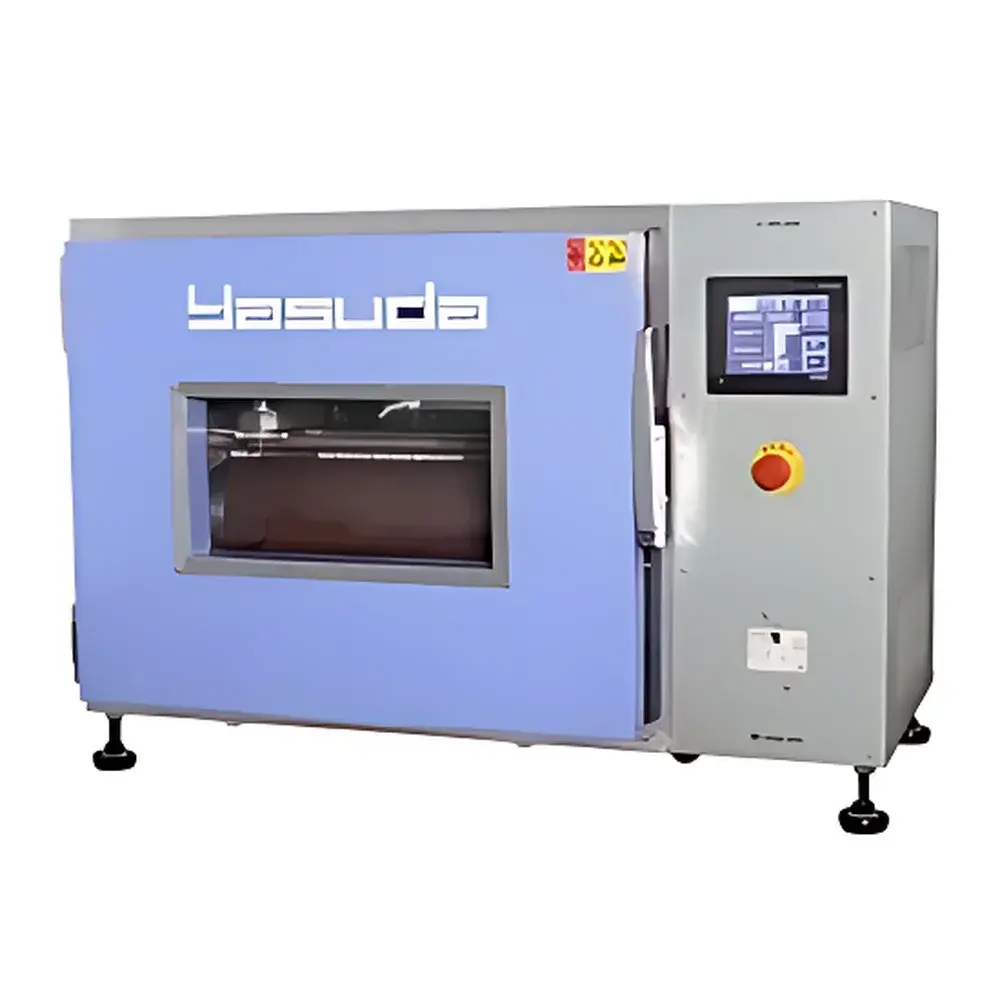
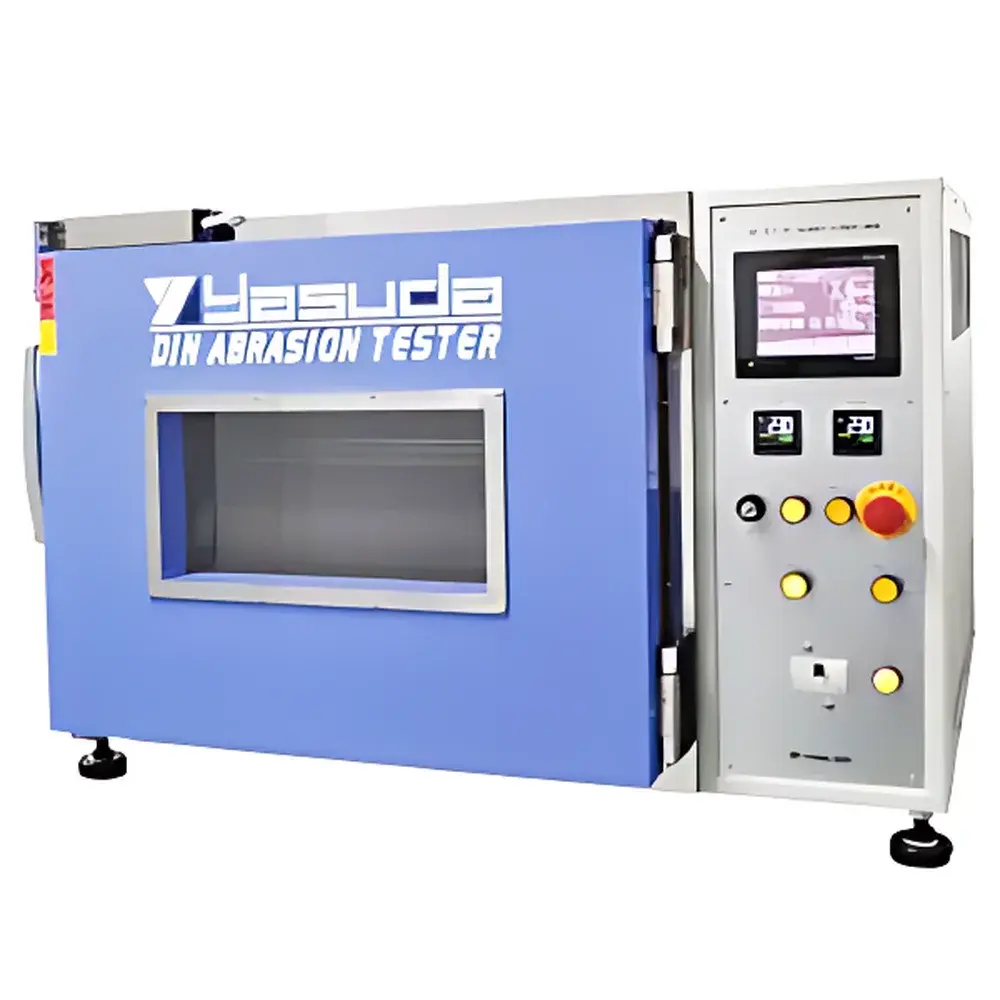
Yasuda No.151-OV DIN Abrasion Tester with Integrated Oven
| Brand | Yasuda |
|---|---|
| Origin | Japan |
| Model | No.151-OV |
| Standards | JIS K6264-2, ISO 4649, DIN 53516 |
| Drum Diameter | φ150 mm |
| Drum Length | 450 mm |
| Rotational Speed | 10–100 rpm (standard: 40 ± 1 rpm) |
| Specimen Feed Rate | 1.5–15 mm/s (standard: 2.8 mm/s) |
| Applied Load | 5.0 ± 0.1 N or 10.0 ± 0.2 N |
| Specimen Dimensions | φ16.0 ± 0.2 mm × 6–10 mm |
| Abrasive Belt Width | ≥400 mm |
| Abrasive Material | Aluminum Oxide |
| Grit Size | P60 |
| Max Oven Temperature | 100 °C |
| Power Supply | AC 200 V, 3-phase, 20 A, 50/60 Hz |
| Dimensions (W×D×H) | ≈1130 × 920 × 745 mm |
| Weight | ≈255 kg |
| Accessories | Dust Extraction Unit, Specimen Alignment Gauge, Certified Reference Specimen (1 pc), Metallic Calibration Specimens (2 pcs), Punching Tool for Specimen Preparation |
Overview
The Yasuda No.151-OV DIN Abrasion Tester with Integrated Oven is a precision-engineered tribological testing system designed to quantify the abrasion resistance of vulcanized and thermoplastic elastomers under controlled thermal and mechanical conditions. It operates on the principle of rotary drum abrasion—where a standardized cylindrical specimen is pressed radially against a moving abrasive belt wrapped around a rotating drum, simulating real-world wear mechanisms such as sliding friction, particle cutting, and surface fatigue. Unlike ambient-only testers, the integrated oven enables temperature-controlled testing up to 100 °C, facilitating evaluation of thermal degradation effects on wear performance—a critical parameter for automotive seals, conveyor belts, and high-temperature industrial gaskets. The instrument complies strictly with three internationally harmonized standards: JIS K6264-2 (Japan), ISO 4649 (global), and DIN 53516 (Germany), ensuring data traceability and inter-laboratory comparability in quality assurance and R&D environments.
Key Features
- Integrated temperature-controlled oven (max. 100 °C) enabling ASTM D5963-compliant thermal abrasion profiling without external environmental chambers
- Precision-machined φ150 mm × 450 mm steel drum with dynamic speed regulation (10–100 rpm, factory-set at 40 ± 1 rpm per ISO 4649)
- High-stability load application system delivering calibrated forces of either 5.0 ± 0.1 N or 10.0 ± 0.2 N via dead-weight or servo-assisted mechanism
- Linear specimen feed mechanism with adjustable traverse velocity (1.5–15 mm/s; default 2.8 mm/s per DIN 53516 Method A)
- Wide-format abrasive belt (≥400 mm width) coated with P60 aluminum oxide grit—certified to ISO 8442-2 for uniform grain distribution and bond integrity
- Dust extraction unit with HEPA-filtered vacuum path to prevent particulate accumulation on drum surface and ensure measurement repeatability
- Robust cast-iron frame and vibration-damped base structure minimizing mechanical drift during extended test cycles (up to 40,000 revolutions)
Sample Compatibility & Compliance
The No.151-OV accepts cylindrical specimens conforming to ISO 4649 Type A and Type B geometries: φ16.0 ± 0.2 mm diameter and 6–10 mm thickness. Specimen preparation is supported by included tools—precision punching die, alignment gauge, and certified reference rubber specimens traceable to NMIJ (National Metrology Institute of Japan). Metallic calibration specimens (two units) allow periodic verification of load application accuracy and lateral feed consistency. All operational parameters—including drum speed, load magnitude, feed rate, and oven temperature—are logged with timestamped metadata, supporting audit readiness for GLP, ISO/IEC 17025, and IATF 16949 quality systems. Test reports generated meet requirements for FDA 21 CFR Part 11 compliance when paired with validated LIMS integration.
Software & Data Management
While the No.151-OV operates via dedicated front-panel controls for manual operation, it features analog/digital I/O ports (RS-485, 0–10 V analog output) for seamless integration with third-party SCADA or laboratory data acquisition systems. Real-time signals include drum rotation count, elapsed test time, oven temperature, and optional load cell feedback. Optional PC-based software (Yasuda TestSuite v3.2, sold separately) provides automated test sequencing, pass/fail threshold logic, statistical process control (SPC) charting, and PDF report generation compliant with ISO 14644-1 cleanroom documentation standards. Audit trails record user ID, parameter changes, calibration events, and emergency stop triggers—fully aligned with FDA 21 CFR Part 11 electronic record requirements when deployed with digital signature modules.
Applications
- Quality control of automotive elastomeric components (e.g., brake hoses, CV joint boots, engine mounts) exposed to elevated under-hood temperatures
- R&D validation of novel polymer blends, nanocomposites, and filler-reinforced rubbers for improved wear life under thermal stress
- Comparative assessment of abrasive resistance across production batches in tire tread compound manufacturing
- Material screening for railway suspension bushings, mining conveyor linings, and offshore sealing systems requiring combined thermal-mechanical durability
- Supporting ISO 22857 certification testing for medical-grade silicone elastomers used in reusable surgical devices
FAQ
What standards does the No.151-OV comply with?
It fully implements JIS K6264-2, ISO 4649, and DIN 53516, including both Method A (specimen rotation) and Method B (fixed-specimen) configurations.
Can the oven temperature be ramped programmatically during a test?
No—the oven operates at a user-set constant temperature; dynamic thermal profiling requires external PLC integration via analog I/O.
Is the abrasive belt replaceable, and where can certified replacements be sourced?
Yes—Yasuda supplies OEM-certified P60 Al₂O₃ belts (part no. AB-151-OV-400) with batch-specific grit uniformity certificates and shelf-life tracking.
What maintenance intervals are recommended for long-term accuracy?
Drum surface flatness verification every 6 months; load cell recalibration annually; abrasive belt replacement after 500 test hours or visible edge wear.
Does the system support unattended overnight testing?
Yes—equipped with automatic test termination upon reaching preset revolution count or time limit, plus thermal cut-off safety interlock at 105 °C.



