
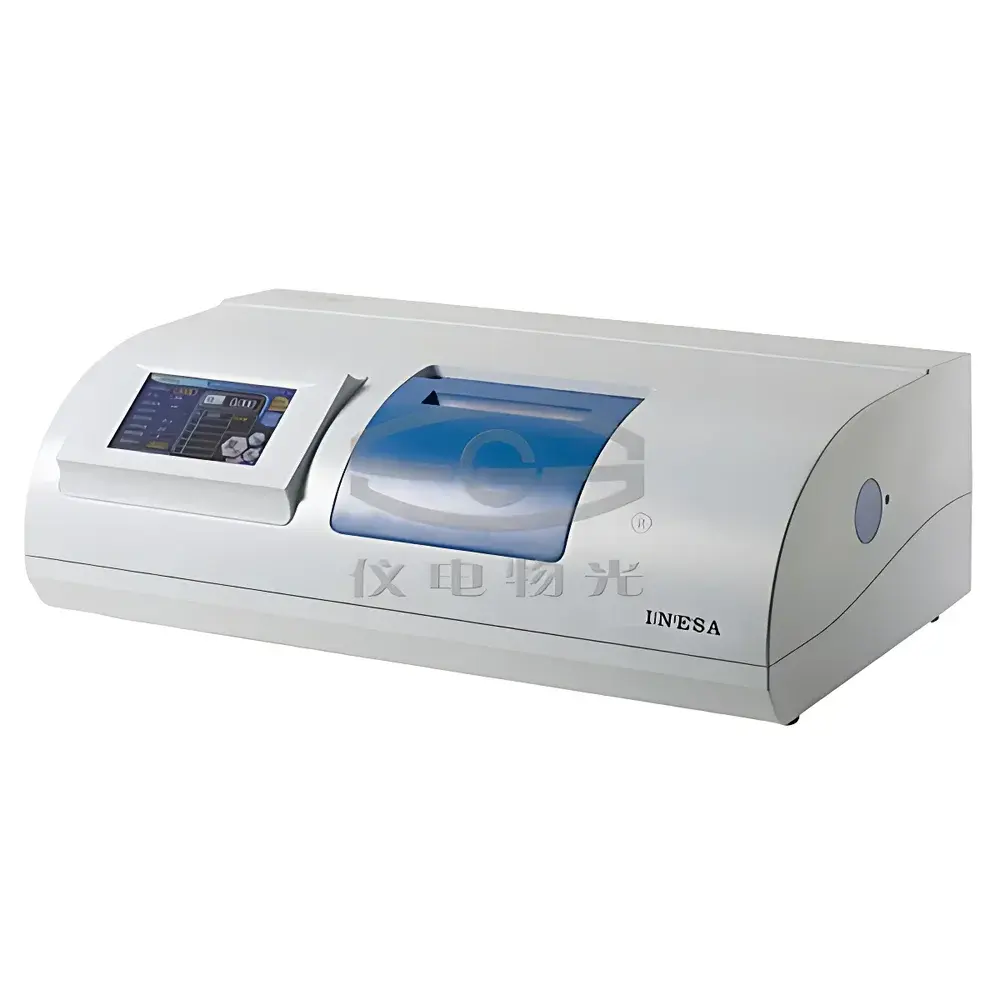
YDWG SGW®-2 Automatic Temperature-Controlled Polarimeter
| Brand | YDWG |
|---|---|
| Origin | Shanghai, China |
| Model | SGW®-2 |
| Product Type | Automatic Polarimeter |
| Temperature Control | Yes (Peltier-based) |
| Display | 7-inch Color Touchscreen LCD |
| Light Source | LED with Interference Filter |
| Wavelength | 589 nm (Na D-line) |
| Measurement Range | ±45° (optical rotation), ±120°Z (saccharimetric scale) |
| Minimum Resolution | 0.001° (optical rotation), 0.01°Z (sugar scale) |
| Accuracy | ±0.01° (for –15° ≤ α ≤ +15°), ±0.02° (outside that range) |
| Repeatability (σ) | ≤0.002° |
| Temperature Control Range | 15–30 °C |
| Temperature Stability | ±0.5 °C |
| Sample Transmittance Limit | ≥1% |
| Interfaces | RS232, USB |
| Dimensions | 710 × 400 × 240 mm |
| Net Weight | 28 kg |
| Accuracy Class | 0.02 |
Overview
The YDWG SGW®-2 Automatic Temperature-Controlled Polarimeter is a precision optical instrument engineered for high-reproducibility measurement of optical rotation in chiral substances—primarily used in pharmaceutical quality control, fine chemical synthesis, food & beverage analysis (especially sucrose quantification), and academic research. It operates on the fundamental principle of polarimetry: linearly polarized light passes through an optically active sample, and the plane of polarization rotates proportionally to the concentration, path length, and specific rotation of the analyte. The instrument employs a stabilized 589 nm LED light source—equivalent to the sodium D-line—combined with an interference filter to ensure spectral purity and long-term photometric stability. Unlike traditional sodium-vapor lamps, this solid-state illumination offers >100,000-hour lifetime, minimal thermal drift, and instant-on operation without warm-up delay.
Key Features
- Integrated Peltier temperature control system enabling precise regulation from 15 °C to 30 °C (±0.5 °C stability), critical for thermally sensitive samples such as enzyme solutions or temperature-dependent enantiomeric assays.
- Four configurable measurement modes: optical rotation (α), specific rotation ([α]), concentration (g/100 mL), and saccharimetric scale (°Z), supporting both pharmacopeial compliance and industrial sugar analysis.
- Automated multi-cycle measurement protocol: up to six sequential readings per sample, with real-time calculation of mean value and root-mean-square deviation (RMSD), enhancing statistical robustness in routine QC workflows.
- High-sensitivity detection down to 1% minimum sample transmittance, allowing reliable analysis of deeply colored or turbid solutions—including caramelized syrups, herbal extracts, and dyed pharmaceutical intermediates—without dilution or filtration.
- 7-inch full-color capacitive touchscreen interface with intuitive icon-driven navigation, eliminating mechanical buttons and reducing operator training time while minimizing cross-contamination risk in cleanroom environments.
- Dual digital communication interfaces (RS232 and USB) compliant with standard laboratory data acquisition protocols; supports direct integration into LIMS or ELN systems via ASCII or CSV export formats.
Sample Compatibility & Compliance
The SGW®-2 accommodates standard 100 mm and 200 mm path-length cells (including thermostatted jacketed cells) and is compatible with common polarimetric cell materials (e.g., quartz, borosilicate glass). Its optical design meets the essential performance criteria outlined in ISO 13879:2000 (Optics and optical instruments — Polarimeters — Vocabulary and metrological characteristics) and aligns with method requirements in USP , EP 2.2.7, and JP 6.07 for optical rotation determination. For regulated environments, the instrument supports audit-trail-ready data export and may be validated under GMP/GLP frameworks when paired with documented SOPs and calibration records traceable to NIM (National Institute of Metrology, China) or equivalent national metrology institutes.
Software & Data Management
No proprietary software installation is required: the SGW®-2 functions as a plug-and-play HID-compliant device. Raw measurement data—including timestamp, temperature reading, raw angle, calculated concentration/sugar value, and RMSD—are transmitted in structured plain-text format via either RS232 or USB virtual COM port. This architecture ensures compatibility with third-party platforms such as LabArchives, Benchling, or custom Python/Matlab scripts for automated reporting. Optional thermal or dot-matrix printers (RD-TH32 SC or CK NT-T24S) provide immediate hardcopy output meeting 21 CFR Part 11 “electronic record” expectations when used with appropriate procedural controls.
Applications
- Pharmaceutical QC: Enantiomeric purity verification of APIs (e.g., levodopa, ibuprofen, amino acids) per ICH Q5B and USP monographs.
- Sugar industry: Brix and polarization degree assessment in cane/beet sugar refining, honey authenticity testing, and invert sugar monitoring.
- Food & flavor chemistry: Quantitative analysis of chiral additives (e.g., limonene, menthol) and natural extract standardization.
- Academic research: Kinetic studies of asymmetric reactions, temperature-dependent specific rotation profiling, and chiral solvent effect investigations.
- Biotechnology: Monitoring optical rotation changes during enzymatic hydrolysis or fermentation processes involving chiral substrates.
FAQ
Does the SGW®-2 comply with pharmacopeial wavelength requirements?
Yes—it delivers monochromatic 589 nm light using an LED source coupled with a certified interference filter, satisfying USP , EP 2.2.7, and JP 6.07 specifications for sodium D-line equivalence.
Can it measure samples below 10% transmittance?
Yes—the detector system is optimized for low-light conditions and reliably measures down to 1% transmittance, eliminating the need for pre-dilution of dark-colored samples.
Is temperature calibration traceable to national standards?
The integrated Pt100 sensor is factory-calibrated against reference thermistors traceable to NIM; users may perform field verification using certified NIST-traceable liquid baths.
What is the typical warm-up time before first measurement?
Zero—LED illumination achieves stable output within 1 second of power-on, and temperature stabilization to setpoint typically requires ≤8 minutes depending on ambient conditions and sample volume.
How is measurement repeatability verified during routine use?
The built-in six-cycle averaging function computes standard deviation (σ ≤ 0.002°) in real time; daily verification can be performed using a quartz control plate (e.g., +34.0° at 20 °C) with documented results retained per GLP record-keeping guidelines.




