
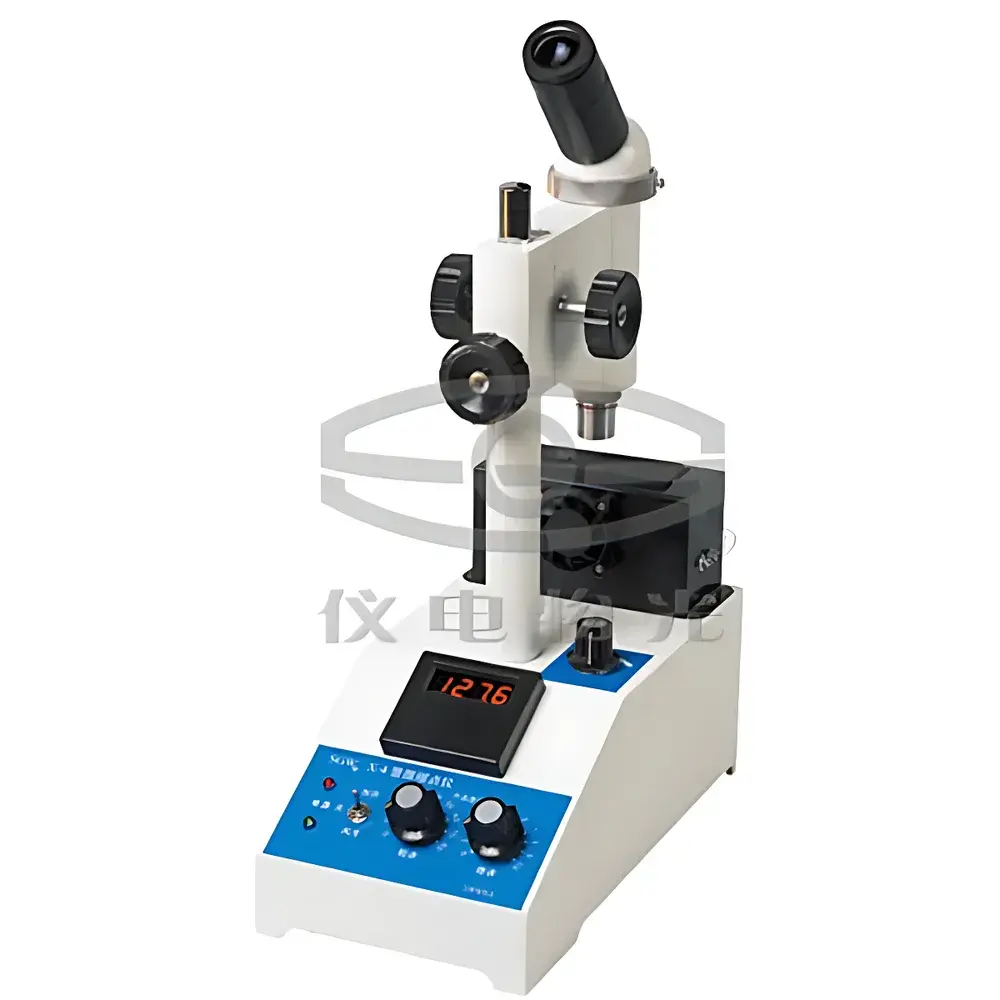
YDWG SGW® X-4 Microscopic Melting Point Apparatus
| Brand | YDWG |
|---|---|
| Origin | Shanghai, China |
| Model | SGW® X-4 |
| Temperature Range | Ambient to 330 °C |
| Heating Methods | Capillary Method & Hot Stage Method |
| Temperature Repeatability | ±1 °C at ≤200 °C |
| Temperature Accuracy | ±0.1 °C |
| Temperature Resolution | 0.1 °C |
| Optical System | Monocular Microscope, 40× Magnification |
| Power Supply | 220 V ±22 V, 50 Hz ±1 Hz |
| Dimensions | 215 × 140 × 395 mm |
| Net Weight | 3.5 kg |
Overview
The YDWG SGW® X-4 Microscopic Melting Point Apparatus is a precision thermal analysis instrument engineered for the accurate determination of melting points in crystalline organic compounds. It operates on the principle of controlled thermal ramping combined with real-time optical observation via an integrated monocular microscope, enabling direct visualization of phase transitions—including onset, meniscus formation, and complete liquefaction—at the microscale. Unlike bulk thermal analyzers (e.g., DSC), this apparatus delivers high spatial resolution and operator-controlled endpoint judgment, making it particularly suitable for quality control laboratories where regulatory compliance, method traceability, and visual verification are critical. Designed for routine use in pharmaceutical QC, fine chemical synthesis, and academic research, the SGW® X-4 supports both capillary-based and hot-stage-based measurement protocols—ensuring adaptability across diverse sample forms and regulatory frameworks.
Key Features
- Temperature-controlled heating stage with programmable ramp rates and digital PID regulation, achieving stable thermal profiles from ambient up to 330 °C
- Dual-mode operation: standardized capillary tube method (per USP & EP general chapter <281>) and hot-stage method using standard glass slides and coverslips
- Integrated 40× monocular microscope with adjustable focus and coaxial illumination for clear visualization of crystal morphology changes during heating
- High-resolution temperature display (0.1 °C) with accuracy certified to ±0.1 °C and repeatability validated per ISO 8677:2017 (Melting Point Determination – Reference Materials and Procedures)
- Compact benchtop design (215 × 140 × 395 mm) with low power consumption (220 V, 50 Hz), optimized for shared lab environments and limited workspace
- Robust mechanical architecture with corrosion-resistant heating block and calibrated thermocouple feedback loop ensuring long-term stability
Sample Compatibility & Compliance
The SGW® X-4 accommodates solid crystalline samples in standard 1-mm OD capillaries (90 mm or 120 mm length) as well as thin-film preparations on borosilicate glass slides. It is routinely employed for pharmacopeial testing of active pharmaceutical ingredients (APIs), excipients, and intermediates per United States Pharmacopeia (USP) <741>, European Pharmacopoeia (Ph. Eur.) 2.2.14, and Japanese Pharmacopoeia (JP) 2.60. The instrument’s manual endpoint detection protocol aligns with GLP-compliant workflows when paired with documented SOPs, reference standard calibration (e.g., pure naphthalene, adipic acid, anthraquinone), and operator training records. While not inherently 21 CFR Part 11–compliant (as it lacks electronic audit trail functionality), its operation supports full traceability when integrated into paper-based or LIMS-linked QC documentation systems.
Software & Data Management
The SGW® X-4 is a manually operated, non-digital instrument with no embedded software or data logging capability. All measurements are recorded manually by the analyst, including observed onset temperature, clear point, and morphological notes. This analog architecture ensures operational simplicity, minimal maintenance, and immunity to firmware-related validation challenges—making it especially appropriate for labs maintaining legacy validation protocols or operating under strict change-control regimes. For laboratories requiring digital archiving, external documentation tools (e.g., electronic lab notebooks or LIMS templates) may be used to capture results alongside instrument ID, calibration date, reference standard lot number, and analyst signature—fully satisfying ISO/IEC 17025 clause 7.8 on result reporting.
Applications
- Pharmaceutical QC release testing of raw materials and finished dosage forms
- Purity assessment of synthetic intermediates via mixed-melting point analysis
- Polymorph screening and identification in early-stage drug development
- Quality assurance of dyes, pigments, fragrances, and agrochemical crystals
- Educational demonstrations of solid-state phase behavior in undergraduate chemistry laboratories
- Verification of thermal stability in polymer additives and organic semiconductors
FAQ
What reference standards are recommended for calibration?
Naphthalene (MP 80.26 °C), adipic acid (MP 152.1 °C), and anthraquinone (MP 286 °C) are commonly used primary standards traceable to NIST or national metrology institutes.
Can the SGW® X-4 be used for decomposition point determination?
While not designed for formal decomposition analysis, experienced operators may observe discoloration, charring, or gas evolution during heating—providing qualitative indicators of thermal instability prior to melting.
Is third-party calibration and 3Q qualification supported?
Yes—YDWG-authorized service providers offer IQ/OQ/PQ documentation packages, including installation verification, operational performance testing against certified reference materials, and preventive maintenance logs compliant with GMP Annex 15 requirements.
How often should temperature calibration be performed?
Per ISO/IEC 17025 and internal SOPs, calibration should be verified before each analytical session or at least daily when used in regulated environments; full recalibration is recommended every 6 months or after instrument servicing.
Are replacement capillaries and slides available through YDWG distribution channels?
Yes—standard 1-mm OD capillaries (90 mm and 120 mm lengths), precision-cut glass slides (76 × 26 mm), and #1.5 coverslips are stocked and supplied with batch-specific certificates of conformance.



