
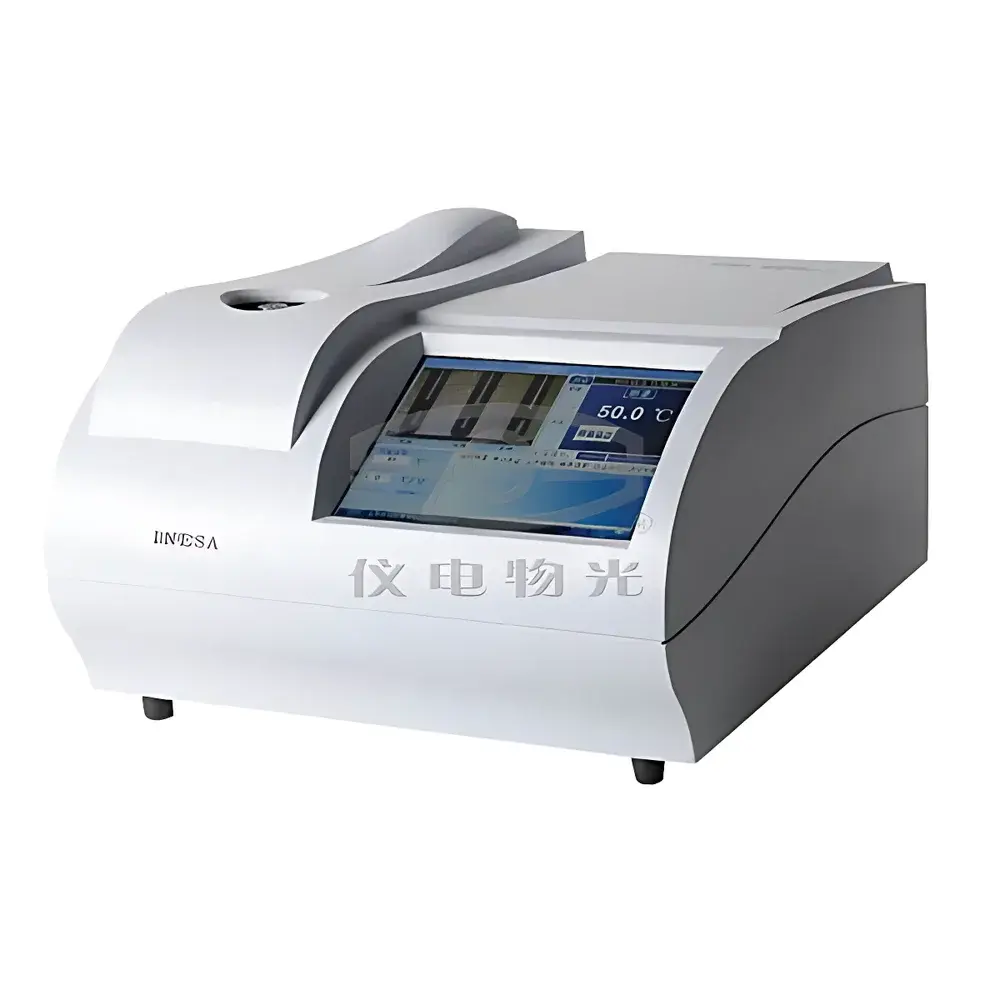
YDWG SGW®-650 Automated Digital Image Melting Point Apparatus
| Brand | YDWG |
|---|---|
| Origin | Shanghai, China |
| Model | SGW®-650 |
| Temperature Range | Ambient to 400 °C |
| Heating Rates | 0.2, 0.5, 1.0, 1.5, 2.0, 3.0, 4.0, 5.0 °C/min |
| Temperature Repeatability | ±0.3 °C at 1.0 °C/min |
| Temperature Accuracy | ±0.4 °C ≤200 °C |
| Capillary Dimensions | OD 1.4 mm, ID 1.0 mm, Length 90 mm |
| Sample Capacity | 5 capillaries simultaneously |
| Temperature Resolution | 0.1 °C |
| Calibration Points | 8-point programmable calibration |
| Data Storage | 16 GB internal |
| Display | 8-inch capacitive touchscreen LCD |
| Operating System | Embedded Windows-based platform |
| Compliance | Meets requirements of Chinese Pharmacopoeia, USP <741>, EP 2.2.17, ISO 11357-3, FDA 21 CFR Part 11 (audit trail, electronic signatures, role-based access control), GLP/GMP data integrity standards |
Overview
The YDWG SGW®-650 Automated Digital Image Melting Point Apparatus is a precision thermal analysis instrument engineered for pharmaceutical, chemical, and materials laboratories requiring regulatory-compliant, high-reproducibility melting point determination. It employs real-time digital image acquisition—via a high-resolution CMOS camera—and algorithm-driven pixel-intensity analysis to detect phase transitions with objective, operator-independent endpoint identification. Unlike traditional analog visual methods, the SGW®-650 captures continuous video sequences of sample behavior during linear heating, enabling retrospective frame-by-frame review and validation of melt onset and clear point. Its temperature control architecture integrates a platinum resistance thermometer (Pt100) sensor with closed-loop PID regulation, ensuring stable ramp profiles and minimizing thermal lag across the full 0–400 °C range. Designed for routine QC and R&D environments, the system delivers traceable, auditable results aligned with pharmacopeial monographs and international quality frameworks.
Key Features
- Simultaneous analysis of up to five standard capillaries (1.4 mm OD × 1.0 mm ID × 90 mm length) under identical thermal conditions, enhancing throughput and inter-sample comparability.
- Dual-mode operation: fully automated image-based detection + manual visual verification with synchronized video playback—enabling cross-validation and troubleshooting of ambiguous transitions.
- Eight-point programmable temperature calibration using NIST-traceable reference standards, supporting multi-point linearity correction across the operational range.
- Embedded Windows OS with intuitive touch interface (8-inch capacitive display), USB peripheral support (keyboard/mouse/printer), VGA output, and optional Wi-Fi/Ethernet connectivity for LIMS integration.
- FDA 21 CFR Part 11–compliant software architecture featuring four-tier user permission levels (up to 80 accounts), electronic signatures, immutable audit trails, password policies, and encrypted local data storage (16 GB).
- Robust thermal design with ±10% ramp rate accuracy, resolution of 0.1 °C, and verified repeatability of ±0.3 °C at 1.0 °C/min—meeting USP and EP 2.2.17 precision criteria.
Sample Compatibility & Compliance
The SGW®-650 accommodates a broad spectrum of solid organic compounds—including colored, opaque, or low-contrast samples—without reliance on optical transparency. Its image-processing algorithm detects subtle morphological changes (e.g., meniscus formation, sintering, shrinkage, and liquefaction onset) irrespective of sample hue or crystallinity. All measurement protocols adhere to pharmacopeial definitions: onset is determined as the first observable structural collapse, while clear point corresponds to complete disappearance of solid-phase texture. The instrument satisfies data integrity requirements of GMP, GLP, and ICH guidelines, with full compliance to Chinese Pharmacopoeia (ChP), United States Pharmacopeia (USP ), European Pharmacopoeia (EP 2.2.17), and ISO 11357-3 for differential thermal analysis methodology. Built-in validation tools support IQ/OQ documentation and periodic performance verification per laboratory SOPs.
Software & Data Management
The embedded application provides 300 pre-configured method templates—customizable for ramp rate, dwell time, hold temperature, and image capture frequency—and supports export of raw video (.avi), metadata-rich CSV reports, and PDF certificates. All data entries include timestamps, operator ID, instrument serial number, calibration status, and environmental log (ambient temperature/humidity if externally interfaced). Audit trails record every user action—including method edits, result overrides, and calibration events—with tamper-proof hashing. Network-enabled units allow secure remote monitoring via HTTPS, role-based web dashboard access, and direct push to enterprise LIMS or ELN systems using ASTM E1384 or HL7-compatible protocols. Data backups are configurable to external drives or cloud repositories with AES-256 encryption.
Applications
- Pharmaceutical QC release testing of active pharmaceutical ingredients (APIs) and excipients per ChP/USP/EP specifications.
- Polymorph screening and stability-indicating assays during preformulation and accelerated aging studies.
- Verification of synthetic purity in fine chemical manufacturing and academic organic synthesis labs.
- Regulatory submission support with ALCOA+ principles (Attributable, Legible, Contemporaneous, Original, Accurate, Complete, Consistent, Enduring, Available) embedded in all workflows.
- Teaching laboratories requiring visual pedagogy—students observe real-time crystal lattice breakdown and correlate thermal events with molecular structure.
FAQ
Does the SGW®-650 support ASTM E324 or ISO 11357-3 compliant testing?
Yes—the instrument’s linear heating control, Pt100 sensor accuracy, and documented uncertainty budget align with ISO 11357-3 Annex A for melting point determination by optical methods.
Can the system be validated for GMP production environments?
Yes—it includes integrated qualification tools (IQ/OQ checklists), electronic signature capability, and 21 CFR Part 11–ready audit trail generation required for FDA-inspected facilities.
Is video playback compatible with third-party forensic analysis software?
Raw AVI files are encoded in Motion JPEG format at 30 fps and 1280×720 resolution, fully compatible with industry-standard media analysis platforms.
What capillary types are supported beyond the standard 1.0 mm ID specification?
The stage geometry is optimized for 1.0 mm ID capillaries; use of non-standard dimensions may compromise thermal uniformity and image focus consistency.
How frequently must the eight-point calibration be performed?
Per ICH Q2(R2), calibration should be executed prior to each analytical session or at least daily when used continuously; documented calibration records must be retained for audit purposes.



