
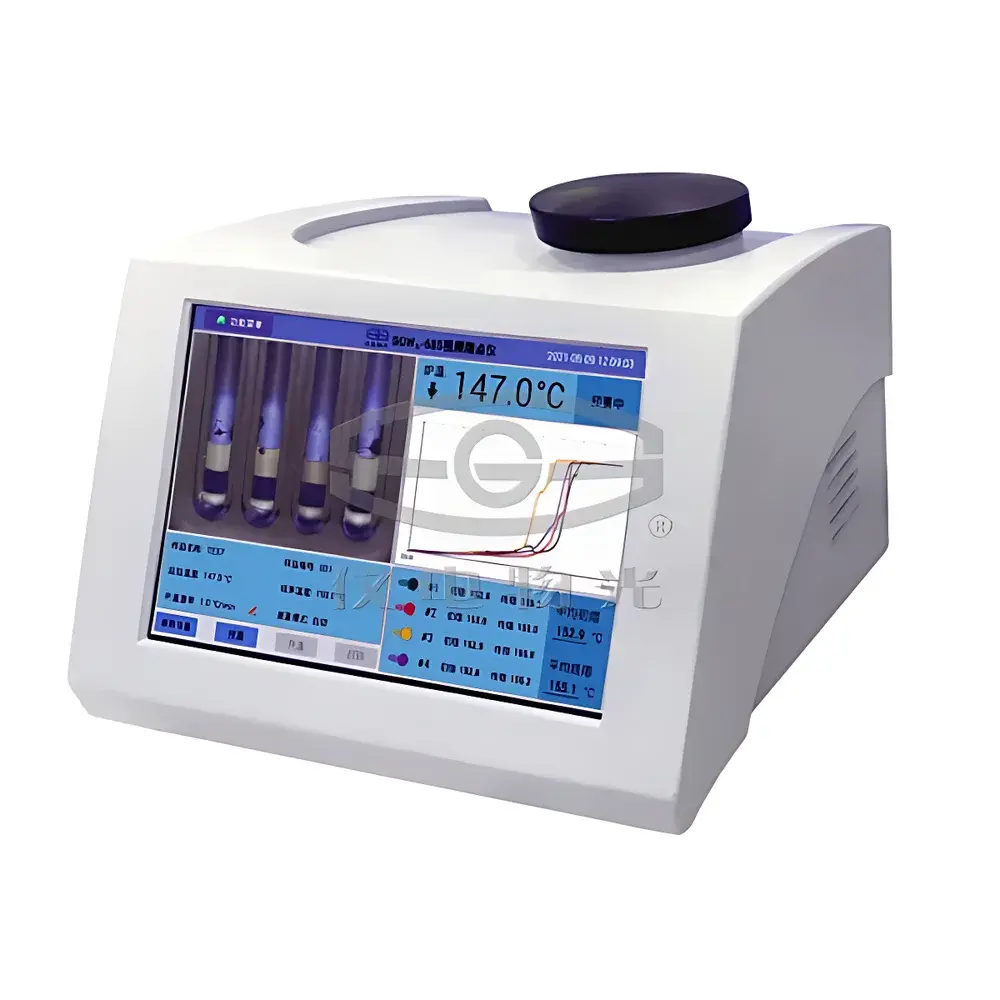
YDWG SGW®-681 Automated Video Melting Point Apparatus
| Brand | YDWG |
|---|---|
| Origin | Shanghai, China |
| Model | SGW®-681 |
| Temperature Range | Ambient to 360 °C |
| Heating Rate | 0.1–20.0 °C/min (continuously adjustable) |
| Temperature Accuracy | ±0.4 °C ≤200 °C |
| Temperature Repeatability | 0.3 °C at 1.0 °C/min |
| Temperature Resolution | 0.1 °C |
| Capillary Dimensions | OD 1.4 mm, ID 1.0 mm, Length 90 mm |
| Sample Capacity | 4 capillaries per run |
| Display | 10.1″ IPS capacitive touchscreen |
| Camera | 720p @ 30 fps |
| Data Storage | 64 GB internal |
| Operating System | Android-based embedded OS |
| Compliance | Compliant with USP <741>, EP 2.2.17, and ChP 0612 melting point determination methods |
Overview
The YDWG SGW®-681 Automated Video Melting Point Apparatus is a precision thermal analysis instrument engineered for pharmaceutical, chemical, and materials laboratories requiring pharmacopoeial-compliant, high-reproducibility melting point determination. It employs real-time video monitoring combined with photometric detection to objectively identify onset (onset of melting), clear point (complete liquefaction), and intermediate phase transitions—enabling full traceability of thermal behavior in solid-state characterization. Unlike traditional analog or semi-automated units, the SGW®-681 integrates a closed-loop PID/PWM temperature control system with a calibrated platinum resistance thermometer (Pt100), ensuring stable ramp profiles and minimal thermal overshoot across its full operating range (ambient to 360 °C). Its dual-mode operation—fully automated photometric detection and manual visual verification via synchronized HD video—supports both routine QC release testing and method development under GLP/GMP conditions.
Key Features
- 10.1-inch IPS capacitive touchscreen running a dedicated Android-based OS with intuitive workflow navigation and multi-language support (English, Chinese, Spanish, German)
- 720p high-definition camera capturing at 30 frames per second, enabling smooth playback and frame-by-frame analysis of melt progression
- Adjustable LED illumination and photodetector sensitivity to accommodate diverse sample optical properties—including dark-colored, opaque, or low-contrast organic solids
- Precision heating block with integrated Pt100 sensor and optimized thermal mass design, delivering rapid heat-up times and exceptional temperature stability (±0.05 °C over 10 min at 150 °C)
- Four independent capillary channels processed simultaneously, each monitored in real time with individual timestamped video streams and thermal curves
- Onboard 64 GB storage supporting ≥10,000 complete measurement records—including raw video (.mp4), thermal curve data (.csv), and annotated PDF reports
- Native support for ASTM E324, USP , European Pharmacopoeia 2.2.17, and Chinese Pharmacopoeia 0612 methodologies, with configurable pass/fail criteria per pharmacopoeial chapter
Sample Compatibility & Compliance
The SGW®-681 accepts standard pharmacopoeial capillaries (1.4 mm OD / 1.0 mm ID / 90 mm length) loaded with 2–3 mm sample columns. Its optical detection system accommodates crystalline powders, recrystallized intermediates, polymorphic forms, hydrates, and amorphous dispersions—provided samples are dry and free of solvent residues. The instrument meets critical regulatory expectations for audit readiness: all measurements include immutable metadata (operator ID, timestamp, method name, calibration status), and video recordings are stored with SHA-256 hash integrity verification. Optional LIMS integration via RS232 or TCP/IP enables direct transfer of results—including embedded video thumbnails—to enterprise quality management systems, satisfying FDA 21 CFR Part 11 requirements for electronic records and signatures when deployed with appropriate access controls and audit trail configuration.
Software & Data Management
Embedded software provides full lifecycle data handling—from method creation and calibration logging to report generation and export. Users may define up to 100 custom methods, each specifying target temperature range, heating rate, dwell time, detection thresholds, and video capture settings. All measurements generate timestamped CSV files containing temperature vs. time, derivative (dT/dt) values, and photometric intensity profiles. Reports are exportable as PDFs with embedded video links (via QR code or file reference), or as structured XML/JSON payloads compatible with laboratory informatics platforms. USB host ports support direct export to flash drives; optional Wi-Fi or Ethernet connectivity allows remote monitoring and scheduled firmware updates without physical access. Calibration history—including multi-point verification using certified NIST-traceable standards—is retained with digital signatures and version-controlled logs.
Applications
- Pharmaceutical QC release testing of active pharmaceutical ingredients (APIs) and excipients per USP/EP/ChP monographs
- Polymorph screening and thermal stability assessment during preformulation studies
- Verification of identity and purity in synthetic chemistry workflows
- Educational use in university analytical chemistry labs for teaching solid-state phase behavior
- Regulatory submission support, including ICH Q5A and Q5C documentation of thermal characteristics
- Stability-indicating assays for detecting degradation products via depressed or broadened melting ranges
FAQ
Does the SGW®-681 comply with 21 CFR Part 11 for electronic records?
Yes—when configured with user authentication, audit trail activation, and electronic signature enforcement, the system supports ALCOA+ data integrity principles. Full audit trail logs record all user actions, parameter changes, and report exports.
Can the instrument be validated per IQ/OQ/PQ protocols?
Yes—comprehensive validation documentation, including URS templates, test scripts, and performance qualification checklists, is provided upon request for GMP environments.
Is external calibration required, and how often?
Annual calibration using NIST-traceable reference standards (e.g., indium, tin, zinc) is recommended. The built-in multi-point calibration function supports up to five reference points across the operating range.
What video formats are supported for export and archival?
All recordings are saved in MP4 (H.264) format at 720p resolution and 30 fps, optimized for long-term archiving and playback on standard media players or LIMS viewers.
How is temperature uniformity across the four capillary positions verified?
Factory verification includes thermal mapping at three representative ramp rates (0.5, 2.0, and 10.0 °C/min) confirming positional deviation ≤±0.2 °C within the active zone.



