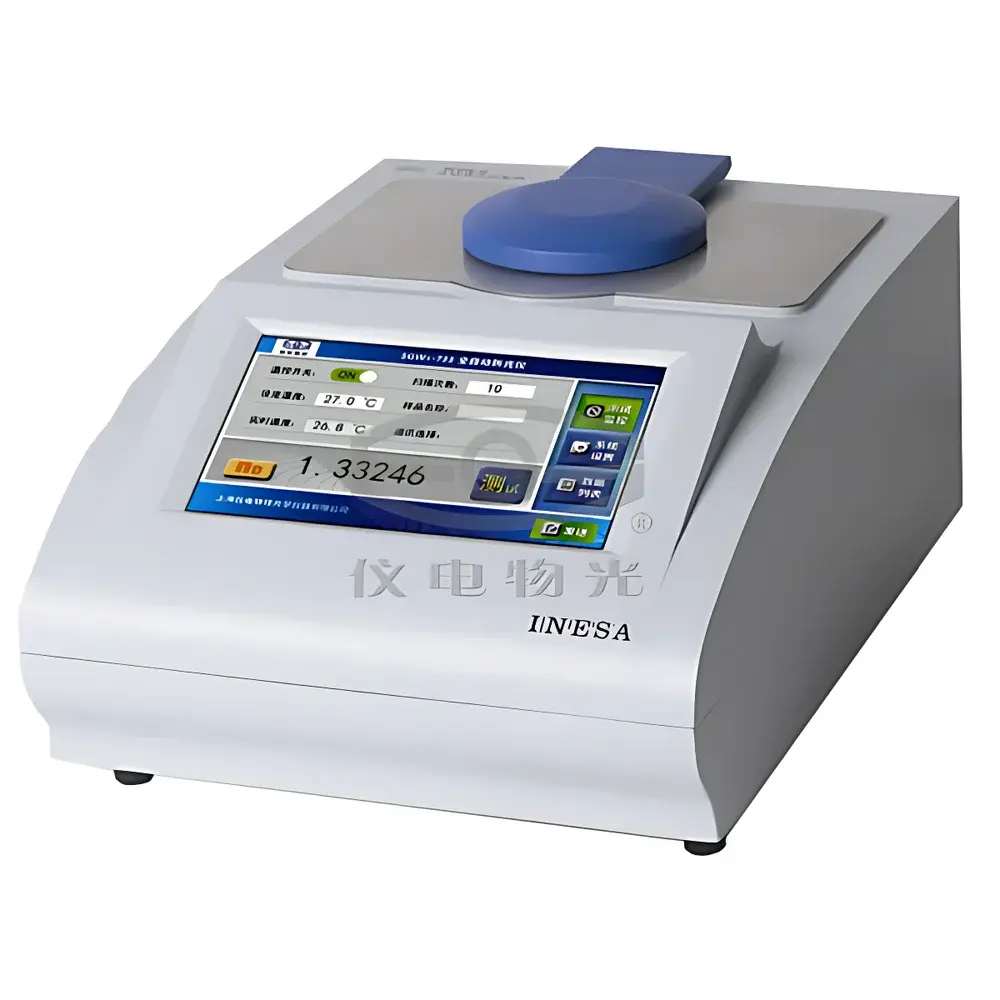
YDWG SGW®-732 Automated Refractometer with Flow Cell
| Brand | YDWG |
|---|---|
| Origin | Shanghai, China |
| Model | SGW®-732 |
| Product Type | Benchtop Refractometer |
| Temperature Control | Yes |
| Digital Display | Yes |
| Refractive Index Range | 1.30000–1.70000 |
| Brix Range | 0–100% |
| Resolution (nD) | 0.00001 |
| Resolution (Brix) | 0.01% |
| Accuracy (nD) | ±0.0002 |
| Accuracy (Brix) | ±0.1% |
| Measurement Precision (nD) | ±0.00001 |
| Measurement Precision (Brix) | ±0.01% |
| Sample Volume | 0.5 mL |
| Light Source | LED (Lifespan ≥ 100,000 h) |
| Display | 7-inch Color Touchscreen |
| Data Storage | 1,000 measurements |
| Interface | RS232 / USB / USB Flash Drive Support |
| Compliance | GB/T 12143–2008, GB/T 18963–2012, GB/T 21730–2008 |
Overview
The YDWG SGW®-732 Automated Refractometer with Flow Cell is a precision benchtop instrument engineered for high-reproducibility refractive index (nD) and Brix concentration measurements in quality control, R&D, and production environments. It operates on the principle of total internal reflection at the prism–sample interface, where a high-resolution CCD linear array captures the critical angle shift induced by sample refractivity. Unlike manual or semi-automated refractometers, the SGW®-732 integrates a dedicated flow cell module—enabling continuous, unattended measurement of liquids without manual prism wiping or repositioning. This architecture eliminates operator-induced variability and supports repeatable, traceable analysis across batch-to-batch workflows. The instrument employs a stable, long-life LED light source (rated ≥100,000 hours), eliminating thermal drift associated with halogen lamps and ensuring consistent illumination over extended operational cycles. Its optical path is sealed and mechanically static—no moving parts are involved in measurement execution—enhancing long-term calibration stability and reducing maintenance requirements.
Key Features
- Integrated flow cell design enabling continuous, non-contact liquid sampling with minimal dead volume (0.5 mL required per measurement)
- High-precision CCD detection system delivering 0.00001 refractive index resolution and ±0.00001 measurement precision (nD)
- Automated temperature correction and real-time temperature monitoring (0–90 °C display range); compatible with external Peltier-controlled recirculating baths for ISO/ASTM-compliant thermal stabilization
- 7-inch full-color capacitive touchscreen interface with intuitive icon-driven navigation and multilingual UI support (English, Chinese, Spanish)
- Dual-mode data handling: onboard storage for up to 1,000 measurement records with timestamp, operator ID, and method tag; export via USB flash drive or RS232/USB serial link to LIMS or Excel-compatible databases
- Corrosion-resistant, scratch-hardened optical glass prism with simplified cleaning protocol—compatible with aqueous, alcoholic, and mildly acidic/basic solutions
- Built-in industry-specific calculation tables aligned with GB/T standards: F42 & F55 HFCS, glucose, sucrose, fruit/vegetable juice solids, soft drink TSS, honey moisture content, nD20, and user-defined units
Sample Compatibility & Compliance
The SGW®-732 accommodates a broad spectrum of transparent to lightly turbid liquid samples—including syrups, beverages, pharmaceutical solutions, chemical intermediates, and food-grade emulsions—provided they do not permanently coat or etch optical surfaces. Its flow cell configuration ensures compatibility with inline process streams when paired with peristaltic or diaphragm pumps (external). The instrument conforms to multiple national standard methodologies: GB/T 12143–2008 (soft drinks), GB/T 18963–2012 (honey quality), and GB/T 21730–2008 (fruit and vegetable juices). While not certified to ISO 21542 or ASTM D1218, its measurement repeatability (RSD < 0.05% for nD under controlled conditions) meets typical GLP laboratory validation criteria for routine QC use. Calibration verification is supported via NIST-traceable sucrose reference standards (e.g., 10%, 30%, 60% w/w).
Software & Data Management
Data integrity and audit readiness are ensured through structured metadata capture: each stored record includes date/time stamp, operator code (configurable), measurement mode, temperature reading, and raw nD/Brix values. Export files follow CSV format with UTF-8 encoding, preserving numeric precision and enabling direct ingestion into statistical process control (SPC) platforms. USB mass-storage mode allows drag-and-drop backup without proprietary software. For regulated environments, optional PC-based software (YDWG LabLink v3.x) provides 21 CFR Part 11-compliant features—including electronic signatures, audit trail logging, and role-based access control—though native instrument firmware does not implement cryptographic authentication or biometric login.
Applications
- Quality assurance of sugar-based formulations (soft drinks, jams, confectionery syrups) per Brix equivalence
- Concentration monitoring during evaporation, blending, or dilution steps in food & beverage manufacturing
- Honey adulteration screening via water activity correlation with nD-derived moisture estimates
- Pharmaceutical excipient solution verification (e.g., glycerin, propylene glycol concentrations)
- Routine QC of industrial solvents, coolants, and antifreeze mixtures where refractivity correlates with composition
- Educational laboratories requiring robust, low-maintenance instrumentation for physical chemistry and food science curricula
FAQ
Does the SGW®-732 support automatic temperature control (Peltier)?
No—the instrument displays temperature (0–90 °C) and applies algorithmic compensation using built-in thermistor readings, but it lacks an integrated Peltier element. External temperature-regulated flow cells or recirculating chillers are required for active thermal control.
Can the flow cell be sterilized or cleaned in situ with caustic solutions?
The prism and wetted flow path are fabricated from high-hardness optical glass and stainless-steel fittings, rated for repeated exposure to 1–2% NaOH or HNO3; however, prolonged contact with strong oxidizers or HF-containing cleaners must be avoided.
Is method validation documentation provided for regulatory submissions?
YDWG supplies factory calibration certificates and metrological specifications compliant with JJG 616–2006 (Chinese national verification regulation for refractometers); full IQ/OQ/PQ protocols require site-specific development per ISO/IEC 17025 or FDA guidance.
What is the minimum sample volume required for reliable measurement?
0.5 mL is sufficient to fill the flow cell and establish stable optical contact; no purge or priming volume beyond this is necessary under laminar flow conditions.
How frequently should calibration verification be performed?
Daily verification with at least two certified reference standards (e.g., distilled water and 30% sucrose) is recommended for GLP-aligned operations; weekly full calibration is advised if ambient temperature fluctuates >±3 °C or after instrument relocation.