
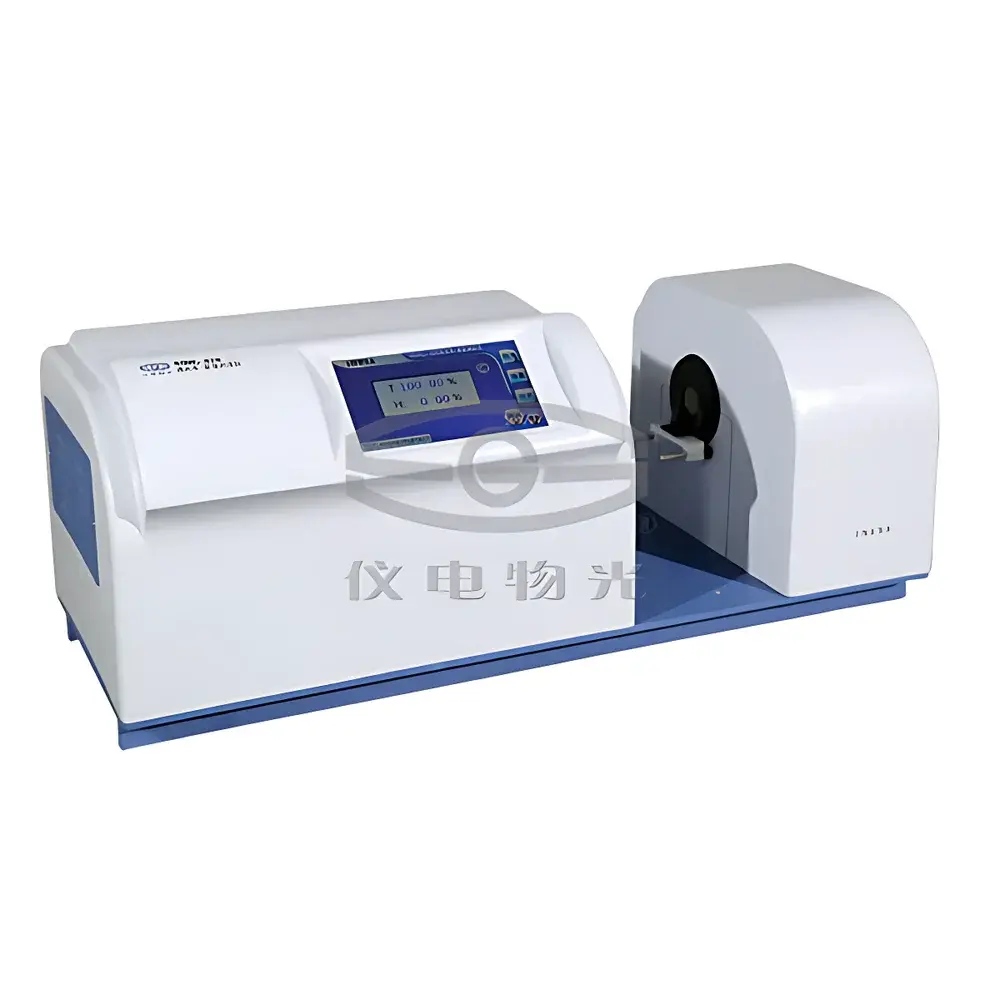
YDWG SGW®-810 Transmittance and Haze Meter
| Brand | YDWG |
|---|---|
| Origin | Shanghai, China |
| Model | SGW®-810 |
| Product Type | Automatic |
| Haze Range | 0–30.00% |
| Transmittance Range | 0–100.00% |
| Haze Repeatability | ±0.05% (for haze ≤0.5%), ±0.1% (for haze >0.5%) |
| Transmittance Repeatability | ≤0.5% |
| Light Source | C-illumination (6774 K) |
| Minimum Display Resolution | 0.01% (both transmittance and haze) |
| Sample Port Diameter | Incident Ø25 mm / Exit Ø21 mm |
| Display | 7-inch color LCD |
| Data Storage | 1000 measurement sets internally + USB flash drive export |
| Interface | Standard USB-B |
| Power Supply | 220 V ±22 V, 50 Hz ±1 Hz, 100 W |
| Dimensions (L×W×H) | 710 × 270 × 280 mm |
| Net Weight | 15 kg |
Overview
The YDWG SGW®-810 Transmittance and Haze Meter is a microprocessor-controlled optical instrument engineered for precise, repeatable quantification of total transmittance and haze in transparent and translucent planar materials. It operates on the principle of collimated beam transmission combined with hemispherical diffuse light collection via an integrating sphere photodetector system—fully compliant with the geometric and photometric requirements defined in ISO 13468-1, ASTM D1003-22, GB/T 2410-2008, JIS K 7105:1981, and JJF 1303-2011. The instrument employs a standardized C-illuminant (6774 K color temperature) to ensure spectral consistency across measurements, minimizing variability caused by source drift or ambient lighting interference. Its modulation-based optical design eliminates sensitivity to ambient light, enabling reliable operation without darkroom installation—a critical advantage for quality control laboratories handling large-format panels or production-line sampling.
Key Features
- Integrated dual-parameter measurement: simultaneous acquisition of total transmittance (%) and haze (%) per ASTM D1003 Annex A1 methodology.
- High-stability C-illuminant source with calibrated spectral power distribution, traceable to national photometric standards.
- 7-inch full-color LCD touchscreen interface with intuitive navigation, real-time data visualization, and on-device statistical summary (mean, SD, min/max).
- Internal memory capacity for 1000 test records; expandable via USB flash storage with CSV export for LIMS or Excel integration.
- Dedicated sample fixtures: magnetic film holder for thin flexible substrates (e.g., PET, PC films) and liquid cuvette adapter for solution-phase haze assessment (e.g., colloidal suspensions, polymer dispersions).
- Self-diagnostic functionality with included certified haze reference standard; designed for daily verification without recalibration.
- Robust mechanical architecture with precision-machined sample ports (Ø25 mm incident / Ø21 mm exit) ensuring consistent beam geometry and minimal edge diffraction error.
Sample Compatibility & Compliance
The SGW®-810 accommodates rigid and semi-rigid flat specimens up to 20 mm thick, including thermoplastic sheets (PMMA, PC, PS), tempered glass, coated optics, laminated safety glazing, and packaging films. Its optical path geometry conforms to the “parallel beam, integrating sphere” configuration mandated for haze measurement under ASTM D1003 and ISO 14782. All reported values satisfy the repeatability thresholds required for GLP-compliant material qualification: transmittance repeatability ≤0.5% and haze repeatability ≤0.2% (per internal validation per JJF 1303-2011). Instrument performance is verifiable against NIST-traceable neutral density filters and certified haze standards (e.g., PMMA-based reference plates with assigned haze values of 1.5%, 5.0%, and 15.0%). Documentation supports audit readiness for ISO/IEC 17025-accredited testing laboratories.
Software & Data Management
Data acquisition and reporting are fully automated via embedded firmware with timestamped logging, operator ID tagging (optional), and automatic pass/fail flagging against user-defined specification limits. Measurement files include raw analog-to-digital converter (ADC) counts, calculated transmittance/haze values, environmental metadata (date/time, ambient temperature), and instrument status flags (lamp stability, detector saturation). USB communication enables bidirectional data transfer compatible with Windows-based QC software platforms. Exported CSV files contain column headers aligned with ASTM E131 terminology (e.g., “%T_Total”, “%Haze_CIE”), facilitating direct import into statistical process control (SPC) tools such as Minitab or JMP. Audit trail functionality meets FDA 21 CFR Part 11 requirements when deployed with validated third-party laboratory information management systems (LIMS).
Applications
- Quality assurance of optical-grade polymers in automotive glazing, display cover lenses, and LED light-diffusing plates.
- Batch release testing of pharmaceutical blister packaging films where moisture barrier integrity correlates with haze shift.
- R&D evaluation of anti-fog coatings on polycarbonate visors and greenhouse cladding materials.
- Validation of cleaning efficacy on architectural glass by quantifying post-wipe haze residuals.
- Characterization of nanoparticle dispersion homogeneity in transparent nanocomposites via haze–transmittance correlation analysis.
- Compliance verification for ISO 11431 (automotive interior plastics) and EN 45545-2 (railway fire safety) optical transparency clauses.
FAQ
What standards does the SGW®-810 comply with for transmittance and haze measurement?
It conforms to ASTM D1003-22, ISO 13468-1, GB/T 2410-2008, JIS K 7105:1981, and JJF 1303-2011 for optical geometry, illuminant specification, and calculation algorithms.
Can the instrument measure liquid samples?
Yes—via the optional liquid sample cup accessory, enabling haze assessment of colloidal suspensions, sol-gel precursors, or purified solvents per ASTM D5781.
Is darkroom operation required?
No—the modulated optical design rejects ambient light interference, permitting use in typical laboratory ambient lighting conditions.
How is calibration verified?
Using the supplied certified haze reference plate; users perform routine verification (not recalibration) to confirm system linearity and detector response stability.
What is the maximum sample thickness supported?
Up to 20 mm for rigid planar specimens; thinner films require the magnetic fixture to ensure perpendicular alignment and minimize air-gap scattering.




