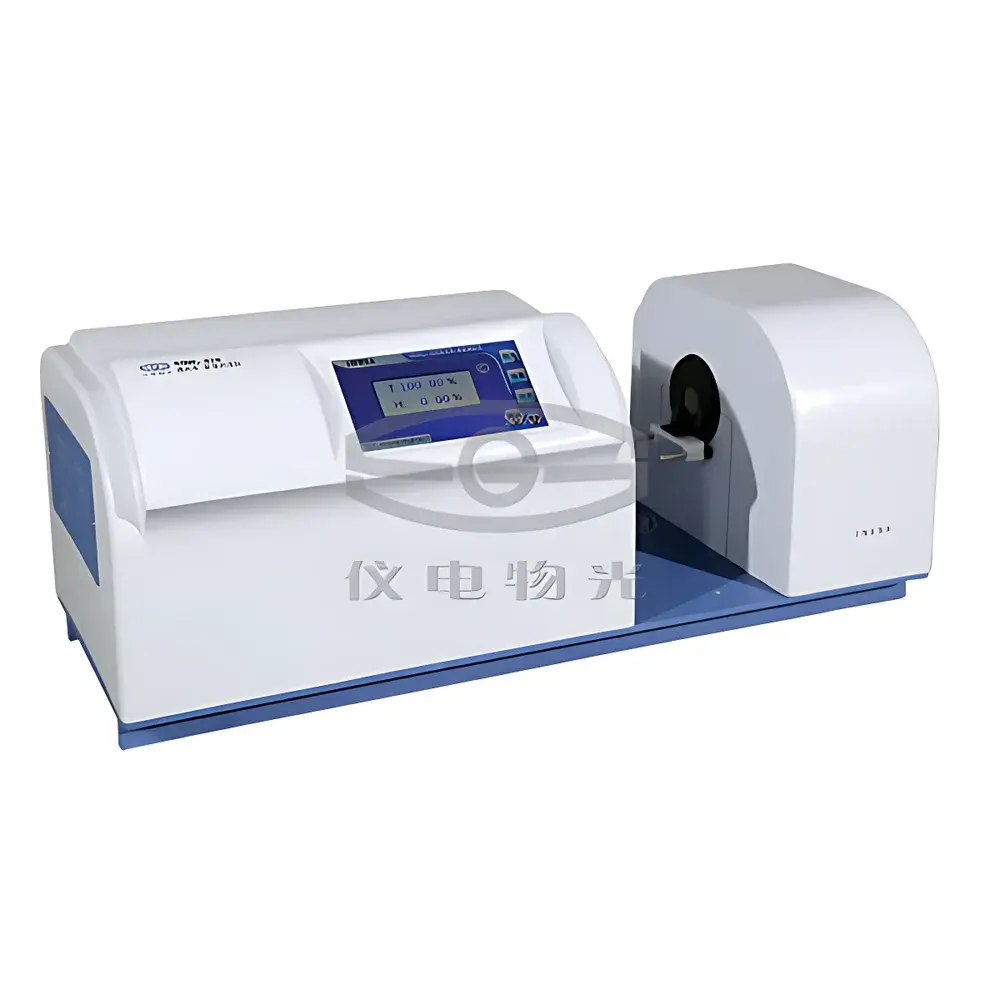
YDWG SGW®-820 Transmittance and Haze Meter
| Brand | YDWG |
|---|---|
| Origin | Shanghai, China |
| Model | SGW®-820 |
| Product Type | Automatic |
| Haze Range | 0–30.00% |
| Transmittance Range | 0–100.0% |
| Haze Repeatability | ±0.05% (for haze ≤0.5%), ±0.1% (for haze >0.5%) |
| Transmittance Repeatability | ≤±0.5% |
| Light Source | CIE A (2856 K) and C (6774 K) |
| Minimum Display Resolution | 0.01% (both transmittance and haze) |
| Sample Port Diameter | Incident Ø25 mm / Exit Ø21 mm |
| Data Storage Capacity | 2000 test records |
| Interface | Standard USB |
| Power Supply | 220 V ±10%, 50 Hz ±1 Hz, 100 W |
| Dimensions (L×W×H) | 710 × 270 × 280 mm |
| Net Weight | 15 kg |
Overview
The YDWG SGW®-820 Transmittance and Haze Meter is a microprocessor-controlled optical measurement instrument engineered for precise, repeatable quantification of total transmittance and haze in transparent and translucent planar materials. It operates on the principle of collimated beam transmission combined with hemispherical diffuse light collection via an integrating sphere photodetector system—fully compliant with ISO 13468-1, ISO 14782, ASTM D1003-22, GB/T 2410-2008, JIS K 7105:1981, and JJF 1303-2011. Designed for routine quality control and R&D applications in polymer processing, flat-glass manufacturing, optical film development, and packaging material evaluation, the SGW®-820 delivers traceable, standardized measurements without requiring ambient light shielding or darkroom installation—enabled by its built-in optical modulation system that suppresses stray-light interference.
Key Features
- Automated dual-light-source selection (CIE Illuminant A at 2856 K and C at 6774 K) to support spectral sensitivity matching across diverse application standards.
- High-stability integrating sphere geometry with calibrated baffle design ensures uniform diffuse reflectance collection and minimizes angular dependency errors.
- 7-inch full-color LCD touchscreen interface with intuitive navigation, real-time waveform preview, and on-device statistical summary (mean, SD, min/max) for up to 2000 stored measurements.
- USB host port enables direct data export to flash drives; standard USB-B interface supports bidirectional communication with Windows-based laboratory PCs for automated report generation.
- Dedicated sample fixtures—including magnetic film clamps for thin flexible substrates and a removable liquid cuvette holder—facilitate rapid, reproducible positioning of heterogeneous sample types.
- Integrated reference validation protocol: includes certified haze reference standard (supplied), enabling daily performance verification without external calibration services.
Sample Compatibility & Compliance
The SGW®-820 accommodates rigid and semi-rigid planar specimens up to 25 mm in diameter and 50 mm in thickness, including thermoplastic sheets (e.g., PMMA, PC, PET), tempered glass panels, coated optical films, laminated safety glazing, and pharmaceutical blister packaging. Its optical path geometry conforms to the “parallel beam, integrating sphere” configuration specified in ASTM D1003 Annex A1 and ISO 13468-1 Clause 6. The instrument’s photometric linearity, repeatability, and spectral response have been verified against NIST-traceable neutral density filters and haze standards. It supports GLP-compliant operation through user-accessible audit trails (via PC software), password-protected method storage, and timestamped result logs—meeting foundational requirements for FDA 21 CFR Part 11 readiness when deployed with validated software extensions.
Software & Data Management
Onboard firmware provides complete local operation without PC dependency: measurement initiation, unit toggling (%, decimal), pass/fail threshold setting, and batch ID assignment are all configurable via touchscreen. Raw and processed data—including transmittance (%T), haze (%H), and calculated clarity index where applicable—are saved in CSV format with embedded metadata (date/time, operator ID, instrument serial number). When connected to YDWG’s optional LabLink™ PC Suite (v3.2+), users gain access to advanced features: multi-curve overlay comparison, trend analysis across production lots, automated PDF report templating (with company logo insertion), and export to LIMS-compatible XML schemas. All data transfers comply with IEC 62304 Class B software safety classification.
Applications
- Quality assurance of injection-molded automotive interior lenses and headlamp covers per SAE J576.
- Validation of anti-fog coating efficacy on greenhouse polyethylene films (ASTM D1003 + ISO 489).
- Batch release testing of medical device packaging trays (ISO 11607-1) for optical clarity compliance.
- R&D screening of nanoparticle-doped transparent composites for aerospace canopy applications.
- Process monitoring of float-glass annealing lines, where haze drift correlates with residual internal stress.
- Regulatory submission support for cosmetic container transparency claims under EU Cosmetics Regulation No. 1223/2009 Annex VII.
FAQ
Does the SGW®-820 meet FDA requirements for use in regulated pharmaceutical environments?
Yes—when operated with validated LabLink™ software and configured with electronic signatures, audit trail logging, and secure user roles, it satisfies baseline 21 CFR Part 11 expectations for non-automated systems. Full validation documentation packages are available upon request.
Can the instrument measure curved or non-planar samples?
No—the optical design assumes parallel incident illumination and requires flat, optically homogeneous surfaces normal to the beam axis. Curved, textured, or highly scattering bulk materials fall outside its defined scope of measurement validity.
Is recalibration required after changing the light source mode (A ↔ C)?
No—factory calibration coefficients for both illuminants are permanently stored in non-volatile memory; switching modes does not affect photometric accuracy or necessitate user intervention.
What maintenance is recommended for long-term repeatability?
Monthly cleaning of the integrating sphere interior using lint-free swabs and spectroscopic-grade isopropanol; annual verification using the supplied reference haze standard (Lot-certified); biannual inspection of sample stage alignment by authorized service personnel.
Is the USB interface compatible with modern Windows 11 and macOS Ventura systems?
Yes—the device enumerates as a CDC ACM-class virtual COM port and requires no proprietary drivers on Windows 10/11 or macOS 12+. Linux kernel 5.4+ also supports plug-and-play enumeration.