
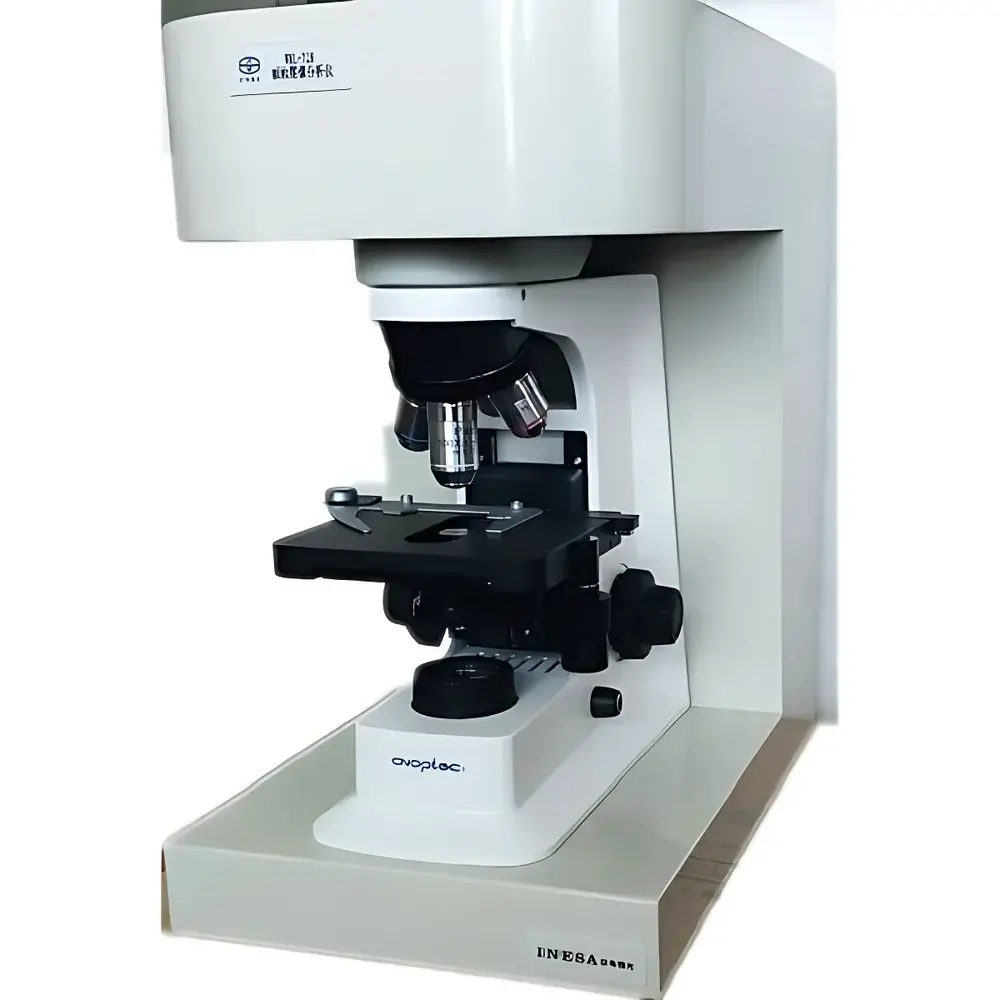
YDWG WKL-722 Dust Morphology and Dispersibility Analyzer (Microscopy-Based Image Analysis System)
| Brand | YDWG |
|---|---|
| Origin | Shanghai, China |
| Model | WKL-722 |
| Dispersion Method | Dry Dispersion |
| Instrument Type | Laboratory Microscopy-Based Particle Image Analyzer |
| Measurement Range | 0.1–3000 µm |
| Maximum Magnification | 8000× |
| Pixel Resolution | 0.1 µm/pixel |
| Repeatability | ≤ ±1% |
| Automatic Segmentation Speed | ≤ 1 s |
| Segmentation Success Rate | ≥ 99% |
| CCD Camera | 5 MP |
| Power Supply | AC 220 V ±10%, 50 Hz, 200 W |
| Dimensions | 270 × 410 × 440 mm |
| Net Weight | 15 kg |
| Compliance | GBZ/T 192.3–2007 |
Overview
The YDWG WKL-722 Dust Morphology and Dispersibility Analyzer is a dedicated microscopy-based image analysis system engineered for quantitative characterization of airborne dust particles in occupational health and industrial hygiene laboratories. Unlike laser diffraction or dynamic light scattering instruments, the WKL-722 employs high-magnification optical microscopy coupled with digital imaging and deterministic image segmentation algorithms to extract morphological and dimensional parameters directly from particle micrographs. This approach preserves true particle shape, surface texture, and agglomeration state—critical attributes for assessing respirable fraction, deposition behavior in the human respiratory tract, and compliance with occupational exposure limits. The system integrates a high-resolution 5-megapixel CCD camera, an 8000× total optical magnification path, and calibrated pixel-to-length mapping (0.1 µm/pixel), enabling direct measurement of individual particle dimensions—including equivalent circular diameter, Feret diameter, aspect ratio, convexity, perimeter, and projected area—across a validated range of 0.1 to 3000 µm.
Key Features
- Optical architecture optimized for dry-dispersed dust sampling on conductive stubs or membrane filters, minimizing charging artifacts and preserving native morphology.
- Deterministic image segmentation engine with ≥99% success rate in resolving overlapping particles using multi-threshold adaptive contour separation and morphological reconstruction.
- Real-time image enhancement suite including contrast normalization, brightness leveling, noise suppression, local histogram equalization, and edge-preserving smoothing—enabling robust analysis even under suboptimal illumination or low-contrast conditions.
- Preconfigured reporting templates aligned with GBZ/T 192.3–2007, automatically classifying particles into four regulatory size fractions: ≤2 µm (respirable), 2–5 µm (thoracic), 5–10 µm (inhalable upper airway), and >10 µm (non-respirable).
- Customizable grading logic supporting user-defined bin boundaries, statistical weighting (e.g., number-, area-, or volume-weighted distributions), and export of raw coordinate data for third-party statistical modeling.
- USB 3.0 interface ensures stable, low-latency image streaming; compatible with Windows 98 through Windows 11 on systems equipped with Intel Core i3 or higher, 16 GB RAM, and SSD storage.
Sample Compatibility & Compliance
The WKL-722 is validated for analysis of mineral dusts (e.g., silica, coal, limestone), metal oxides, organic particulates (e.g., wood, grain, textile fibers), and mixed aerosol samples collected via membrane filtration (e.g., PVC, polycarbonate, mixed cellulose ester) per NIOSH Method 7300 and ISO 7708:2022. It meets the technical requirements of GBZ/T 192.3–2007 “Determination of Dust Dispersibility in Workplace Air” for both qualitative morphology assessment and quantitative size distribution reporting. While not certified to ISO 13322-1:2014 (static image analysis) or ASTM E2454–22 (digital image analysis of particulates), its measurement traceability is established through stage micrometer calibration and documented inter-laboratory verification protocols. The system supports GLP-aligned audit trails when operated under controlled documentation practices, including timestamped image archiving and versioned analysis parameter logs.
Software & Data Management
The embedded image analysis software provides full non-destructive image annotation, batch processing, and hierarchical data export (CSV, XLSX, PDF). Each measurement session generates a structured metadata file containing acquisition settings (exposure time, gain, magnification), calibration constants, segmentation parameters, and operator ID. Raw images are stored losslessly in TIFF format; processed results include particle-by-particle coordinate tables, binned histograms, cumulative distribution curves, and summary statistics (D10, D50, D90, skewness, kurtosis). Software supports FDA 21 CFR Part 11–compatible electronic signatures when deployed with domain-authenticated Windows accounts and encrypted local storage—though full Part 11 compliance requires site-specific validation per organizational SOPs.
Applications
- Occupational health surveillance: Quantifying respirable crystalline silica (RCS) content in construction, mining, and foundry environments.
- Industrial hygiene program development: Correlating particle morphology (e.g., fiber aspect ratio, angularity) with toxicological endpoints per IARC and ACGIH guidelines.
- Filter efficiency testing: Evaluating capture mechanisms of HEPA and PPE filtration media by analyzing upstream/downstream particle shape changes.
- Regulatory submission support: Generating auditable datasets for OSHA, MSHA, or provincial CDC reporting under China’s Work Safety Law and GBZ series standards.
- Research on dust generation mechanisms: Studying fracture patterns, abrasion wear, and comminution behavior across material classes using shape descriptors (circularity, solidity, convex hull ratio).
FAQ
Does the WKL-722 require sample coating or conductive treatment before imaging?
Yes—non-conductive dust samples (e.g., coal, polymers) must be sputter-coated with gold/palladium or carbon to prevent charging artifacts under electron-optical illumination paths; however, the WKL-722 uses visible-light transmission/reflection optics, so conductive coating is optional unless static-induced particle displacement is observed.
Can the system analyze wet-dispersed suspensions?
No—the WKL-722 is configured exclusively for dry-dispersed solid-phase samples mounted on planar substrates; it does not include fluidic cells, flow chambers, or environmental control units required for liquid-phase analysis.
Is firmware or software update support available outside China?
YDWG provides English-language software updates and calibration utilities via secure FTP upon registration; however, remote technical support and on-site service are limited to authorized distributors in APAC regions.
What validation documentation accompanies the instrument?
Each unit ships with a factory calibration certificate referencing NIST-traceable stage micrometers, a system verification report (including repeatability test data at 5, 20, and 100 µm), and GBZ/T 192.3–2007 conformance statement.
How is measurement uncertainty quantified for reported size distributions?
Uncertainty arises primarily from pixel resolution (±0.1 µm), depth-of-field limitations at high magnification, and segmentation algorithm sensitivity to contrast gradients; combined expanded uncertainty (k=2) is ≤±1.2% for monodisperse reference standards within the 1–100 µm range.



