
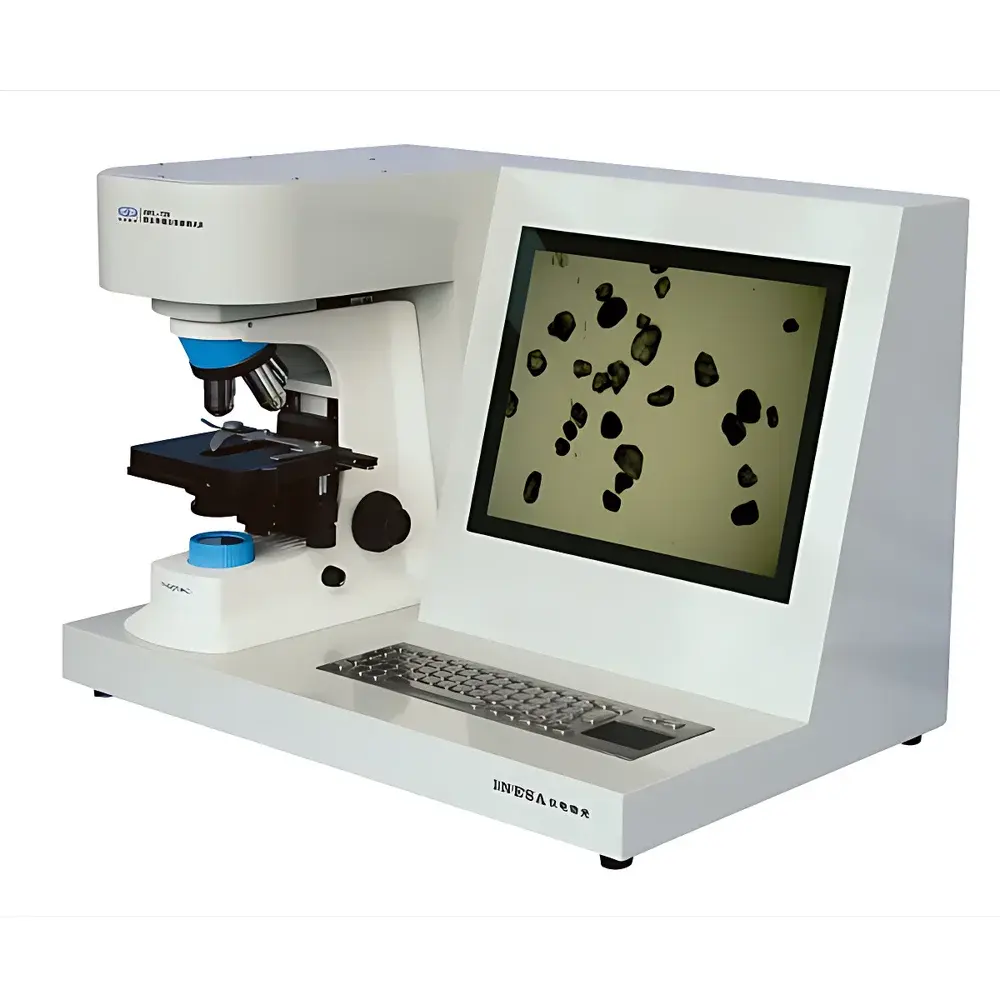
YDWG WKL-728 Intelligent Dust Morphology and Dispersion Analyzer
| Brand | YDWG |
|---|---|
| Origin | Shanghai, China |
| Model | WKL-728 |
| Dispersion Method | Dry Dispersion |
| Instrument Type | Laboratory Microscopic Image-Based Particle Analyzer |
| Measurement Range | 0.1–3000 µm |
| Repeatability | ≤ ±1% |
| Maximum Magnification | 8000× |
| Pixel Resolution | 0.1 µm/pixel |
| Auto-Segmentation Speed | ≤1 s |
| Segmentation Success Rate | ≥99% |
| Camera | 5 MP CCD |
| Data Storage | Integrated 128 GB SSD + 15″ LCD Display |
| Interface | USB |
| Power Supply | AC 220 V ±10%, 50 Hz, 200 W |
| Dimensions | 270 × 410 × 440 mm |
| Net Weight | 25 kg |
Overview
The YDWG WKL-728 Intelligent Dust Morphology and Dispersion Analyzer is a laboratory-grade, image-based particle characterization system engineered for regulatory-compliant dust dispersion analysis in occupational health and industrial hygiene applications. Unlike laser diffraction or dynamic light scattering instruments, the WKL-728 employs high-magnification optical microscopy coupled with digital image acquisition and deterministic segmentation algorithms to quantify both morphological features (e.g., aspect ratio, circularity, convexity) and size distribution of airborne dust particles. Its core measurement principle relies on direct visualization and pixel-level geometric analysis of dry-dispersed particulate samples deposited on standard graticule slides—ensuring preservation of native particle shape and aggregation state. Designed specifically to meet the metrological requirements of GBZ/T 192.3–2007 (“Determination of Dust Dispersion in Workplace Air”), the system delivers traceable, auditable results suitable for occupational exposure assessment, respirable fraction estimation, and compliance reporting under national workplace safety frameworks.
Key Features
- Integrated hardware-software architecture: Combines an optical microscope (up to 8000× total magnification), a calibrated 5 MP monochrome CCD camera, and a dedicated all-in-one computing unit (128 GB SSD, 15″ touchscreen display, pre-installed Windows OS).
- Sub-micron resolution capability: Achieves 0.1 µm/pixel spatial resolution at maximum magnification, enabling reliable detection and boundary delineation of fine and ultrafine dust fractions (≤2 µm).
- Deterministic image segmentation engine: Utilizes adaptive thresholding, morphological operators, and overlap-aware splitting algorithms to achieve ≥99% segmentation success rate—even for partially overlapping or agglomerated particles.
- Standardized dispersion classification: Automatically categorizes measured particles into four regulatory-defined size bins: ≤2 µm, 2–5 µm, 5–10 µm, and >10 µm—fully aligned with GBZ/T 192.3–2007 reporting requirements.
- Comprehensive morphometric analysis: Computes over 20 shape descriptors per particle—including equivalent diameter, Feret diameter, perimeter, projected area, elongation, roundness, and solidity—supporting advanced dust source fingerprinting and hazard ranking.
- Robust workflow automation: Supports batch processing of multiple slide fields-of-view, auto-calibration via stage micrometer, and one-click report generation with embedded metadata (operator ID, date/time stamp, magnification, calibration status).
Sample Compatibility & Compliance
The WKL-728 accepts standard 25 mm × 75 mm glass microscope slides prepared using conventional air-sampling methods (e.g., membrane filtration followed by acetone mounting or direct impaction). It is validated for use with mineral dusts (coal, silica, limestone), metal fumes (welding aerosols), organic dusts (wood, grain, cotton), and mixed industrial particulates. All measurement protocols and software algorithms are developed in accordance with GBZ/T 192.3–2007, ensuring full technical equivalence to the reference method specified in China’s national occupational health standards. While not certified to ISO 13322-1 (Microscopic Image Analysis), the system’s documented repeatability (≤±1% CV for D50 across repeated slide measurements) and traceable calibration chain support internal quality control and GLP-aligned laboratory practices.
Software & Data Management
The proprietary YDWG ParticleVision™ software provides a validated, audit-ready environment for image acquisition, processing, and reporting. It includes full audit trail functionality—recording every user action, parameter change, and calibration event with timestamp and operator ID. Raw images (TIFF/RAW), processed binary masks, and tabular output (CSV/Excel) are stored with immutable metadata. The software supports 21 CFR Part 11–compliant electronic signatures when deployed on networked, domain-controlled systems with appropriate IT governance. Export formats include PDF reports with embedded histograms, cumulative curves, and scatter plots; data can also be exported to LIMS via standardized CSV templates compatible with common laboratory informatics platforms.
Applications
- Occupational hygiene monitoring: Quantitative assessment of inhalable and respirable dust fractions in mining, construction, foundry, and pharmaceutical manufacturing environments.
- Epidemiological exposure reconstruction: Retrospective analysis of archived filter samples to correlate particle size distributions with respiratory disease incidence.
- Engineering control validation: Evaluation of local exhaust ventilation (LEV) efficiency by comparing upstream/downstream dispersion profiles.
- Material safety data sheet (MSDS) development: Generation of particle morphology datasets supporting hazard classification under GHS criteria.
- Research on dust toxicity mechanisms: Correlation of shape metrics (e.g., aspect ratio, surface roughness) with macrophage activation and fibrotic potential in vitro.
- Method transfer and verification: Used as a reference technique during validation of alternative rapid screening tools (e.g., portable aerosol spectrometers).
FAQ
What regulatory standards does the WKL-728 comply with?
The system is fully aligned with GBZ/T 192.3–2007 for workplace dust dispersion analysis. It is not CE-marked or FDA-cleared, and its use outside China requires local method validation.
Can the WKL-728 measure wet-dispersed samples?
No—it is designed exclusively for dry-dispersed, slide-mounted samples. Liquid suspension analysis requires separate optical or sedimentation-based instrumentation.
Is external calibration required?
Yes. Annual calibration using NIST-traceable stage micrometers and certified particle standards (e.g., PSL spheres) is recommended to maintain measurement integrity and audit readiness.
Does the software support multi-user permissions?
Yes. Role-based access control (administrator, analyst, reviewer) is available, with configurable privileges for method editing, result approval, and audit log viewing.
How is data integrity ensured during long-term archiving?
All raw images and analysis logs are stored in non-proprietary formats (TIFF, CSV) with embedded EXIF metadata. Checksums and folder-level hashing are supported for integrity verification during archival transfers.



