
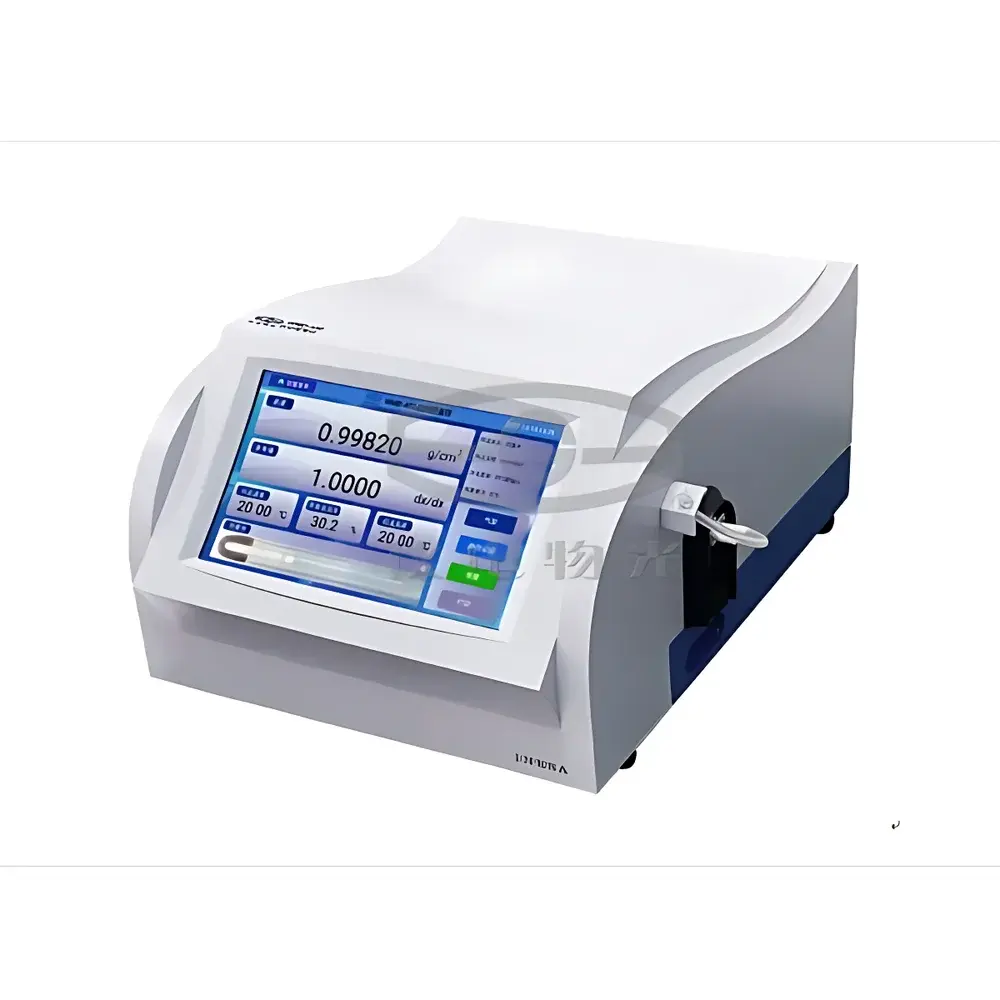
YDWG WMD-430 Video-Assisted Oscillating U-Tube Digital Density Meter
| Brand | YDWG |
|---|---|
| Origin | Shanghai, China |
| Model | WMD-430 |
| Instrument Type | Benchtop Laboratory Digital Densimeter |
| Measurement Principle | Oscillating U-Tube |
| Sample Type | Liquids |
| Density Range | 0.00000–3.00000 g/cm³ |
| Density Accuracy | ±0.0005 g/cm³ |
| Density Repeatability | ±0.0002 g/cm³ |
| Resolution | 0.0001 g/cm³ |
| Temperature Control Range | 15–40 °C (extendable to 5–70 °C per spec) |
| Temperature Accuracy | ±0.2 °C |
| Temperature Resolution | 0.01 °C |
| Minimum Sample Volume | 2–3 mL |
| Display | 10.1″ Android-based color touchscreen |
| Imaging | Integrated HD video camera for real-time sample injection monitoring |
| Calibration Standards | Dry air and distilled water |
| Data Storage | 64 GB internal |
| Connectivity | RS232, 3×USB, RJ-45 Ethernet |
| Compliance | ASTM D4052-11, ASTM D5002-13, ASTM D3505-12e1, ISO 12185:1996, GB/T 29617–2013, GB/T 2013–2010, SH/T 0604–2000, SN/T 2383–2009 |
Overview
The YDWG WMD-430 Video-Assisted Oscillating U-Tube Digital Density Meter is a precision benchtop instrument engineered for high-accuracy, traceable density determination of liquid samples in regulated and research laboratory environments. It operates on the fundamental physical principle of oscillating U-tube densimetry: a precisely manufactured borosilicate glass U-tube is electromagnetically excited into resonance; the natural frequency of oscillation shifts proportionally with the mass of the sample filling the tube. By correlating measured frequency against factory-calibrated reference data—traceable to NIST-certified standards—the instrument computes density with metrological rigor. Unlike hydrostatic or pycnometric methods, this technique eliminates operator-dependent variables such as meniscus reading error or thermal expansion correction uncertainty. The WMD-430 integrates real-time HD video observation of sample injection directly into its Android-based UI, enabling visual confirmation of bubble-free filling and meniscus positioning—a critical step for reproducibility in high-precision applications.
Key Features
- Real-time HD video-assisted sample injection monitoring via integrated 1080p camera, synchronized with touchscreen interface for immediate visual verification of fill quality and absence of entrapped air.
- High-stability Peltier temperature control system with ±0.2 °C accuracy across 5–70 °C range, ensuring compliance with temperature-sensitive test protocols (e.g., ASTM D4052 requires measurement at 15–30 °C; ISO 12185 specifies 15–25 °C).
- Four-tier user management architecture supporting role-based access control (RBAC), electronic signatures, and optional FDA 21 CFR Part 11-compliant audit trail module for GLP/GMP environments.
- Dual-mode operation: rapid screening mode (<15 s per measurement) for process checks, and high-accuracy mode (<60 s) with extended averaging and temperature equilibration for certification-grade reporting.
- Multi-standard unit support: g/cm³, kg/m³, relative density (d420, d2020, d2525), API gravity, and customizable formula entry for industry-specific conversions (e.g., Brix–density, ethanol–water tables).
- 64 GB internal flash storage with timestamped, user-annotated measurement records exportable as PDF or Excel files via USB, Ethernet, or optional Wi-Fi printer integration.
Sample Compatibility & Compliance
The WMD-430 accommodates a broad spectrum of Newtonian and mildly non-Newtonian liquids—including volatile solvents, viscous oils, aqueous solutions, and corrosive reagents—within its validated density range (0.00000–3.00000 g/cm³). Its inert U-tube construction resists chemical degradation from common organic and inorganic media. The instrument meets or exceeds requirements of major international standards: ASTM D4052-11 (digital density meters), ISO 12185:1996 (oscillating U-tube method for crude oil and petroleum products), GB/T 29617–2013 (Chinese national standard for digital density meters), and SH/T 0604–2000 (petroleum product density testing). For pharmaceutical applications, it supports USP density requirements when operated under validated conditions with documented calibration history and audit-trail-enabled software.
Software & Data Management
Running on a certified Android 9.0 OS, the embedded software provides intuitive workflow navigation, context-sensitive help, and configurable report templates compliant with ISO/IEC 17025 documentation requirements. All measurements are automatically time-stamped, associated with operator ID, and logged with environmental metadata (temperature, ambient pressure if external sensor connected). The system supports CSV/Excel batch export, direct network printing, and secure remote diagnostics via encrypted Ethernet connection. Optional audit-trail firmware enables full traceability of all user actions—including method edits, calibration events, and result deletions—in accordance with FDA 21 CFR Part 11 and EU Annex 11 regulations.
Applications
- Beverage & Food Quality Control: Brix concentration mapping in fruit juices (GB/T 15038–2006), density-based adulteration screening in olive oil (GB 5526–1985), and ethanol content verification in alcoholic beverages (GB/T 10345–2007, GB/T 4928–2008).
- Petrochemical Process Monitoring: API gravity calculation per ASTM D1250, diesel blend ratio validation, and crude oil density grading per SH/T 0604–2000.
- Pharmaceutical Manufacturing: Raw material identity testing (USP monographs), excipient density qualification, and batch release testing of liquid dosage forms per ICH Q5C stability guidelines.
- Chemical Production: Concentration monitoring of ethylene glycol, caustic soda, ammonia solution, and urea solutions per GB/T 6324.7–2014 and ASTM D3505–12e1.
- Regulatory Testing: Accredited testing in CNAS-certified labs for food safety (GB/T 5009.2–2016), customs inspection (SN/T 2383–2009), and environmental analysis of industrial effluents.
FAQ
What calibration standards are required for daily verification?
Dry air and freshly boiled, cooled distilled water are sufficient for two-point calibration per ASTM D4052. Certified density reference fluids (e.g., NIST SRM 2820) may be used for performance qualification.
Can the WMD-430 measure samples with suspended solids or particulates?
No—U-tube densimeters require optically clear, homogeneous, bubble-free liquids. Suspended particles may clog the 2.5 mm internal diameter tube or induce damping artifacts. Filtration or centrifugation is mandatory prior to analysis.
Is temperature equilibration time included in the stated measurement cycle?
Yes—the specified measurement duration (e.g., 60 s in precision mode) includes full thermal stabilization of the sample within the U-tube cavity, verified by the integrated Pt100 sensor with 0.01 °C resolution.
How is data integrity ensured during power interruption?
All active measurements are buffered in non-volatile RAM; the system auto-resumes logging upon restart without data loss. Critical calibration constants are stored in write-protected memory sectors.
Does the instrument support automated sample handling?
Manual injection is standard; an optional external autosampler (YDWG AS-200) can be interfaced via RS232 to enable unattended sequential analysis of up to 48 vials.



