
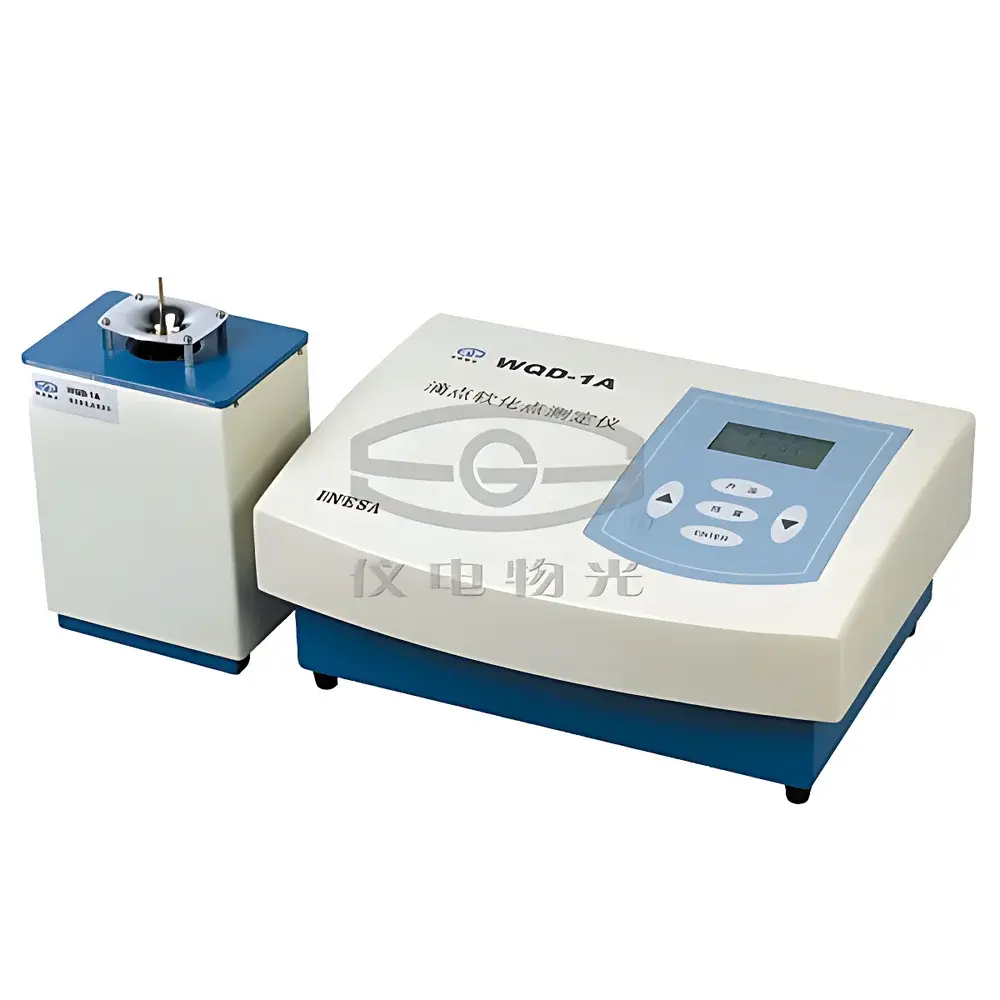
YDWG WQD-1A Dropping Point & Softening Point Tester
| Brand | YDWG |
|---|---|
| Origin | Shanghai, China |
| Model | WQD-1A |
| Temperature Range | Ambient to 300 °C |
| Heating Rate | 0.2–5.0 °C/min (8 selectable steps) |
| Temperature Repeatability | ±0.1 °C |
| Temperature Accuracy | ±0.1 °C (at calibration point) |
| Temperature Resolution | 0.1 °C |
| Capillary Tube Diameter | 1 mm (standard) |
| Sample Capacity | 1 position |
| Display | LCD |
| Power Supply | 220 V ±10%, 50 Hz, 100 W |
| Dimensions (Electronic Unit) | 400 × 300 × 160 mm |
| Dimensions (Detection Unit) | 155 × 110 × 230 mm |
| Net Weight | 10 kg |
| Compliance | Designed per ASTM D3461–97 |
Overview
The YDWG WQD-1A Dropping Point & Softening Point Tester is a precision thermal analysis instrument engineered for the standardized determination of dropping point and ring-and-ball softening point of non-crystalline organic materials. It operates on the principle of controlled linear heating combined with real-time optical detection of sample deformation or flow onset—enabling unambiguous identification of the temperature at which a material transitions from solid-like to fluid-like behavior under defined thermal stress. Unlike manual capillary methods or classical metal-ring apparatuses, the WQD-1A integrates automated temperature ramping, high-resolution digital thermometry, and visual endpoint confirmation via integrated optics, eliminating operator-dependent interpretation errors. Its design adheres to the procedural framework of ASTM D3461–97 for dropping point determination and supports equivalent evaluation of softening behavior in accordance with ISO 4625 and ASTM D36 (ring-and-ball method adaptations). The system is optimized for routine QC/QA laboratories in petrochemicals, pharmaceuticals, cosmetics, and polymer manufacturing where reproducible thermal transition data are critical for raw material qualification, batch release, and formulation stability assessment.
Key Features
- Eight-step programmable heating rate (0.2–5.0 °C/min), enabling method flexibility across diverse sample matrices—from low-melting waxes to high-softening-point resins.
- Digital PID temperature control with ±0.1 °C repeatability and traceable accuracy (±0.5 °C up to 200 °C; ±1.0 °C above), verified against NIST-traceable reference standards.
- High-contrast LCD interface with intuitive menu navigation, real-time temperature curve display, and automatic endpoint logging.
- Single-position sample chamber with standardized 1 mm internal diameter capillary tube configuration—compatible with ASTM D3461-compliant sample preparation protocols.
- Modular mechanical architecture: compact electronic control unit (400 × 300 × 160 mm) paired with a dedicated optical detection module (155 × 110 × 230 mm), facilitating benchtop integration and service accessibility.
- Energy-efficient operation (100 W nominal load) with robust thermal shielding and fail-safe overtemperature cutoff (320 °C hardware limit).
Sample Compatibility & Compliance
The WQD-1A is validated for use with thermally sensitive, non-crystalline substances exhibiting broad glass transitions or gradual softening behavior—including bituminous binders (asphalt, coal tar), hydrocarbon-based greases and lubricants (lithium, calcium sulfonate), natural and synthetic resins, pharmaceutical ointments (e.g., PEG-based suppositories), cosmetic emulsions (vanishing creams, cold creams), edible fats and oils (cocoa butter analogs, hydrogenated vegetable shortenings), and rosin derivatives. All testing procedures align with documented laboratory practices under GLP conditions. While the instrument itself does not provide full 21 CFR Part 11 compliance (e.g., electronic signatures, audit trail encryption), its deterministic measurement logic, fixed calibration intervals, and immutable endpoint recording support data integrity requirements for internal QA documentation and regulatory submissions where raw thermal transition values are secondary endpoints.
Software & Data Management
The WQD-1A operates as a standalone embedded system with no external PC dependency. Measurement data—including start time, ramp rate, observed dropping/softening temperature, and final stabilized reading—are stored in non-volatile memory (100-test capacity) and exportable via RS-232 serial interface (optional cable required) for integration into LIMS or Excel-based reporting workflows. Timestamped records include instrument ID, operator code (manually entered), and environmental ambient temperature (measured via internal sensor). Calibration history (date, standard used, deviation recorded) is retained separately and accessible through service mode. For laboratories requiring enhanced traceability, optional firmware upgrade paths support CSV-formatted output with ISO 8601 timestamps and UTC synchronization.
Applications
- Quality control of asphalt binders per AASHTO T 58 and EN 1427 for road construction specifications.
- Batch-to-batch consistency verification of pharmaceutical semi-solids (USP <721> softening range guidance).
- Thermal stability screening of polymer additives during R&D formulation cycles.
- Specification conformance testing of industrial lubricating greases (NLGI grade correlation).
- Raw material acceptance testing for edible oil hydrogenation intermediates and cocoa butter replacers.
- Educational use in university polymer science and materials engineering labs for fundamental thermal transition studies.
FAQ
What standards does the WQD-1A comply with?
It is designed and verified per ASTM D3461–97 for dropping point and functionally supports softening point determinations aligned with ISO 4625 and ASTM D36 methodologies.
Can the instrument be calibrated in-house?
Yes—using certified reference materials (e.g., indium, tin, zinc melting point standards) and following the built-in calibration routine; full calibration certificate generation requires external metrology lab validation.
Is multi-sample throughput possible?
No—the WQD-1A is a single-position instrument optimized for precision rather than parallelism; sequential analysis is supported via rapid cooldown (<15 min from 300 °C to ambient with forced air assist).
Does it support GLP-compliant data archiving?
Basic GLP elements (operator ID, timestamp, instrument ID, calibration status) are captured; full audit trail and electronic signature capability require integration with third-party LIMS or document management systems.
What maintenance is required?
Annual thermocouple verification, optical path cleaning (lens and capillary viewport), and heater block inspection for carbon residue—detailed in the English-language service manual supplied with each unit.



