
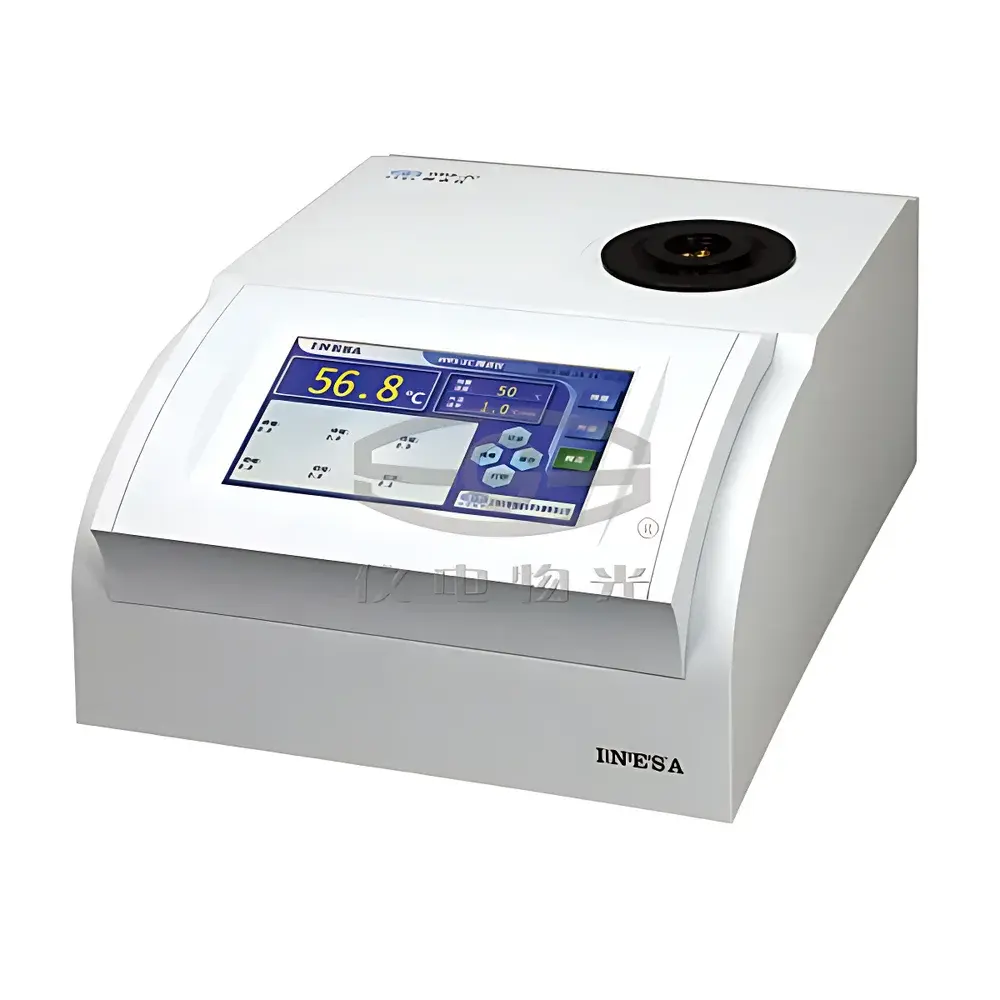
YDWG WRS-2C Automatic Melting Point Apparatus
| Brand | YDWG |
|---|---|
| Origin | Shanghai, China |
| Model | WRS-2C |
| Temperature Range | Ambient to 360 °C |
| Heating Rate | 0.1–20 °C/min (continuously adjustable) |
| Temperature Repeatability | ±0.3 °C (at 0.1 °C/min) |
| Temperature Accuracy | ±0.4 °C ≤200 °C |
| Capillary Dimensions | OD 1.4 mm, ID 1.0 mm, Length 90 mm |
| Sample Capacity | 3 capillaries simultaneously |
| Temperature Resolution | 0.1 °C |
| Display | 7-inch color TFT touchscreen |
| Data Storage | 1000 test records |
| Interface | RS232 and USB |
| Power Supply | 220 V ±22 V, 50 Hz ±1 Hz, 120 W |
| Dimensions | 360 × 290 × 170 mm |
| Net Weight | 9 kg |
Overview
The YDWG WRS-2C Automatic Melting Point Apparatus is a precision thermal analysis instrument engineered for reliable, reproducible determination of melting point ranges in solid organic compounds, pharmaceuticals, polymers, and reference standards. It operates on the principle of optical detection of phase transition—specifically, the onset and completion of solid-to-liquid transformation—as observed through real-time transmission photometry across a heated capillary tube. The system employs a high-stability platinum resistance thermometer (Pt100) as the primary temperature sensor, coupled with PID-based closed-loop control and PWM-driven heating regulation to ensure linear, stable, and repeatable thermal ramps. Designed in full compliance with pharmacopoeial requirements—including Chinese Pharmacopoeia (ChP), United States Pharmacopeia (USP <741>), and European Pharmacopoeia (Ph. Eur. 2.2.17)—the WRS-2C utilizes standardized 1.0 mm internal diameter capillaries (90 mm length, 1.4 mm OD) and supports simultaneous analysis of three independent samples per run. Its ambient-to-360 °C operating range accommodates both low-melting excipients and high-melting active pharmaceutical ingredients (APIs) or specialty chemicals.
Key Features
- Automated optical detection of initial and final melt transitions with real-time graphical display of melting curves on a 7-inch color TFT touchscreen
- PID + PWM temperature control architecture delivering exceptional thermal stability and ramp linearity (±10% deviation tolerance per USP <741>)
- Adjustable heating rate from 0.1 to 20 °C/min in 0.1 °C/min increments—enabling method optimization for crystalline purity assessment or polymorph screening
- Multi-point temperature calibration function supporting traceable verification against NIST-traceable reference standards
- Onboard data storage for up to 1000 complete test records, including date/time stamp, heating rate, observed onset/offset temperatures, and curve metadata
- Dual communication interfaces (RS232 and USB) for seamless integration into laboratory information management systems (LIMS) or electronic lab notebooks (ELN)
- Pre-programmed support for eight user-defined measurement protocols, facilitating rapid method recall and SOP-driven operation
Sample Compatibility & Compliance
The WRS-2C accepts standard pharmacopoeial capillaries (1.0 mm ID, 1.4 mm OD, 90 mm length) with sample loading height controlled at 3 mm—ensuring consistent heat transfer and minimizing superheating artifacts. It is validated for use with crystalline solids exhibiting sharp or broad melting transitions, including APIs, intermediates, chiral compounds, and polymer additives. Instrument performance meets critical regulatory expectations: temperature accuracy and repeatability conform to USP <741> and Ph. Eur. 2.2.17 acceptance criteria for melting point apparatus qualification. All stored data include immutable timestamps and operator IDs (when configured via external authentication), supporting audit readiness under GLP and GMP environments. While the device itself does not provide 21 CFR Part 11-compliant electronic signatures, its RS232/USB output enables secure data export to validated software platforms that do.
Software & Data Management
Data acquisition and reporting are managed entirely through the embedded firmware interface; no proprietary PC software is required for basic operation. However, raw temperature-vs.-transmittance datasets and summary results (onset, offset, range width) can be exported in CSV format via USB flash drive or serial transmission. The system logs full thermal profiles—including time-resolved analog photodiode signals—allowing post-acquisition re-evaluation of melt thresholds using derivative-based algorithms if needed. All parameters—including heating rate, target hold time, and auto-stop conditions—are configurable and retained after power cycling. Firmware supports firmware-upgradable functionality, ensuring long-term compatibility with evolving pharmacopoeial updates and laboratory IT infrastructure requirements.
Applications
- Quality control release testing of pharmaceutical raw materials and finished dosage forms per ICH Q5A and Q6A guidelines
- Polymorph identification and stability monitoring during accelerated storage studies
- Verification of compound identity and purity in synthetic chemistry laboratories
- Educational demonstrations of thermal phase behavior in university analytical chemistry curricula
- Regulatory submission support—data generated are acceptable for inclusion in ANDA, NDA, and DMF dossiers when operated under documented SOPs
- Material characterization in fine chemical and agrochemical R&D, particularly for thermally sensitive crystalline actives
FAQ
Does the WRS-2C comply with USP <741> requirements for melting point instrumentation?
Yes—the instrument’s temperature accuracy (±0.4 °C ≤200 °C), repeatability (±0.3 °C at 0.1 °C/min), and heating rate linearity meet all mandatory performance criteria specified in USP General Chapter <741>.
Can the WRS-2C be used for eutectic mixture analysis?
Yes—its high-resolution optical detection (0.1 °C) and real-time curve visualization allow clear differentiation between sharp single-phase melts and depressed, broadened transitions characteristic of eutectic systems.
Is calibration traceable to national standards?
The multi-point calibration routine supports use of certified reference materials (e.g., NIST SRM 742b, 1507a); users must maintain calibration records per ISO/IEC 17025 or internal QA procedures.
What is the maximum recommended sample load height in the capillary?
3 mm—this dimension is fixed by pharmacopoeial guidance to ensure uniform heat conduction and minimize temperature gradients within the sample column.
Does the instrument support GLP-compliant audit trails?
While the standalone unit does not generate electronic audit trails, its timestamped, operator-tagged data exports integrate fully with validated LIMS or ELN platforms that enforce 21 CFR Part 11 compliance.
Related Products



