
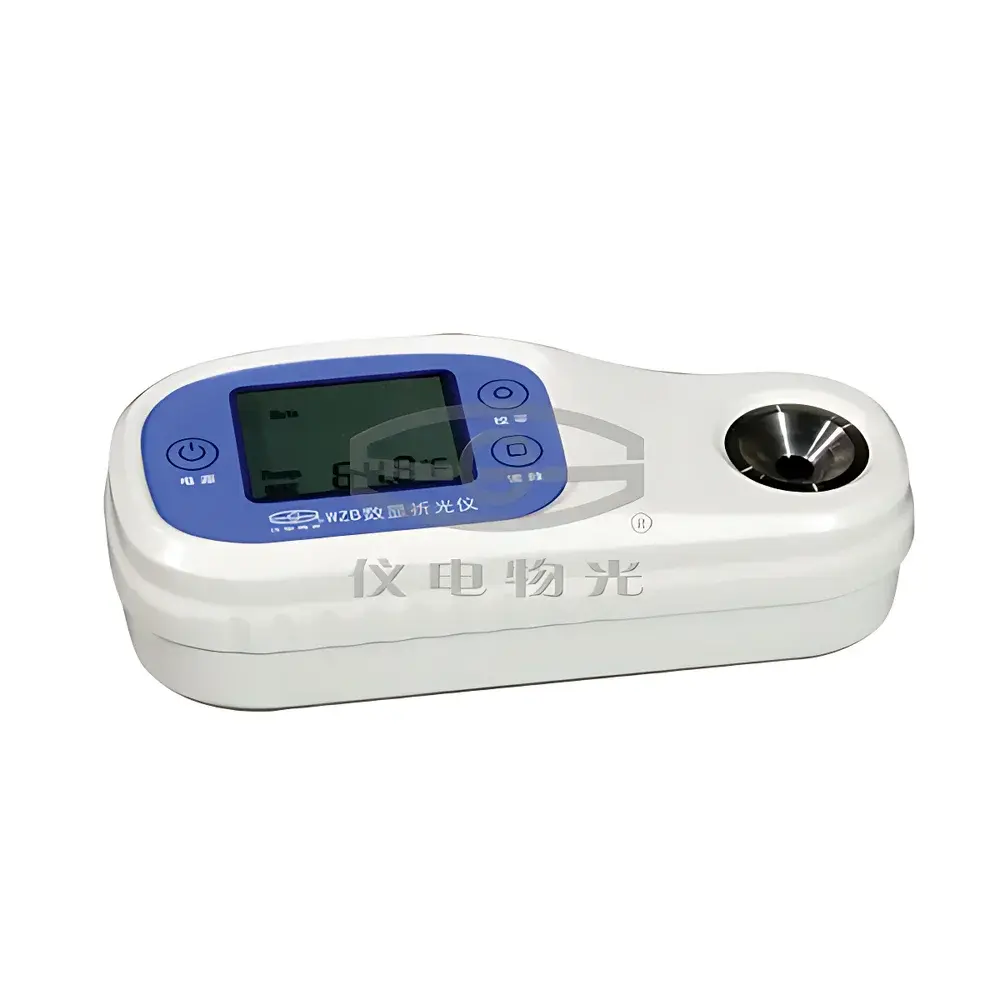
YDWG WZB Series Portable Digital Refractometer
| Brand | YDWG |
|---|---|
| Origin | Shanghai, China |
| Product Type | Handheld Refractometer |
| Display | LCD digital |
| Measurement Principle | Critical-angle refractometry |
| Auto Temperature Compensation (ATC) | Yes |
| Auto Power-Off | Yes |
| Battery Low Warning | Yes |
| Unit Conversion | °C / °F |
| Measurement Range | Brix 0–92%, Refractive Index 1.3300–1.5233, Salinity 0–28%, Urine Specific Gravity 1.000–1.060, Alcohol 0–60% v/v or w/w, Honey Moisture (IHC2002/GB), Serum Protein 0–14 g/dL, Glycol Concentration, Battery Electrolyte, Soy Milk Solids |
| Resolution | 0.1% (Brix), 0.001 (SG), 0.0001 (RI) |
| Accuracy | ±0.2% Brix (typical), ±0.0003 RI (typical) |
| Operating Life | >10,000 measurements per charge |
Overview
The YDWG WZB Series Portable Digital Refractometer is a precision handheld optical instrument engineered for rapid, field-deployable measurement of refractive index and derived concentration units across diverse liquid samples. Based on the principle of critical-angle refractometry—where incident light undergoes total internal reflection at the prism-sample interface—the device calculates refractive index (nD) with high reproducibility and minimal operator dependency. Unlike analog Abbe refractometers requiring visual scale interpretation, the WZB Series employs a calibrated photodiode array and embedded microprocessor to convert angular deviation into digital output, eliminating parallax error and subjective judgment. Its compact, ergonomic housing (dimensions: ~150 × 70 × 40 mm; weight: <200 g) enables pocket-portability without compromising optical stability. The instrument operates across ambient temperatures of 10–40 °C and incorporates built-in Automatic Temperature Compensation (ATC) using a high-stability thermistor adjacent to the sapphire prism surface, ensuring traceable readings referenced to 20 °C per ISO 21748 and ASTM D1218 standards.
Key Features
- High-resolution LCD display with backlight for low-light environments and dual-unit readout (e.g., Brix % and nD simultaneously)
- Optically polished sapphire measuring prism (Vickers hardness ≥1800 HV) resistant to scratching and chemical corrosion from acids, alkalis, and organic solvents
- ATC algorithm compliant with ISO 21748 Annex A, compensating for sample temperature drift within ±0.5 °C accuracy across 10–40 °C range
- Rechargeable lithium-ion battery supporting >10,000 consecutive measurements per full charge; auto power-off after 3 minutes of inactivity
- Integrated battery-level indicator and low-power warning alert prior to shutdown
- One-touch unit switching between °C/°F, and application-specific modes (e.g., Brix → Salinity → Urine SG → Ethanol %) via intuitive membrane keypad
- No calibration fluid required beyond standard sucrose solutions (e.g., 10%, 30%, 50% w/w); factory-calibrated against NIST-traceable reference materials
Sample Compatibility & Compliance
The WZB Series accommodates aqueous and semi-viscous liquids with surface tension >25 mN/m and viscosity <500 cP—including fruit juices, honey, soft drinks, brines, antifreeze coolants, urine, serum, soy milk, battery electrolytes, and wine must. It is unsuitable for volatile, highly viscous, or suspended-particle-laden samples without pre-filtration. All models comply with CE marking requirements for electromagnetic compatibility (EN 61326-1) and safety (EN 61010-1). While not certified for IVD use under EU IVDR or FDA 510(k), the instruments support GLP/GMP-aligned workflows through documented calibration logs, user-accessible firmware versioning, and non-volatile memory retention of last-used parameters. ATC validation reports and factory calibration certificates (traceable to NIM, China) are available upon request for audit readiness.
Software & Data Management
The WZB Series operates as a standalone instrument with no PC connectivity or proprietary software dependency. All configuration, mode selection, and unit conversion occur locally via the front-panel interface. Measurement history is not stored—consistent with ISO/IEC 17025 Clause 7.7.2 requirements for instruments used in accredited testing where data integrity relies on contemporaneous manual recording. However, the consistent 3-second response time and unambiguous digital output facilitate direct transcription into LIMS or electronic lab notebooks (ELN) compliant with 21 CFR Part 11 when paired with validated entry protocols. Firmware updates (if released) are delivered via USB-C service port only by authorized YDWG service centers—not end-user modifiable—to preserve metrological integrity.
Applications
- Food & Beverage QC: Brix verification in juice concentrate, jam fillings, and soft drink syrups per AOAC 932.12 and ISO 2173
- Honey Analysis: Simultaneous Brix, water content (IHC2002/GB), and HMF estimation via correlation tables per Codex Alimentarius STAN 12-1981
- Clinical Screening: Urine specific gravity (USG) and serum protein screening in veterinary clinics (dog/cat modes per CVMA guidelines) and point-of-care labs
- Automotive Maintenance: Ethylene glycol and propylene glycol concentration in engine coolant, battery electrolyte density assessment
- Alcohol Production: Rapid ethanol estimation in distillate fractions (v/v or w/w) during craft brewing and winemaking
- Quality Auditing: Incoming raw material checks (e.g., sugar syrup concentration, salt brine strength) in contract manufacturing facilities
FAQ
Does the WZB Series require periodic recalibration?
Yes—annual recalibration against NIST-traceable sucrose standards is recommended for ISO/IEC 17025 compliance. Field verification using 0% and 30% Brix control solutions should be performed before each shift.
Can the instrument measure turbid or particulate samples?
No. Suspended solids scatter incident light and invalidate critical-angle detection. Centrifugation or filtration is mandatory for cloudy samples such as unfiltered apple cider or whey.
Is the prism surface chemically resistant to cleaning agents?
The sapphire prism tolerates isopropyl alcohol, distilled water, and mild detergent solutions. Avoid acetone, chlorinated solvents, or abrasive cloths that may degrade anti-reflective coatings.
What is the warranty coverage and service support structure?
YDWG provides a 12-month limited warranty covering material and workmanship defects. Technical support and accredited recalibration services are available through YDWG’s Shanghai Service Center and authorized global partners.
How does ATC function without external temperature probes?
An integrated platinum thermistor mounted directly beneath the prism measures thermal equilibrium at the optical interface in real time, applying polynomial correction per ISO 21748 Annex A—no user input required.





