
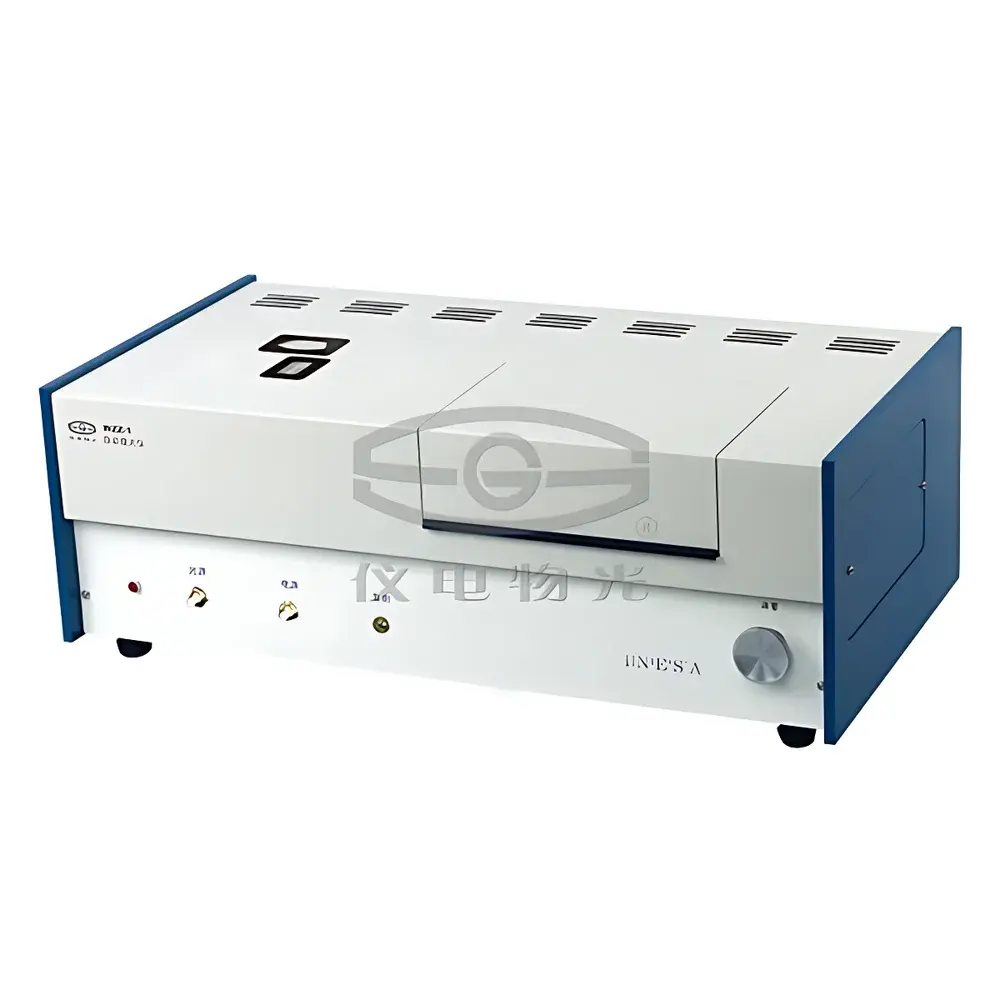
YDWG WZZ-1 Automatic Polarimeter
| Brand | YDWG |
|---|---|
| Origin | Shanghai, China |
| Model | WZZ-1 |
| Instrument Type | Automatic Polarimeter |
| Light Source | Sodium Lamp (589 nm) |
| Measurement Range | ±45° (optical rotation) |
| Minimum Scale Division | 0.001° |
| Accuracy Class | 0.05 |
| Permissible Error | ±(0.01 + 0.05% of reading)° |
| Repeatability (Std. Dev. δ) | ≤0.01° |
| Sample Transmittance Requirement | ≥10% |
| Power Supply | 220 V ±22 V, 50 Hz ±1 Hz, 150 W |
| Dimensions (L×W×H) | 605 × 320 × 220 mm |
| Net Weight | 26 kg |
| Temperature Control | None |
| Display | Analog scale dial (no digital readout) |
| Standard Cells | 100 mm and 200 mm path-length glass tubes |
Overview
The YDWG WZZ-1 Automatic Polarimeter is a precision optical instrument engineered for the quantitative measurement of optical rotation — the angular deflection of plane-polarized light induced by chiral substances in solution. Based on the classical principle of polarimetry, the WZZ-1 employs a sodium lamp (λ = 589.3 nm) as its monochromatic light source, ensuring compliance with standard reference conditions defined in pharmacopoeial methods (e.g., USP , EP 2.2.7, and ChP IV). Unlike manual or semi-automatic polarimeters requiring visual interpolation, the WZZ-1 integrates a photoelectric detection system coupled with an automatic mechanical indexing mechanism that drives the analyzer until null-balance is achieved, then positions a calibrated scale dial to indicate the measured rotation angle. This design eliminates observer parallax and significantly improves measurement reproducibility for low-rotation samples — particularly valuable in quality control of pharmaceutical intermediates, fine chemicals, and natural product extracts where rotation values may fall below ±0.1°.
Key Features
- Photoelectric null-balance detection system ensures objective, operator-independent endpoint determination
- Mechanically driven analog scale dial with 0.001° minimum division for direct visual readout — optimized for routine QC environments where digital interfaces are unnecessary or discouraged
- Dual-standard sample cell compatibility: includes both 100 mm and 200 mm path-length cells to accommodate concentration-dependent measurement requirements per ICH Q5C and USP general chapter <781>
- High-stability sodium vapor lamp with narrow spectral bandwidth (589.3 nm D-line), meeting ISO 13807:2019 requirements for reference wavelength accuracy in polarimetric calibration
- Rugged cast-metal optical bench and vibration-damped base structure enhance long-term alignment stability under laboratory bench conditions
- No active temperature regulation — intended for use in climate-controlled laboratories (20–25 °C, ±1 °C) where ambient thermal drift is minimized per GLP-compliant measurement protocols
Sample Compatibility & Compliance
The WZZ-1 supports transparent liquid samples with minimum transmittance ≥10% at 589 nm, accommodating common solvents such as water, ethanol, chloroform, and acetone. It is routinely deployed in accordance with pharmacopeial monographs requiring optical rotation verification — including assays for sucrose, glucose, fructose, camphor, nicotine, and numerous amino acids. While not equipped with Peltier-based thermostatic control, its mechanical and optical architecture conforms to the baseline performance criteria outlined in ISO 13807:2019 for “polarimeters used in routine analysis.” Its 0.05 accuracy class certifies conformance with national metrological verification regulations (JJG 536–2015 in China), and its error specification (±0.01° + 0.05% of reading) satisfies typical acceptance thresholds for non-GMP release testing in API manufacturing and botanical extract standardization.
Software & Data Management
The WZZ-1 operates as a standalone analog instrument with no embedded microprocessor, USB interface, or data logging capability. All measurements are recorded manually by the analyst directly from the scale dial. This architecture intentionally avoids electronic data handling, making it suitable for laboratories maintaining strict separation between regulated analytical instruments and IT infrastructure — especially where 21 CFR Part 11 compliance is managed via procedural controls rather than electronic audit trails. Calibration records, verification checks (e.g., quartz control plates), and daily system suitability tests are documented in paper-based or LIMS-integrated logbooks per internal SOPs aligned with ISO/IEC 17025:2017 clause 7.7.
Applications
- Pharmaceutical QC: Identity confirmation and assay of optically active APIs (e.g., levofloxacin, L-DOPA, escitalopram)
- Sugar industry: Brix-corrected polarization measurements for sucrose content in cane and beet syrups (in accordance with ICUMSA Method GS5-12)
- Food & flavor chemistry: Enantiomeric purity assessment of limonene, carvone, and menthol in essential oils
- Academic teaching labs: Fundamental demonstration of molecular chirality, Fresnel’s theory, and optical activity principles
- Contract testing labs: Cost-effective platform for routine optical rotation reporting where full digital traceability is not mandated
FAQ
Does the WZZ-1 support temperature-controlled measurements?
No. The instrument lacks integrated temperature regulation and must be operated in a stable ambient environment (20–25 °C) with minimal air currents.
Can the WZZ-1 measure samples with very low optical rotation?
Yes. Its photoelectric null-detection system provides superior sensitivity over visual polarimeters, enabling reliable measurement down to ±0.01° under optimal lighting and sample clarity conditions.
Is the sodium lamp user-replaceable?
Yes. The lamp assembly is designed for field replacement using standard M12 socket sodium lamps compliant with IEC 60064 specifications.
What calibration standards are recommended for routine verification?
Quartz rotatory plates certified to ±0.005° (e.g., NIST SRM 8500 series) or sucrose solutions prepared per USP are recommended for daily system suitability checks.
Does the WZZ-1 comply with pharmacopeial requirements?
Yes — its optical configuration, wavelength, and accuracy class meet the instrumental prerequisites specified in USP , EP 2.2.7, and ChP IV for optical rotation determination, provided environmental and procedural controls are maintained.




