
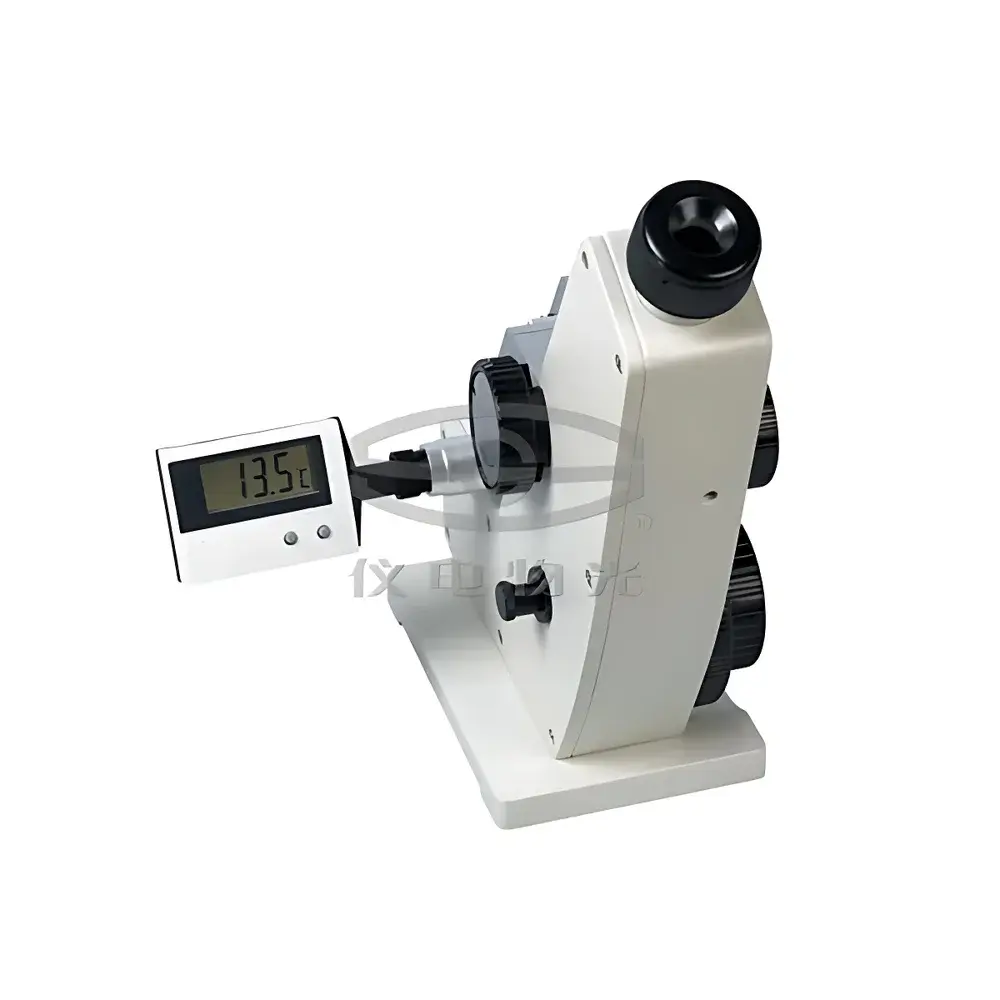
YDWO WYA Abbe Refractometer (Monocular)
| Brand | YDWO (Yidian Woguang) |
|---|---|
| Origin | Shanghai, China |
| Model | WYA |
| Type | Benchtop Abbe Refractometer |
| Display | Digital temperature readout & optical scale reading |
| Measurement Range (nD) | 1.3000–1.7000 |
| Brix Range | 0–95% |
| Accuracy (nD) | ±0.0002 (estimated reading) |
| Mean Dispersion Indication | ±0.0005 |
| Temperature Display | Digital thermometer |
| Viewing Method | Monocular |
| Dimensions | 130 mm × 90 mm × 240 mm |
| Net Weight | 2 kg |
| Construction | Stainless steel base, hardened optical glass prisms |
| Thermal Integration | Integrated flow cell compatible with external thermostatic water bath |
Overview
The YDWO WYA Abbe Refractometer (Monocular) is a precision benchtop optical instrument engineered for accurate determination of refractive index (nD) and related concentration parameters—such as Brix, % w/w, or molar fraction—in transparent or translucent liquid and semi-liquid samples. Based on the classical Abbe principle, it operates by measuring the critical angle of total internal reflection at the interface between a high-refractive-index prism and the sample under test. This method provides direct, non-destructive, and operator-independent quantification of optical density, making it indispensable in quality control laboratories across food & beverage, pharmaceutical, chemical, and petrochemical industries. Unlike digital automatic refractometers, the WYA retains a manually aligned optical scale and monocular viewing system—offering mechanical robustness, long-term calibration stability, and minimal electronic dependency. Its stainless steel chassis and hardened optical glass prisms ensure resistance to mechanical wear and chemical exposure during routine use.
Key Features
- Optical measurement path compliant with ISO 21147:2022 and ASTM D1218–20 standards for refractometric analysis
- Digital temperature display integrated into the base unit, enabling real-time ambient temperature monitoring during manual operation
- High-stability Abbe prism assembly fabricated from optical-grade hardened glass (BK7 equivalent), minimizing surface abrasion and maintaining long-term angular accuracy
- Stainless steel main frame and base structure for dimensional stability and corrosion resistance in laboratory environments
- Integrated flow cell design allows seamless connection to external thermostatic water baths (e.g., Julabo or Huber units) for temperature-controlled measurements at defined setpoints (e.g., 20 °C or 25 °C)
- Calibration verification via certified reference standards (e.g., distilled water at 20 °C: nD = 1.3330; bromonaphthalene: nD = 1.6584)
Sample Compatibility & Compliance
The WYA accommodates homogeneous, optically clear liquids—including aqueous solutions, organic solvents, oils, syrups, and glycerol-based formulations—with viscosity up to approximately 500 mPa·s. Samples must be free of suspended particulates or air bubbles to avoid scattering-induced measurement deviation. While the instrument itself lacks built-in Peltier temperature control, its flow cell enables compliance with temperature-sensitive test protocols specified in USP , EP 2.2.12, and AOAC Official Methods of Analysis®. The absence of embedded electronics ensures full compatibility with GLP/GMP documentation workflows requiring audit-ready manual entry and traceable calibration logs.
Software & Data Management
As a manually operated optical instrument, the WYA does not incorporate onboard data logging or proprietary software. All measurements are recorded manually by the operator using the engraved optical scale and digital temperature readout. This architecture supports strict regulatory environments where electronic records require validation per FDA 21 CFR Part 11; in such settings, users typically document results in validated LIMS or paper-based lab notebooks with dual-signature verification. Calibration certificates, standard reference material lot numbers, and environmental conditions (e.g., room temperature, humidity) are maintained separately to fulfill ISO/IEC 17025 clause 7.7 requirements for measurement traceability.
Applications
- Concentration verification of sucrose solutions in juice, soft drink, and honey production (Brix 0–95%)
- Quality assurance of ethylene glycol and propylene glycol antifreeze mixtures
- Batch release testing of pharmaceutical excipients (e.g., sorbitol, glycerin) per pharmacopoeial monographs
- Refractive index profiling of essential oils and fragrance compounds during distillation
- Educational demonstration of dispersion relationships and Cauchy equation fitting in undergraduate physics and analytical chemistry labs
FAQ
Does the WYA support automatic temperature compensation (ATC)?
No. The WYA features a digital temperature display but no ATC mechanism. Users must regulate sample temperature externally using a circulating water bath connected to the integrated flow cell.
Can the instrument measure opaque or turbid samples?
No. The Abbe principle requires optical transparency at the prism-sample interface. Suspended solids, emulsions, or highly scattering media will yield unreliable or unmeasurable readings.
What calibration standards are recommended for routine verification?
Distilled water at 20 °C (nD = 1.3330) and certified bromonaphthalene (nD = 1.6584 at 20 °C) are standard references. Calibration should be performed before each analytical session per ISO 8655-6 guidelines.
Is the optical scale readable without magnification?
Yes—the engraved scale is optimized for direct monocular observation with standard visual acuity. A supplementary magnifier is optional but not required for nominal resolution (0.0002 nD).
How frequently should prism cleaning and maintenance be performed?
Prisms should be cleaned with lens-grade tissue and reagent-grade ethanol or acetone immediately after each sample measurement to prevent residue buildup and refractive index drift. Annual inspection of mechanical alignment and scale zero-point is advised.





