
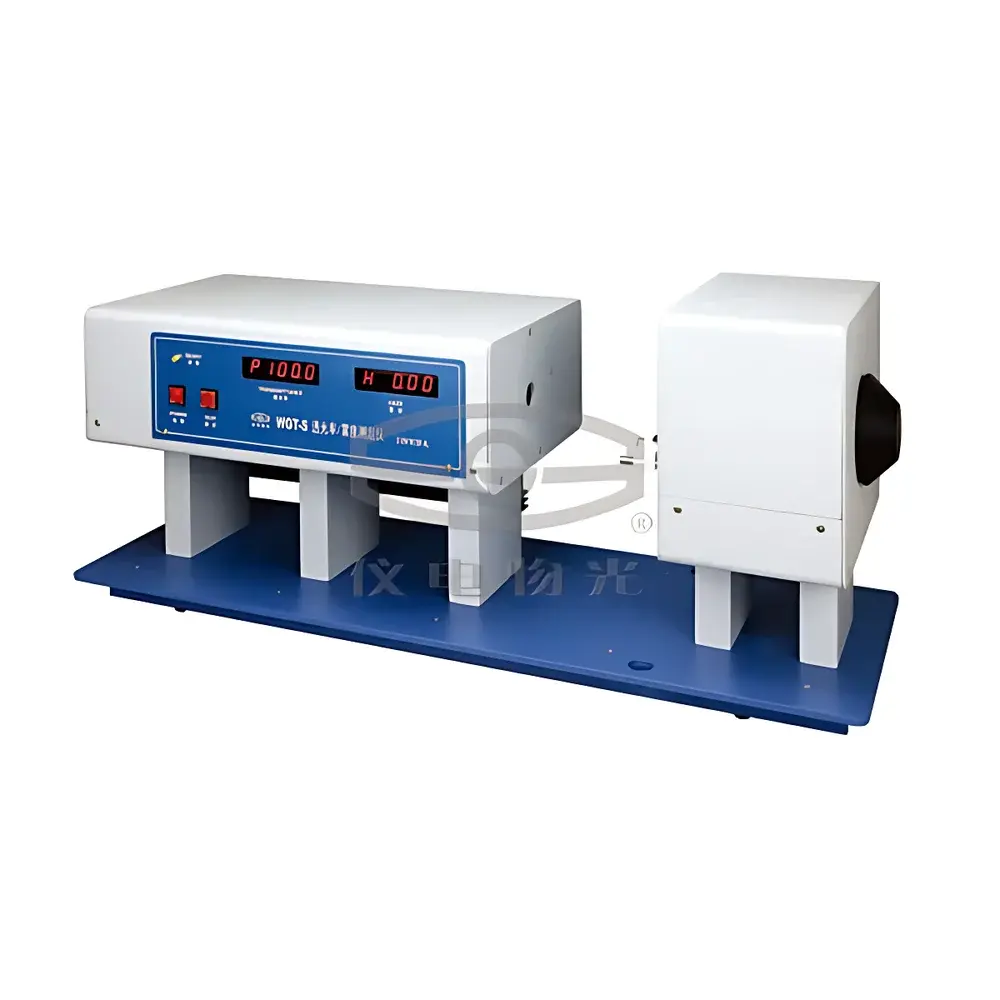
Yidian Wuguang WGT-S Transmittance and Haze Meter
| Brand | Yidian Wuguang (YDWG) |
|---|---|
| Origin | Shanghai, China |
| Model | WGT-S |
| Type | Automatic |
| Haze Range | 0–100% |
| Transmittance Range | 0–100% |
| Haze Repeatability | ≤0.2% |
| Transmittance Repeatability | ≤0.5% |
| Light Source | C-illuminant (6774 K) |
| Minimum Display Resolution | 0.1% for transmittance, 0.01% for haze |
| Measurement Error | ±1% (transmittance, certified neutral density filters), ±2% (transmittance, standard haze plates), ±5% relative (haze) |
| Sample Port Diameter | Input Ø25 mm, Output Ø21 mm |
| Interface | USB |
| Power Supply | 220 V ±22 V, 50 Hz ±1 Hz, 100 W |
| Dimensions | 710 × 270 × 280 mm |
| Net Weight | 19 kg |
Overview
The Yidian Wuguang WGT-S Transmittance and Haze Meter is a precision optical instrument engineered for the quantitative assessment of light transmission and scattering characteristics in transparent and translucent solid materials. It operates on the principle of integrating sphere photometry with parallel beam illumination and hemispherical diffuse collection—fully compliant with internationally recognized standards including GB/T 2410–2008, ASTM D1003–2007 (Standard Test Method for Haze and Luminous Transmittance of Transparent Plastics), and JIS K7105–1981. The system employs a stabilized C-illuminant source (correlated color temperature 6774 K) to ensure spectral consistency aligned with CIE standard illuminant C, enabling traceable, inter-laboratory comparable measurements. Unlike conventional analog meters, the WGT-S integrates a microprocessor-based control architecture with zero-drift digital signal processing, eliminating mechanical zero adjustments and environmental light interference via built-in optical modulation. Its open-type sample port design accommodates irregular or oversized specimens without requiring custom fixtures, supporting rapid throughput in QC laboratories and R&D environments.
Key Features
- Integrated sphere detection geometry with parallel incident beam and 2π solid angle collection for high-fidelity haze quantification per ASTM D1003 Annex A2.
- Microcontroller-driven automation: fully menu-guided operation with no manual knobs—parameter selection, measurement initiation, and statistical averaging are executed via front-panel interface.
- Real-time computation of arithmetic mean from multiple sequential readings; results displayed simultaneously for both transmittance (%) and haze (%) with user-selectable averaging count (n = 3–10).
- Optical modulation circuitry suppresses ambient light influence, ensuring stable baseline performance under typical laboratory lighting conditions (up to 500 lux).
- USB 2.0 interface enables direct data export to Windows-based PCs for integration into LIMS or Excel-based reporting workflows; no proprietary drivers required.
- Rugged mechanical construction: cast aluminum housing, precision-machined sample stage, and thermal-stabilized LED-based C-source deliver long-term calibration stability and operational reliability.
Sample Compatibility & Compliance
The WGT-S accepts flat, rigid, or semi-rigid planar samples up to 25 mm in diameter (limited only by input port aperture), including optical films, polymer sheets, glass substrates, coated lenses, and packaging materials. Curved or highly textured surfaces require optional flat-sample holders to ensure perpendicular beam incidence and minimize edge diffraction artifacts. All measurement protocols adhere to ISO/IEC 17025–2017 general requirements for competence of testing and calibration laboratories. Instrument validation includes factory-certified verification using NIST-traceable neutral density filters (transmittance) and calibrated haze standards (e.g., PMMA reference plates with certified haze values of 10%, 30%, and 70%). Data integrity meets FDA 21 CFR Part 11 expectations for electronic records when used with validated software configurations.
Software & Data Management
While the WGT-S operates autonomously with onboard display and statistics, its USB interface supports bidirectional communication with host systems running Windows 10/11. Optional PC software (supplied on secure USB drive) provides GLP-compliant features: operator login audit trails, timestamped measurement logs with metadata (sample ID, date/time, operator, instrument serial number), and CSV/Excel export with automatic column headers. Raw analog-to-digital converter (ADC) values are accessible for advanced users performing uncertainty analysis per GUM (JCGM 100:2008). Firmware updates are delivered via signed binary packages to maintain cryptographic integrity and prevent unauthorized modification.
Applications
- Quality control of optical-grade polymers (e.g., PC, PMMA, PETG) during extrusion and thermoforming processes.
- Validation of anti-fog coatings on automotive glazing and medical device housings.
- Characterization of diffusion films and light-guide plates in backlight units for LCD displays.
- Regulatory compliance testing for pharmaceutical blister packaging per USP and ISO 11607–1.
- Research on nanocomposite transparency degradation under UV aging or thermal cycling.
- Incoming inspection of architectural glass, solar panel cover glass, and OLED encapsulation substrates.
FAQ
What standards does the WGT-S comply with for regulatory submissions?
It satisfies ASTM D1003–2007, GB/T 2410–2008, and JIS K7105–1981—widely accepted for material qualification in FDA, CE, and CCC certification pathways.
Can the instrument measure curved or non-planar samples?
Direct measurement requires flat, parallel surfaces. Curved specimens must be mounted in optional flat-holding jigs to ensure consistent beam geometry and avoid specular reflection artifacts.
Is calibration traceable to national metrology institutes?
Yes—factory calibration uses NIST-traceable neutral density filters and PMMA haze standards, with full documentation provided in the Certificate of Conformance.
Does the WGT-S support automated pass/fail decision logic?
Not natively; however, exported CSV data can be processed via external scripts or integrated into MES/QMS platforms to enforce specification limits (e.g., haze ≤ 1.2% for AR-coated optics).
How often is recalibration recommended?
Annual recalibration is advised per ISO/IEC 17025 guidelines, or after any mechanical shock, lamp replacement, or sustained deviation beyond repeatability specifications.




