
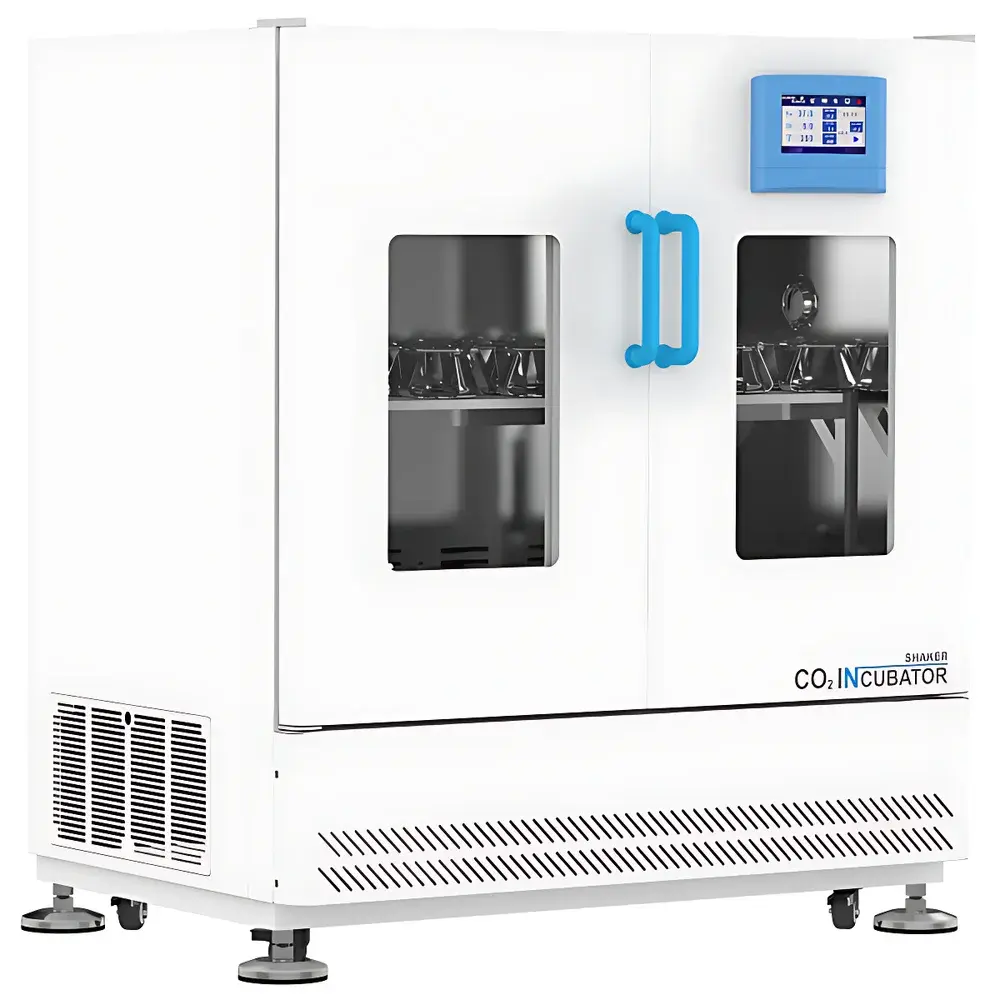
Yiheng BPNZ-500CS & BPNZ-500CD Large-Capacity CO₂ Orbital Shaking Incubator
| Brand | Yiheng |
|---|---|
| Origin | Shanghai, China |
| Manufacturer Type | Direct Manufacturer |
| Model | BPNZ-500CS (Single-Tier), BPNZ-500CD (Dual-Tier) |
| Temperature Range & Stability | 4–65 °C ±0.1 °C |
| Temperature Uniformity | ±0.5 °C at 25 °C ambient |
| Humidity Control | 50–95% RH (≥85% RH at 37 °C, real-time control, ±1% RH deviation) |
| CO₂ Range & Accuracy | 0–20% ±0.1% |
| CO₂ Uniformity & Stability | ±0.1% at 5% setpoint |
| Shaking Frequency | 40–300 rpm ±1 rpm |
| Amplitude | 20 mm |
| Drive Mechanism | Triple-Eccentric-Balanced Drive |
| Max Load Capacity (incl. fixtures) | 30 kg (BPNZ-500CS), 50 kg (BPNZ-500CD) |
| Chamber Volume | 500 L (CS), 500 L (CD) |
| External Dimensions (W×H×D) | 1050×1370×875 mm (CS), 1200×1370×875 mm (CD) |
| Power Input | 220 V, 50 Hz |
| Sterilization | 90 °C moist-heat cycle (18 h, full-chamber including sensors, fans, shelves) |
| Optional | HEPA filtration (≥99.99% @ ≥0.3 µm), RS-485/USB data logging, multi-level user authentication (admin/operator/visitor), GLP-compliant audit trail, microbial CO₂ inlet filter (≥0.3 µm) |
Overview
The Yiheng BPNZ-500CS and BPNZ-500CD are large-capacity, dual-function CO₂ orbital shaking incubators engineered for demanding life science applications requiring simultaneous environmental control and mechanical agitation. Combining precision CO₂ regulation, active humidity management, and stable orbital shaking in a single integrated platform, these systems eliminate the need for separate incubators and shakers—reducing footprint, minimizing cross-contamination risk, and improving experimental reproducibility. The core measurement and control architecture employs non-dispersive infrared (NDIR) CO₂ sensing, high-stability PT100 temperature sensors rated for continuous operation at 37 °C, and capacitive RH sensors with active drift compensation. Thermal regulation is achieved via six-sided heating elements and adaptive fan-speed modulation—ensuring rapid recovery (<3 minutes to 5% CO₂ post-door-open event) and uniform chamber conditions (±0.5 °C temperature uniformity, ±0.1% CO₂ uniformity). Designed for GLP- and GMP-aligned workflows, the system supports full-cycle 90 °C moist-heat sterilization of all internal surfaces—including sensor housings, fan assemblies, and stainless-steel shelves—validating sterility without disassembly.
Key Features
- Triple-eccentric-balanced drive mechanism ensures consistent orbital motion across the entire shaking platform—even at maximum load (30 kg or 50 kg)—with minimal vibration transmission to the chamber structure.
- Full-chamber 304 stainless-steel construction with electropolished interior, radius-cornered walls, and electrochemical passivation to inhibit biofilm formation and support validated cleaning protocols (e.g., 70% ethanol, hydrogen peroxide vapor).
- Intelligent airflow management: Circulation fan speed dynamically adjusts based on thermal load and setpoint proximity—reducing air velocity during steady-state incubation to prevent medium evaporation while maintaining homogeneity.
- Integrated CO₂ gas path includes a certified microbial filter (≥99.99% efficiency for particles ≥0.3 µm) upstream of the NDIR sensor, preventing sensor fouling and ensuring long-term calibration stability.
- Touchscreen controller with password-protected interface, configurable alarm thresholds (temperature, CO₂, humidity, door open duration, motor fault), and real-time parameter logging to internal memory.
- Heated double-glazed observation window with anti-condensation heating element eliminates visual obstruction and mitigates condensate-mediated microbial ingress risks.
Sample Compatibility & Compliance
The BPNZ series accommodates standard laboratory vessels—including Erlenmeyer flasks (50 mL to 2 L), culture bottles, and multi-well plates—via interchangeable stainless-steel clamping fixtures. All contact surfaces comply with ISO 8573-1 Class 3 compressed air purity requirements when used with filtered CO₂ supply. The system meets essential safety and performance benchmarks per IEC 61010-1 (electrical safety), EN 61326-1 (EMC), and GB/T 23795–2009 (Chinese national standard for CO₂ incubators). Optional HEPA filtration (ISO 14644-1 Class 5 equivalent) enables operation in ISO Class 7 cleanroom-adjacent environments. When equipped with audit-trail-enabled firmware and electronic signature support, the platform satisfies FDA 21 CFR Part 11 requirements for electronic records and signatures in regulated bioprocessing and QC labs.
Software & Data Management
Data integrity is maintained through embedded time-stamped logging of temperature, CO₂ concentration, relative humidity, shaking speed, and operational events (door openings, sterilization cycles, alarm triggers). Standard RS-485 Modbus RTU protocol enables integration with LIMS or SCADA systems. Optional USB export (to FAT32-formatted USB drives) permits offline review of full-session trend data in CSV format. The optional multi-tier user permission system enforces role-based access control: administrators configure parameters and calibrations; operators execute runs and view logs; visitors access read-only status screens. All user actions—including login/logout, parameter changes, and sterilization initiation—are recorded with timestamps, user IDs, and IP addresses (if network-enabled), supporting regulatory audit readiness.
Applications
These incubators serve critical roles in mammalian cell line expansion, suspension culture optimization, microbial fermentation kinetics studies, hybridoma production, recombinant protein expression screening, and stem cell differentiation assays where controlled agitation enhances mass transfer and oxygenation. Their capacity and stability make them suitable for scale-up studies bridging benchtop to pilot-scale bioreactor development. In academic core facilities, they support high-throughput screening of growth media formulations, antibiotic susceptibility testing under dynamic conditions, and co-culture experiments requiring synchronized environmental perturbation. The 90 °C sterilization cycle validates suitability for primary isolation workflows involving clinical specimens or low-biomass samples where carryover contamination must be eliminated between runs.
FAQ
What CO₂ gas purity specifications are recommended for optimal sensor longevity?
We recommend medical-grade or research-grade CO₂ (≥99.998% purity, dew point ≤ –40 °C, hydrocarbon content <1 ppm) supplied through the included 0.3 µm inlet filter.
Can the system maintain humidity >90% RH at 42 °C?
Humidity control is optimized for physiological ranges (35–37 °C); at elevated temperatures (>40 °C), maximum achievable RH decreases due to saturation limits—performance data is validated at 37 °C per ISO 13408-4.
Is third-party IQ/OQ/PQ validation documentation available?
Yes—Yiheng provides customizable 3Q validation templates, traceable calibration certificates for all sensors, and on-site commissioning support (subject to service agreement).
How is temperature overshoot prevented during door-opening recovery?
An independent ambient temperature sensor feeds real-time correction to the PID algorithm, modulating heater output preemptively to suppress thermal overshoot—verified per ASTM E122-22 statistical sampling protocols.
Does the shaking mechanism support asynchronous dual-layer operation?
No—the BPNZ-500CD model operates both tiers synchronously at identical RPM and amplitude; independent control requires separate single-tier units.
Related Products



