
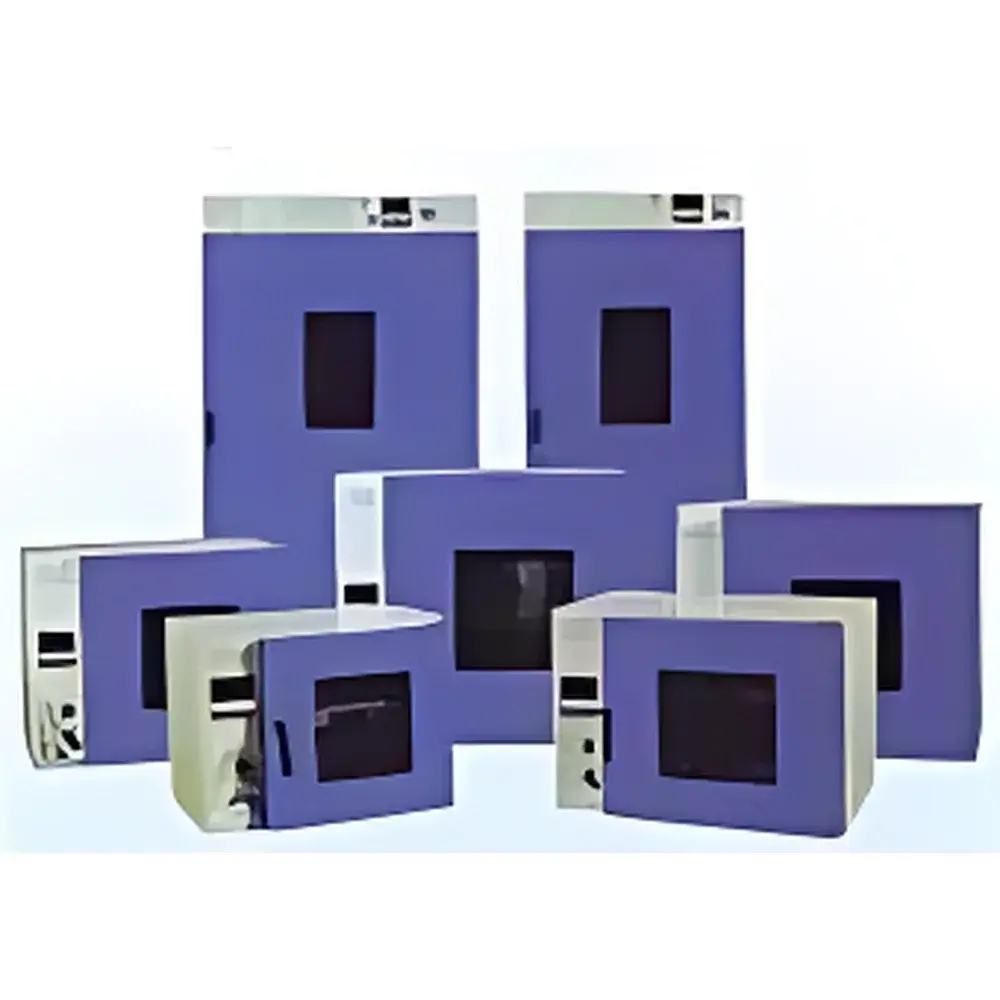
Yiheng DHG-9420A Forced-Air Drying Oven
| Brand | Yiheng |
|---|---|
| Origin | Shanghai, China |
| Model | DHG-9420A (420 L Capacity) |
| Temperature Range | RT+10°C to 200°C / RT+10°C to 250°C |
| Temperature Uniformity | ±3% |
| Temperature Fluctuation | ±1.0°C |
| Temperature Resolution | 0.1°C |
| Chamber Dimensions (W×D×H) | 640 × 585 × 1355 mm |
| External Dimensions (W×D×H) | 780 × 750 × 1880 mm |
| Inner Chamber Material | Mirror-Finish Stainless Steel |
| Heating Method | Forced-Air Circulation |
| Operating Ambient Temperature | +5°C to +40°C |
| Power Supply | AC 220 V / 50 Hz (Standard), Optional AC 380 V / 50 Hz |
| Input Power | 3100 W |
| Standard Shelving | 2 adjustable stainless steel trays |
| Timer Range | 1–9999 minutes |
| Compliance | Designed per IEC 61010-1 for laboratory electrical safety |
Overview
The Yiheng DHG-9420A is a precision-engineered forced-air drying oven designed for consistent thermal processing in research laboratories, quality control environments, and industrial testing facilities. Utilizing a robust hot-air circulation system with axial-flow high-temperature fans and optimized duct geometry, the DHG-9420A maintains uniform heat distribution across its 420-liter working chamber—critical for applications requiring reproducible moisture removal, pre-conditioning of materials, or thermal stabilization of samples prior to analysis. Its microprocessor-based P.I.D. temperature controller ensures stable setpoint maintenance within ±1.0°C fluctuation, while the 0.1°C resolution enables fine-grained thermal protocol execution. The unit operates across two selectable maximum temperatures (200°C or 250°C), accommodating both standard desiccation protocols and higher-temperature curing or ash residue preparation workflows.
Key Features
- Mirror-finish stainless steel inner chamber (grade 304) fabricated via argon arc welding—resistant to corrosion, easy to clean, and compliant with GLP cleaning validation requirements.
- Dual-stage over-temperature protection: primary P.I.D. control with independent mechanical backup limiter (optional), automatically cutting power if user-defined threshold is exceeded—enhancing personnel and sample safety per IEC 61010-1 Clause 7.3.3.
- Adjustable air inlet and exhaust dampers integrated into the rear wall, enabling empirical optimization of airflow dynamics for heterogeneous or stacked sample loads.
- High-efficiency silicone rubber gasket (synthetic fluorosilicone formulation) rated for continuous operation up to 250°C, offering extended service life and low outgassing characteristics suitable for low-particulate environments.
- Front-panel digital interface with real-time temperature display, programmable timer (1–9999 min), and intuitive navigation—no external software required for basic operation.
- Modular electrical architecture supporting optional upgrades including RS485 Modbus RTU communication (for integration into LabVantage or STARLIMS platforms) and embedded thermal printer (supporting ASTM E2582-compliant printout of time-temperature profiles).
Sample Compatibility & Compliance
The DHG-9420A accommodates a broad spectrum of sample formats—including Petri dishes, weighing boats, crucibles, glassware, polymer films, and metal coupons—within its spacious 640 × 585 × 1355 mm chamber. Its ±3% temperature uniformity (measured per ISO 17025 Annex A.3 using 9-point thermocouple mapping at 100°C and 150°C) meets routine calibration requirements for ISO/IEC 17025-accredited testing labs. While not certified to UL 61010-1 or CE marking under EU Machinery Directive without regional conformity assessment, the unit is constructed to IEC 61010-1 Edition 3 safety principles, including reinforced insulation, double-pole isolation switching, and earth leakage detection circuitry. It supports compliance-driven workflows under USP , ISO 9001:2015 clause 7.1.5.2 (monitoring and measuring resources), and FDA 21 CFR Part 11 when paired with validated data logging accessories.
Software & Data Management
Out-of-the-box operation requires no host computer; however, the optional RS485 interface (standard Modbus RTU protocol, 9600 baud, 8N1) allows bidirectional communication with third-party SCADA or LIMS systems. When equipped with the optional thermal printer, the oven generates timestamped hardcopy records showing setpoint, actual chamber temperature, elapsed time, and alarm status—satisfying audit trail requirements under GLP (OECD Principles) and GMP Annex 11. Firmware supports firmware-upgradable logic for future protocol enhancements, and configuration parameters (e.g., PID tuning constants, alarm thresholds) are retained in non-volatile memory during power loss. No proprietary drivers or cloud dependencies are required—ensuring long-term maintainability in regulated environments.
Applications
- Moisture content determination per AOAC 950.46, ASTM D2231, and ISO 712 for food, pharmaceutical excipients, and agricultural commodities.
- Pre-drying of filter papers, crucibles, and volumetric glassware prior to gravimetric analysis.
- Thermal aging studies of polymers and composites under controlled isothermal conditions (e.g., ISO 188, ASTM D573).
- Conditioning of reference standards and calibration artifacts in metrology labs (e.g., NIST traceable hygrometric standards).
- Curing of coatings, adhesives, and printed circuit board laminates where convective heating minimizes surface oxidation.
- Residue ashing support for elemental analysis workflows (ICP-OES, AAS) following EPA Method 3050B sample prep protocols.
FAQ
Is the DHG-9420A suitable for use in a Class 10,000 cleanroom environment?
The unit is not ISO 14644-1 classified, but its sealed chamber design, low-outgassing gasket, and absence of internal lubricants make it compatible with cleanroom-adjacent applications when installed with HEPA-filtered supply air and appropriate exhaust ducting.
Can the oven be validated per IQ/OQ/PQ protocols?
Yes—the mechanical design, sensor layout, and control architecture support full qualification. Documentation templates (including URS, FAT/SAT checklists, and 3-point calibration reports) are available upon request from authorized distributors.
What is the recommended recalibration interval for the built-in temperature sensor?
Per ISO/IEC 17025:2017 §6.5.2, annual verification against a NIST-traceable reference thermometer is advised; field verification can be performed using a calibrated PT100 probe inserted through the optional test port accessory.
Does the unit meet energy efficiency standards such as ENERGY STAR or EU Ecodesign?
It complies with China’s GB 30253–2013 minimum energy performance standard for laboratory ovens, though it is not ENERGY STAR listed due to regional certification scope limitations.



