
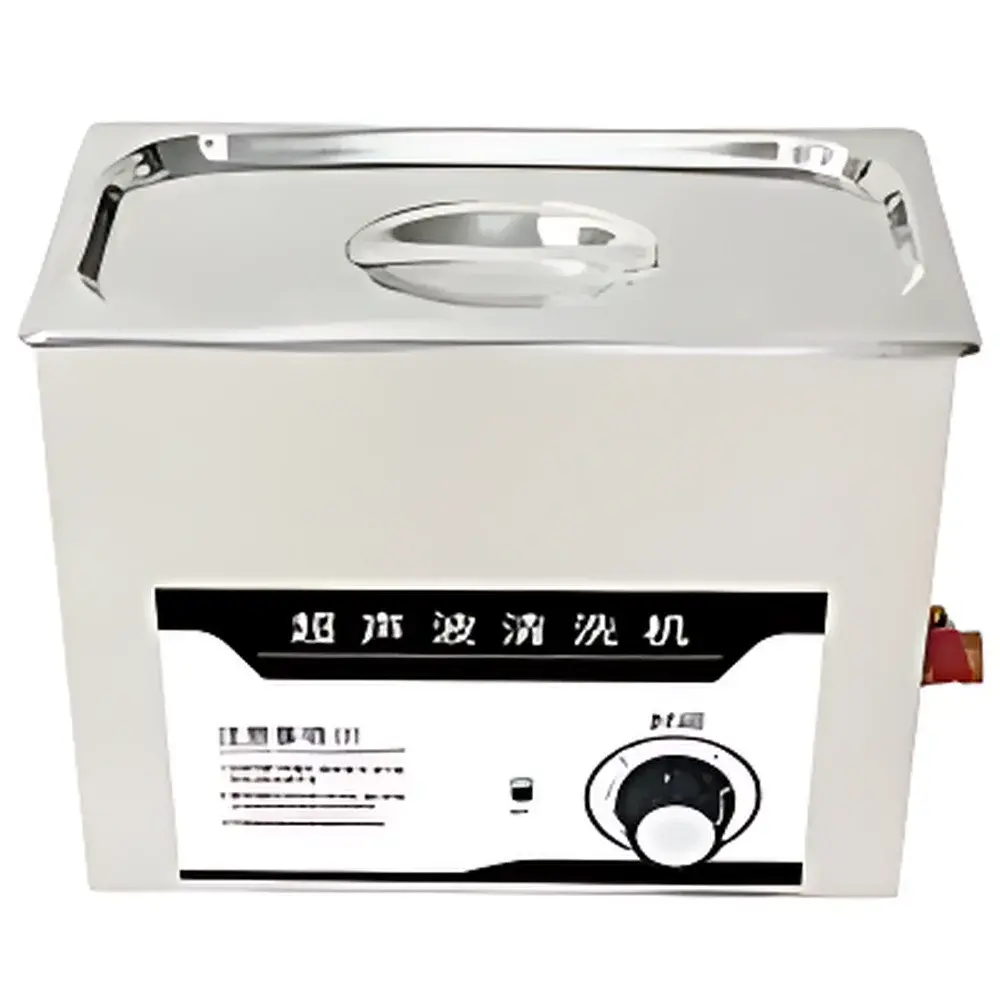
ZiQi ZQ-20 3L Benchtop Mechanical Knob Ultrasonic Cleaner
| Brand | ZiQi |
|---|---|
| Origin | Shanghai, China |
| Manufacturer Type | Direct Manufacturer |
| Product Category | Domestic |
| Model | ZQ-20 (3 L Capacity) |
| Instrument Type | General-Purpose |
| Tank Volume | 3 L |
| Ultrasonic Frequency | 40 kHz |
| Ultrasonic Power Output | 120 W |
| Power Adjustment | Not Adjustable |
| Temperature Control | Not Available |
| Timer Range | 1–30 min (Mechanical Dial) |
| Sound-Dampening Lid | Included |
| Drainage | Manual Valve |
Overview
The ZiQi ZQ-20 is a compact, benchtop ultrasonic cleaner engineered for consistent cavitation-based cleaning in routine laboratory and light industrial environments. It operates on the principle of high-frequency (40 kHz) piezoelectric transduction, generating controlled acoustic pressure waves in aqueous or mild solvent media. These waves induce microscopic bubble formation and collapse—cavitation—which mechanically dislodges particulate contaminants, organic residues, and loosely adhered biofilms from submerged surfaces. Designed for reliability rather than programmability, the ZQ-20 delivers stable energy output across its 120 W nominal power rating, with no variable power or heating functions—making it suitable for temperature-sensitive samples where thermal drift must be avoided. Its fixed-frequency architecture ensures reproducible cleaning performance across repeated cycles, supporting standard operating procedures in QC labs, academic teaching facilities, and R&D support workflows.
Key Features
- Robust 3 L stainless steel tank fabricated via seamless deep-drawn forming—eliminates weld seams that may corrode or harbor residue over time.
- High-reliability ultrasonic transducers sourced from certified international suppliers, integrated into the tank base for uniform energy distribution.
- Mechanical timer dial with precise 1–30 minute range—no electronics to calibrate or fail; ideal for GLP-aligned manual SOPs requiring traceable, non-software-dependent operation.
- Integrated sound-dampening lid reduces airborne noise to ≤55 dB(A) at 1 m distance, improving ergonomic conditions in shared lab spaces.
- Full 304 stainless steel construction for both inner tank and outer housing—resistant to corrosion from common cleaning agents including diluted alkaline solutions and isopropanol/water mixtures.
- Manual drain valve located at the tank base enables rapid, tool-free fluid evacuation—compatible with sink-side or waste container placement without pump dependency.
Sample Compatibility & Compliance
The ZQ-20 accommodates a broad range of sample geometries—including glassware (vials, beakers, pipette tips), metal components (surgical tools, calibration standards), ceramic substrates, and polymer fixtures—provided they are fully submersible and chemically compatible with ultrasonic exposure. It complies with IEC 61000-6-3 (EMC emission limits) and meets basic safety requirements per IEC 61010-1 for laboratory electrical equipment. While not certified to ISO 13485 or FDA 21 CFR Part 11, its mechanical-only control architecture inherently satisfies audit requirements for systems excluded from electronic record regulations. Users performing cleaning validation per ASTM D4169 or USP should establish cycle-specific parameters (duration, solvent type, load configuration) and document outcomes manually.
Software & Data Management
The ZQ-20 operates without embedded firmware, software interfaces, or digital data logging capabilities. All operational parameters are set physically via the front-panel mechanical timer dial. This design eliminates cybersecurity vulnerabilities, firmware update dependencies, and electronic calibration drift—supporting long-term stability in regulated environments where instrument qualification focuses on physical verification (e.g., frequency sweep verification using hydrophone mapping, power output validation via calorimetry). Maintenance records, usage logs, and cleaning cycle documentation must be maintained externally per institutional GLP/GMP policies.
Applications
- Routine cleaning of analytical glassware prior to HPLC, GC, or spectrophotometric analysis to minimize carryover and baseline noise.
- Preparation of metal and ceramic reference standards for dimensional metrology or surface roughness measurement.
- Removal of polishing compounds and machining oils from precision optics and microfluidic device substrates.
- Cell culture accessory decontamination—including reusable stainless steel forceps, spatulas, and weighing boats—when used with validated low-foaming enzymatic or neutral-pH detergents.
- Supporting extraction protocols in natural product chemistry, where ultrasonic-assisted leaching of plant matrices occurs in water or ethanol/water mixtures at ambient temperature.
- De-gassing of degassed solvents (e.g., mobile phase preparation) and removal of entrapped air from porous filters or membrane assemblies.
FAQ
Is the ultrasonic frequency adjustable?
No. The ZQ-20 operates exclusively at 40 kHz—a frequency selected for optimal balance between penetration depth and cavitation intensity in general-purpose aqueous cleaning applications.
Can the unit be used with flammable solvents?
Not recommended. The absence of explosion-proof certification, temperature control, or vapor containment means only water-based or non-volatile, low-flashpoint solvents (e.g., ≤30% IPA in water) should be used under well-ventilated conditions.
What is the maximum recommended operating duration per cycle?
Continuous operation beyond 30 minutes is discouraged. Prolonged use may accelerate transducer fatigue and reduce long-term amplitude consistency; intermittent cycling (e.g., 10 min on / 5 min off) is advised for extended cleaning tasks.
Does the unit include a stainless steel basket?
A stainless steel basket is optional and sold separately. The standard configuration includes only the tank, lid, and manual drain valve.
How is cleaning efficacy verified without built-in sensors?
Users should perform periodic verification using standardized test foils (e.g., aluminum foil erosion test per ASTM E1725) or particle counting of rinse water effluent—methods documented in internal SOPs and aligned with ISO 15883-5 for washer-disinfector validation principles.
Related Products



