
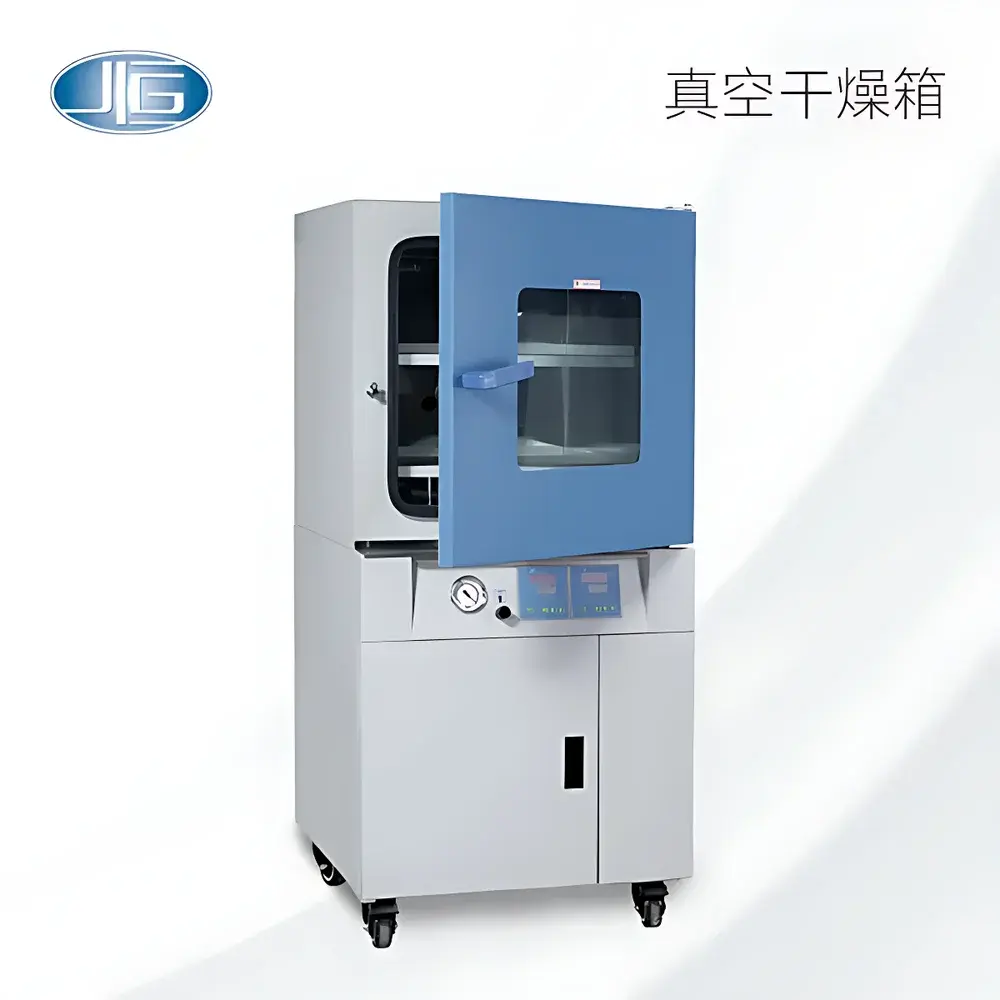
Yiheng DZF-6210 Vacuum Drying Oven
| Brand | Yiheng |
|---|---|
| Origin | Shanghai, China |
| Manufacturer Type | Direct Manufacturer |
| Product Category | Domestic |
| Model | DZF-6210 |
| Instrument Type | Vacuum Oven |
| Temperature Range | RT+10 °C to 200 °C |
| Temperature Uniformity | ±1 °C |
| External Dimensions | 720 mm × 820 mm × 1750 mm |
| Internal Chamber Dimensions | 560 mm × 600 mm × 640 mm |
| Operating Ambient Temperature | 5 °C to 40 °C |
| Chamber Material | Stainless Steel (AISI 304) |
| Heating Method | Direct Plate Conduction + Radiant Heating |
| Ultimate Vacuum Level | ≤133 Pa |
| Control System | Microprocessor-Based PID Temperature Controller |
| Viewing Window | Dual-Layer Tempered Glass with Silicone Sealing Gasket |
| Optional Feature | Inert Gas Purge Port (N₂ or Ar) |
Overview
The Yiheng DZF-6210 Vacuum Drying Oven is an engineered solution for thermal processing under reduced-pressure environments. It operates on the principle that lowering ambient pressure reduces the boiling point of solvents and moisture, enabling gentle, low-temperature drying of thermally labile, oxidation-sensitive, or chemically unstable samples—including pharmaceutical intermediates, polymer precursors, biological extracts, and nanomaterial dispersions. Unlike conventional convection ovens, this system eliminates convective heat transfer and oxygen exposure, thereby minimizing degradation pathways such as hydrolysis, oxidation, and thermal decomposition. Its chamber is rated for continuous operation from ambient +10 °C up to 200 °C, with a certified vacuum performance of ≤133 Pa—sufficient to support solvent removal below 40 °C for many volatile organics (e.g., acetone, ethanol, ethyl acetate) and residual water in hygroscopic powders.
Key Features
- Independent Shelf-Level Thermal Control: Each stainless-steel shelf is equipped with a dedicated Pt100 RTD sensor and discrete PID control loop, enabling precise, load-specific temperature regulation across up to three shelves. This architecture ensures uniform thermal response regardless of sample mass distribution or thermal inertia differences.
- Direct Conductive Heating Architecture: Heating elements are embedded beneath each shelf surface, delivering heat via conduction rather than peripheral wall radiation. This design reduces thermal lag, improves setpoint accuracy (±0.3 °C typical deviation), and cuts heating time by over 50% compared to traditional jacket-heated chambers.
- Vacuum Integrity Engineering: A one-piece molded silicone door gasket—compression-tuned for optimal sealing force—and adjustable cam-latch mechanism maintain stable vacuum levels throughout extended cycles (up to 72 h). The dual-layer tempered glass viewport provides real-time visual monitoring without compromising vacuum integrity.
- Corrosion-Resistant Chamber Construction: Interior surfaces are fabricated from electropolished AISI 304 stainless steel, offering high resistance to acidic vapors, halogenated solvents, and saline residues. All internal welds are ground and passivated to prevent crevice corrosion and facilitate GLP-compliant cleaning validation.
- Optional Inert Gas Compatibility: Integrated gas inlet port (¼” NPT) supports controlled nitrogen or argon purging before, during, or after vacuum cycles—enabling inert-atmosphere annealing, solvent displacement, or oxygen-free storage protocols per ASTM E1228 and ISO 12099 guidelines.
Sample Compatibility & Compliance
The DZF-6210 accommodates heterogeneous sample configurations—including stacked Petri dishes, Buchner funnels, desiccator trays, and custom aluminum sample holders—within its 192 L usable chamber volume. It supports drying of lyophilized proteins, catalysts, battery electrode slurries, ceramic green bodies, and moisture-sensitive APIs without cross-contamination or thermal runaway. The system meets essential safety and operational standards including IEC 61010-1 (Electrical Safety for Laboratory Equipment), GB/T 5170.11–2017 (Environmental Testing—Vacuum Performance Verification), and aligns with FDA 21 CFR Part 11 data integrity expectations when paired with optional RS485/Modbus-enabled data loggers (sold separately). Routine vacuum leak testing and temperature mapping per ISO/IEC 17025 are recommended for regulated QC/QA applications.
Software & Data Management
While the base unit features a front-panel microprocessor controller with digital setpoint display, programmable ramp/soak profiles (up to 9 segments), and auto-shutdown logic, optional connectivity modules enable integration into centralized laboratory informatics systems. An RS485 interface supports Modbus RTU communication for remote parameter setting, real-time temperature/vacuum logging, and alarm event forwarding to LIMS or SCADA platforms. Audit trails—including operator ID, timestamped setpoint changes, vacuum hold duration, and thermal deviation alerts—are retained for ≥30 days onboard and exportable as CSV files for GLP/GMP documentation. Calibration certificates traceable to NIM (National Institute of Metrology, China) are provided with each unit.
Applications
- Drying of heat-sensitive pharmaceutical compounds (e.g., peptides, monoclonal antibodies, probiotics) without denaturation
- Removal of residual solvents from polymer films, OLED layers, and thin-film photovoltaic substrates
- Pre-conditioning of reference standards and calibration materials per USP and ISO 17034
- Stabilization of metal-organic frameworks (MOFs) and porous carbons prior to BET surface area analysis
- Oxygen-free annealing of lithium-ion battery cathode precursors to suppress Ni²⁺/Ni³⁺ disproportionation
- Moisture equilibration of hygroscopic ceramics and dental composites for dimensional stability testing
FAQ
What vacuum pump is recommended for optimal performance with the DZF-6210?
A two-stage oil-sealed rotary vane pump with ultimate vacuum ≤5 Pa and pumping speed ≥12 m³/h is recommended. Dry scroll pumps may be used for solvent-free applications but require careful compatibility assessment with organic vapors.
Can the DZF-6210 be validated for GMP manufacturing environments?
Yes—when equipped with calibrated RTDs, vacuum transducers, and electronic logging, it supports IQ/OQ/PQ protocols per Annex 15 and EU GMP guidelines. Third-party qualification packages are available upon request.
Is over-temperature protection included as standard?
Yes—the unit incorporates dual independent thermal cutouts: a primary PID-controlled solid-state relay and a mechanical backup thermostat rated at 220 °C, compliant with IEC 60519-12.
How often should the silicone door gasket be replaced?
Under normal use (≤20 cycles/week), replacement is recommended every 18–24 months. Visual inspection for cracking, compression set, or loss of tackiness should precede each vacuum cycle.
Does the DZF-6210 support automatic vacuum venting at cycle end?
No—manual venting via integrated needle valve is standard. An optional solenoid-controlled inert-gas venting module can be installed for automated, contamination-free break-vacuum sequences.



