
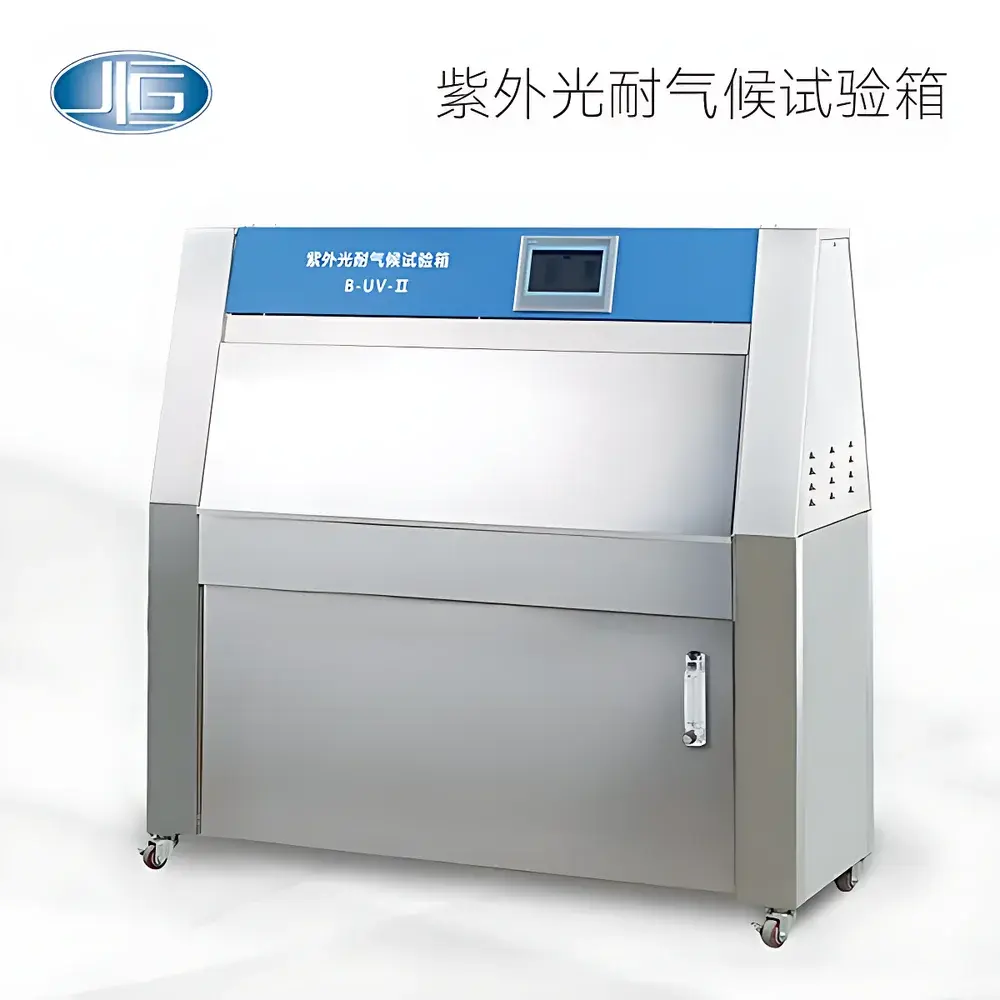
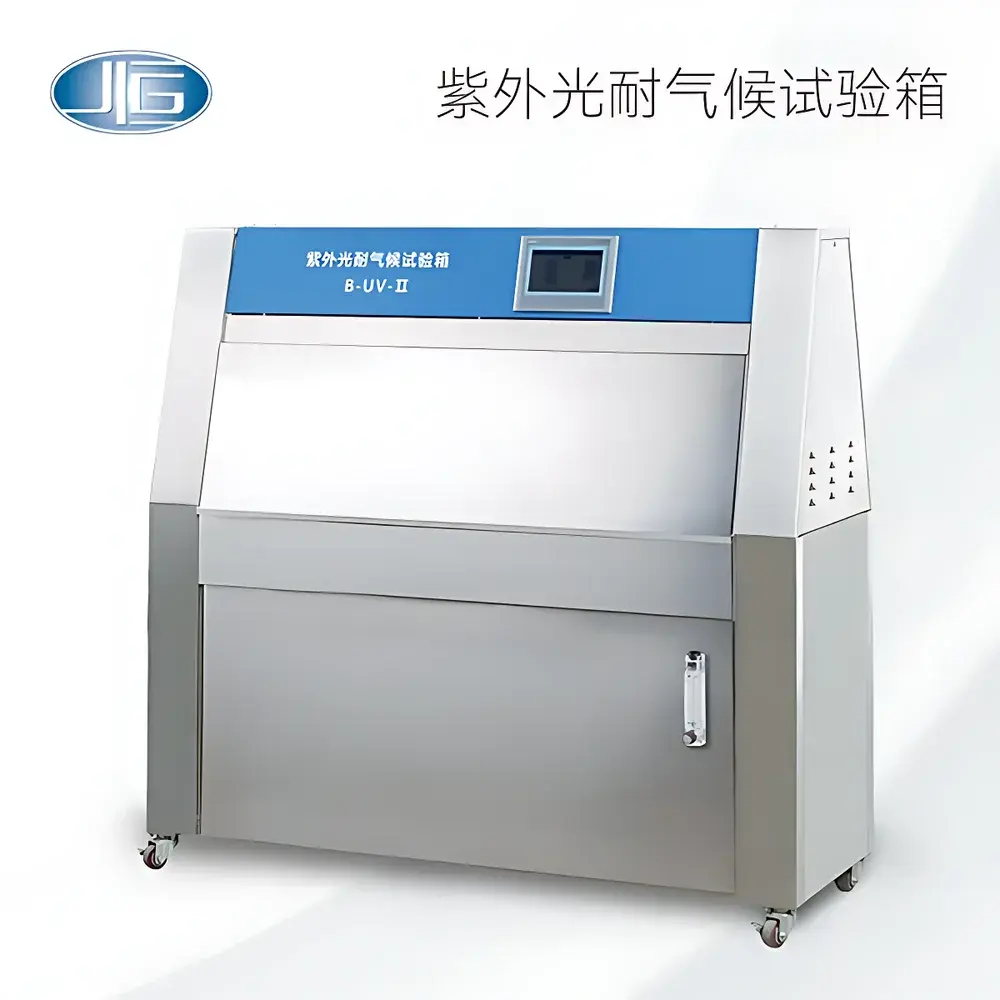
YIHENG B-UV-I / B-UV-II Fluorescent UV Weathering Test Chamber
| Brand | YIHENG |
|---|---|
| Origin | Shanghai, China |
| Manufacturer Type | Direct Manufacturer |
| Country of Origin | China |
| Model | B-UV-I, B-UV-II |
| UV Wavelengths | UVA-340 (0.7 W/m² @ 340 nm), UVB-313 (0.4 W/m² @ 313 nm) |
| UV Lamp Power | 40 W × 8 lamps |
| Irradiance Control | Automatic real-time monitoring and feedback control via 4 built-in calibrated irradiance sensors |
| Temperature Control | Black panel temperature and chamber air temperature, both automatically regulated |
| Humidity Control | Integrated humidification system with water level monitoring and low-water alarm |
| Water Supply | Auto-refill system with vortex-type drainage and sediment trap |
| Controller | SIEMENS 9.7-inch HMI touchscreen, 10-segment programmable cycle, built-in standards library (GB/T, ISO, ASTM, SAE), data logging & fault diagnostics |
| Compliance | GB/T 16422.3, GB/T 14522, ISO 4892-3, ASTM G154, ASTM D4587, ISO 11507, ASTM D4329, ASTM D5208, SAE J2020, M 5982-1990 |
Overview
The YIHENG B-UV-I and B-UV-II Fluorescent UV Weathering Test Chambers are engineered for precision accelerated weathering evaluation of polymeric materials, coatings, adhesives, automotive components, and architectural finishes. Based on the fluorescent ultraviolet (UV) irradiation principle—specifically simulating short-wave solar UV radiation in the 290–400 nm range—these chambers replicate critical degradation drivers including photochemical oxidation, thermal cycling, moisture condensation, and intermittent rain simulation. Unlike broad-spectrum xenon arc or carbon arc systems, fluorescent UV technology provides highly reproducible, spectrally defined exposure conditions centered on UVA-340 (mimicking terrestrial sunlight at 340 nm) and UVB-313 (accelerated, non-solar spectral output). The system operates through tightly controlled, programmable cycles integrating UV irradiation, condensation (via water-cooled black panel and chamber humidity), and optional spray phases—enabling direct correlation to real-world outdoor aging per internationally harmonized test protocols.
Key Features
- Eight high-stability 40 W fluorescent UV lamps (UVA-340 or UVB-313 configurable), sourced from U.S.-based OEM suppliers, delivering consistent spectral power distribution over a rated service life of ≥5,000 hours—minimizing inter-test variability and reducing lamp replacement frequency.
- Four integrated, NIST-traceable broadband irradiance sensors (two front, two rear) continuously monitor UV intensity across the specimen plane; real-time feedback enables dynamic lamp power modulation to maintain setpoint irradiance within ±5% tolerance, compensating for lamp aging and spatial non-uniformity.
- Self-calibrating irradiance control architecture, supported by YIHENG’s proprietary handheld irradiance calibrator—certified traceable to national metrology institutes—ensuring long-term measurement integrity and audit readiness.
- SIEMENS 9.7-inch industrial HMI touchscreen controller with intuitive menu navigation, multi-language support, and full parameter visualization: irradiance (W/m²), black panel temperature (°C), chamber air temperature (°C), relative humidity (%RH), spray duration/frequency, and cycle progression.
- Programmable 10-segment exposure profile capability, supporting complex sequences such as “UV + Condensation”, “UV + Spray”, or “Dark + Condensation” — all compliant with ASTM G154 Cycle 1–6 and ISO 4892-3 Method A/B.
- Stainless steel (SUS304) interior chamber and cold-rolled steel exterior with epoxy coating; corrosion-resistant aluminum sample racks; ergonomic front-access design with dual viewing windows and safety interlock.
Sample Compatibility & Compliance
The B-UV series accommodates flat-panel specimens up to 75 mm thick (standard rack configuration), with optional custom fixtures available for 3D automotive trim, roofing membranes, or coated metal substrates. All operational parameters—including irradiance setpoints, temperature ramp rates, condensation dwell times, and spray pressure—are fully adjustable to meet material-specific qualification requirements. The system is validated against major international weathering standards: ISO 4892-3 (Plastics — Methods of exposure to laboratory light sources — Part 3: Fluorescent UV lamps), ASTM G154 (Standard Practice for Operating Fluorescent Ultraviolet (UV) Lamp Apparatus for Exposure of Non-Metallic Materials), ASTM D4587 (Practice for Fluorescent UV-Condensation Exposures of Paint and Related Coatings), and GB/T 16422.3 (Chinese national standard equivalent). Full compliance documentation—including calibration certificates, sensor linearity reports, and controller firmware validation logs—is provided with each unit shipment.
Software & Data Management
The embedded SIEMENS controller supports continuous data acquisition at 1-second intervals for all monitored variables (irradiance, black panel temp, chamber temp, RH, spray status). Raw datasets are exportable via USB to CSV format for post-processing in MATLAB, Excel, or LIMS platforms. Audit-trail functionality records all user actions—including parameter changes, manual overrides, and alarm events—with timestamp, operator ID, and reason code. While not FDA 21 CFR Part 11-compliant out-of-the-box, the system architecture supports third-party 21 CFR Part 11 add-ons for regulated pharmaceutical packaging validation. Data retention spans ≥30 days onboard; external NAS or cloud backup integration is achievable via Ethernet interface (Modbus TCP/IP).
Applications
- Automotive: Accelerated evaluation of interior trim colorfastness, dashboard cracking resistance, and headlamp lens yellowing under cyclic UV/condensation stress.
- Coatings & Inks: Correlation of QUV exposure hours to Florida/Miami outdoor exposure for architectural acrylics, coil coatings, and UV-curable inks.
- Photovoltaics: Degradation assessment of EVA encapsulant browning, backsheet delamination, and anti-reflective coating erosion.
- Packaging: UV stability testing of PET bottles, flexible laminates, and barrier films used in food and pharmaceutical applications.
- Construction Materials: Weathering resistance validation of PVC window profiles, fiber-cement siding, and silicone sealants per ASTM D4329.
FAQ
What UV lamp types are supported, and how do they differ?
The system accepts UVA-340 (peak 340 nm, best match to solar UV below 360 nm), UVA-351 (simulates透过 window glass), and UVB-313 (shorter wavelength, higher energy, for aggressive acceleration). Lamp selection must align with applicable test standards.
Is irradiance calibration performed onsite or at the factory?
Factory calibration is performed pre-shipment using NIST-traceable reference sensors. Onsite recalibration is recommended annually or after lamp replacement, using the included handheld calibrator.
Can the chamber operate unattended for extended durations?
Yes—equipped with auto-refill, low-water alarm, thermal cutout protection, and continuous fault diagnostics, it supports 7×24 operation for multi-week exposure programs.
Does the controller support remote monitoring?
Ethernet connectivity enables Modbus TCP/IP read-only access to real-time parameters and historical logs via local network; remote desktop or VPN access requires customer-side IT infrastructure.
How is condensation generated during the dark cycle?
By lowering the temperature of the black panel sensor while maintaining elevated chamber humidity—causing atmospheric water vapor to condense directly onto specimen surfaces, replicating nocturnal dew formation.



