
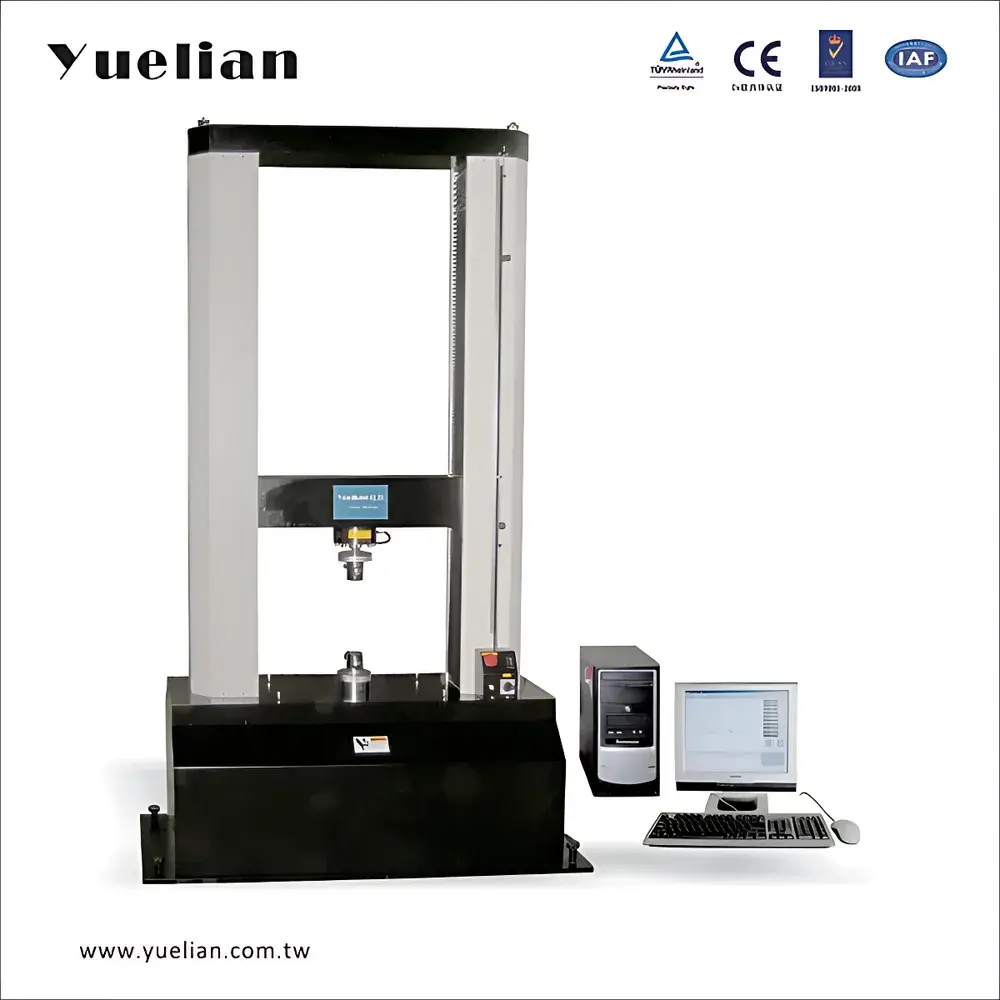
YL-1151 LED Glass Static Pressure Tester | Yuelian Universal Material Testing Machine with Static Load Capability for Display Panel Substrate Evaluation
| Brand | Yuelian (Yuelian) |
|---|---|
| Origin | Guangdong, China |
| Model | YL-1151 |
| Capacity Options | 1 kN, 2 kN, 5 kN, 10 kN, 20 kN, 50 kN, 100 kN (dual-range configuration optional) |
| Force Resolution | 1/250,000 full scale |
| Force Accuracy | ≤ ±0.5% of reading |
| Displacement Resolution | 0.005 mm |
| Test Speed Range | 0.5–500 mm/min (PC-controlled) |
| Maximum Stroke | 1000 mm |
| Test Width | 550 mm |
| Drive System | Servo motor + precision ball screw + timing belt transmission |
| Power Supply | 220 V, 50/60 Hz, 10 A |
| Rated Power | 1800 W |
| Dimensions (W×D×H) | 920 × 750 × 1990 mm |
| Weight | ~800 kg |
| Compliance Standards | ISO 7500-1, ASTM E4, EN 10002-1, EN 10002-2, DIN 51221, JIS B7721/B7733, GB/T 228.1, JJG 475 |
Overview
The YL-1151 LED Glass Static Pressure Tester is a high-precision universal electromechanical testing system engineered for static load evaluation of brittle and semi-rigid substrates—particularly soda-lime silicate, aluminosilicate, and chemically strengthened glass used in flat-panel displays, touch modules, and automotive HUDs. Unlike dynamic impact testers or thermal stress analyzers, this instrument applies controlled, quasi-static compressive force perpendicular to the surface plane under displacement- or load-controlled modes, enabling quantification of fracture initiation threshold, surface defect sensitivity, and interlayer delamination resistance in laminated display assemblies. Its structural architecture adheres to ISO 7500-1 Class 0.5 calibration requirements and supports traceable verification per ASTM E4 guidelines for force measurement systems. Designed for laboratory-based QC labs, R&D centers, and third-party certification bodies, the YL-1151 integrates mechanical rigidity, thermal stability, and software-driven repeatability to meet GLP-compliant test execution workflows.
Key Features
- Modular dual-capacity load cell configuration (e.g., 10 kN / 100 kN) enables high-resolution measurement at low loads and robust overload tolerance during catastrophic failure events.
- Precision-ground ball screw actuation with servo motor feedback ensures <0.005 mm displacement resolution and velocity linearity across the full 0.5–500 mm/min range.
- Integrated safety interlock system includes hardware-based overload cutoff, emergency stop circuitry, specimen rupture detection via real-time load drop algorithm, and programmable upper/lower displacement limits.
- Rigid C-frame construction (800 kg mass, 920 × 750 × 1990 mm footprint) minimizes frame deflection during high-load static compression—critical for maintaining parallelism between platens during glass substrate testing.
- Full PC-based control interface with USB 2.0 connectivity eliminates proprietary controllers, allowing direct integration into enterprise LIMS environments and supporting audit-ready data export in CSV, XML, and PDF formats.
Sample Compatibility & Compliance
The YL-1151 accommodates flat, rigid specimens up to 550 mm wide and 1000 mm stroke height—sufficient for 12.3”–27” display modules, cover glass sheets (0.3–2.0 mm thickness), and laminated OLED stacks. It supports standardized fixtures including parallel compression platens (hardened steel, Ø100 mm), edge-support jigs for four-point bending simulation, and custom vacuum chucks for non-contact loading of fragile substrates. All test protocols align with ISO 178 (flexural properties), ISO 6892-1 (tensile behavior of metallic frames), ASTM C1499 (monotonic flexure of advanced ceramics), and GB/T 15764 (glass for building applications). Calibration certificates are issued per ISO/IEC 17025-accredited procedures, and system validation documentation satisfies FDA 21 CFR Part 11 requirements for electronic records and signatures when deployed in regulated medical device or automotive electronics manufacturing.
Software & Data Management
The embedded Windows-compatible test software provides ISO 17025-aligned data integrity controls: time-stamped audit trails, user role-based access (admin/operator/viewer), password-protected method templates, and immutable raw data logging directly to MS Access databases. Real-time plotting displays load–displacement, stress–strain, and energy absorption curves with automatic identification of yield point, fracture load, and post-peak residual strength. Multi-sensor synchronization supports simultaneous acquisition from extensometers, environmental chambers (optional), and digital image correlation (DIC) systems. Export functions include ASTM E1228-compliant report generation, batch statistical analysis (mean, SD, CV%), and cross-test comparison overlays—all without proprietary runtime dependencies.
Applications
- Evaluation of static pressure resistance in cover glass for smartphones, tablets, and automotive infotainment panels.
- Quantification of interfacial adhesion strength in OCA (optically clear adhesive)-bonded touch sensor stacks under sustained compressive load.
- Comparative assessment of chemical strengthening efficacy (e.g., ion exchange depth vs. breakage load) across production batches.
- Mechanical qualification of flexible hybrid electronics substrates (e.g., PI-on-glass) under constrained bending conditions.
- Supporting accelerated life testing protocols per IEC 60068-2-78 for environmental stress screening of display subassemblies.
FAQ
Does the YL-1151 comply with ISO 7500-1 Class 0.5 accuracy requirements?
Yes—the system undergoes factory calibration using NIST-traceable deadweight standards, and its force transduction chain meets Class 0.5 uncertainty limits per ISO 7500-1 Annex B.
Can the software generate reports compliant with FDA 21 CFR Part 11?
Yes—when configured with electronic signatures, audit trail logging, and secure user authentication, the software satisfies Part 11 predicate rules for electronic records in regulated environments.
Is it possible to integrate external sensors such as strain gauges or temperature probes?
Yes—the system features analog input channels (±10 V, 16-bit resolution) and TTL-triggered synchronization ports compatible with third-party transducers and environmental chambers.
What is the maximum specimen thickness that can be accommodated between platens?
With standard platens, the usable gap is 1000 mm; however, practical static compression testing of display glass typically uses gaps ≤ 50 mm to ensure uniform stress distribution and minimize buckling artifacts.
Are calibration certificates provided with each unit?
Yes—each shipment includes a factory calibration certificate traceable to CNAS-accredited reference standards, along with a full metrological uncertainty budget per ISO/IEC 17025 clause 7.7.



