
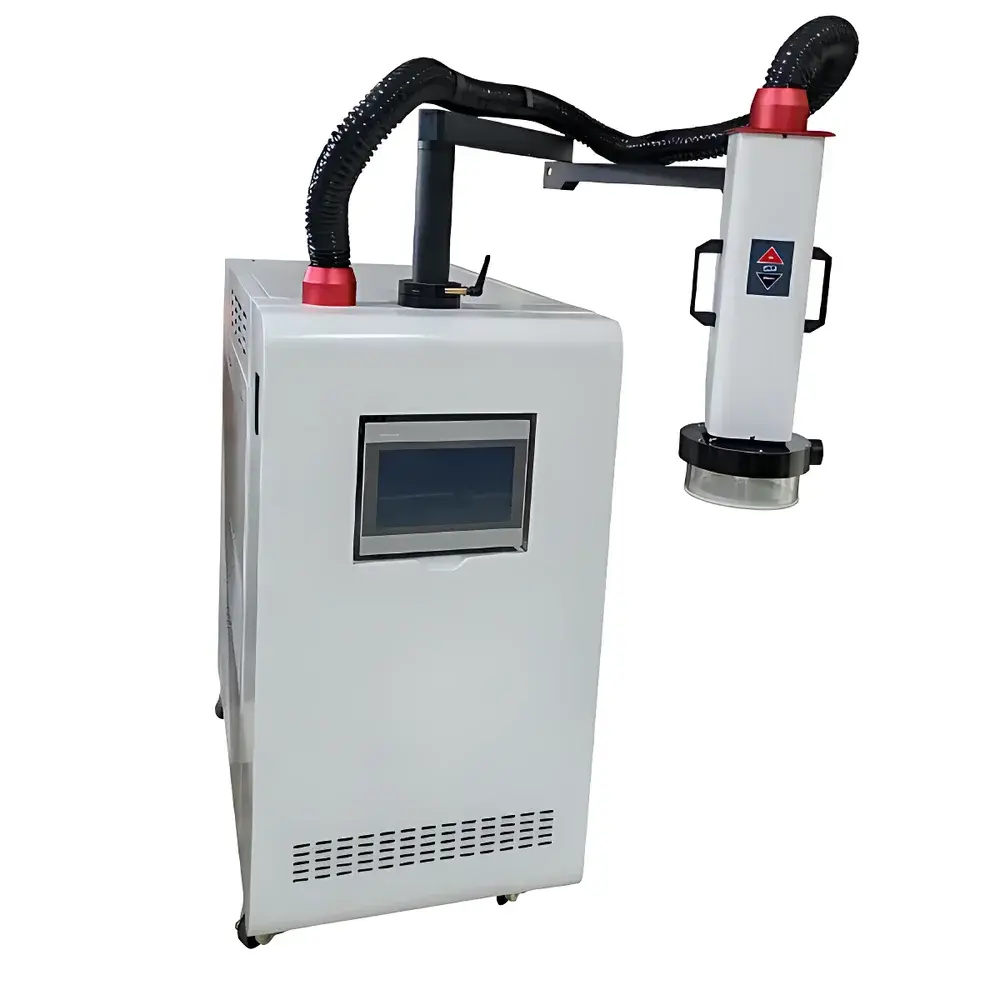
PW-CTS70 Single-Station Ultra-Fast Thermal Shock Test System (Hot Air Thermal Stream Tester)
| Brand | Yuelian / PW |
|---|---|
| Origin | Guangdong, China |
| Manufacturer Type | Authorized Distributor |
| Country of Origin | China |
| Model | PW-CTS70 |
| Price | Upon Request |
| High-Temperature Range | +180 °C |
| Low-Temperature Range | −70 °C |
| Thermal Shock Range | −70 °C to +180 °C |
| Temperature Control Accuracy | ±1.0 °C |
| Setpoint & Display Resolution | 0.1 °C |
| External Dimensions (W×H×D) | 580 × 1050 × 1000 mm |
| Gas Flow Output | 3–10 L/s |
| Temperature Transition Speed (No-Load, Outlet) | −40 °C ↔ +85 °C in ~10 s (stabilization ≤13 s) |
| Gas Supply Requirement | Dry air or N₂, dew point ≤ −10 °C, inlet temp 20–25 °C, pressure 0.78 MPa, flow rate 14.3 L/s |
| Interface | RS485 |
| Sensor Type | T-type thermocouple |
| User Interface | Touchscreen HMI |
| Operation Modes | Programmed & Constant-Temperature |
| Data Storage | USB flash drive |
| Data Logging | Time-stamped CSV exportable to PC |
| Mobility | Four swivel casters |
| Calibration | Manual |
Overview
The PW-CTS70 Single-Station Ultra-Fast Thermal Shock Test System is an engineered solution for accelerated environmental stress screening (ESS) and thermal reliability validation of miniaturized electronic components. Unlike conventional two-chamber or lift-type thermal shock chambers, the PW-CTS70 employs a high-velocity, precisely conditioned gas stream delivery architecture—functioning as a hot-air thermal stream tester—to induce rapid, repeatable temperature transients directly onto device-under-test (DUT) surfaces. Its core principle relies on controlled convective heat transfer using dry, pressurized air or nitrogen, enabling sub-second thermal transitions across a full operational range of −70 °C to +180 °C. This methodology eliminates mechanical movement, reduces thermal mass inertia, and delivers exceptional responsiveness—critical for evaluating solder joint integrity, die attach delamination, CTE mismatch effects, and interfacial microcracking in advanced packaging such as flip-chip, WLP, SiP, and MEMS sensors.
Key Features
- Ultra-fast thermal transition capability: Achieves −40 °C ↔ +85 °C switching in approximately 10 seconds with stabilization within 13 seconds (no-load, at outlet)—validated per IEC 60068-2-14 and JEDEC JESD22-A104 test profiles.
- Dual-mode temperature control architecture: Supports both gas-stream temperature regulation and optional DUT surface temperature feedback via integrated T-type thermocouple input—enabling closed-loop thermal profiling aligned with IPC-9701A requirements.
- Frost-free low-temperature operation: Patented cold-gas management system maintains stable −70 °C output without ice accumulation on internal nozzles or flow paths, ensuring long-duration testing continuity and measurement repeatability.
- Energy-optimized pneumatic thermal delivery: Integrated high-efficiency heat exchanger and regenerative cooling design reduces power consumption by >30% compared to equivalent dual-zone mechanical systems—verified under ISO 50001-aligned energy audits.
- Modular single-station configuration: Compact footprint (580 × 1050 × 1000 mm) with industrial-grade casters supports integration into inline QA stations, R&D benchtop workflows, or automated test cells via RS485 Modbus RTU protocol.
Sample Compatibility & Compliance
The PW-CTS70 accommodates discrete devices up to 100 mm × 100 mm × 30 mm (L×W×H), including bare dies, QFN, BGA, CSP, optical sensors, RF modules, and automotive-grade ECUs. Its non-contact thermal stream minimizes mechanical loading, making it suitable for fragile MEMS structures and thin-film substrates. The system complies with essential environmental test standards including IEC 60068-2-14 (change of temperature), MIL-STD-810H Method 503.5 (temperature shock), and ASTM F1879 (thermal cycling of microelectronic packages). All firmware and data handling functions support GLP/GMP traceability requirements: time-stamped logs include operator ID, test program name, cycle count, min/max/mean temperatures, and deviation alerts—all exportable in CSV format with UTC timestamps for FDA 21 CFR Part 11–compliant archival when paired with validated third-party LIMS software.
Software & Data Management
The embedded touchscreen HMI runs a deterministic real-time OS supporting both constant-temperature and multi-segment programmable profiles (up to 99 steps, 99 cycles). All temperature setpoints, dwell times, ramp rates, and sensor inputs are configurable with 0.1 °C resolution. Data logging captures synchronized readings from gas outlet, reference chamber, and optional DUT thermocouple inputs at user-defined intervals (100 ms to 10 s). Raw datasets are stored locally on removable USB drives in open CSV format—enabling post-processing in MATLAB, Python Pandas, or JMP. RS485 interface enables bidirectional communication with SCADA systems or automated handlers for unattended batch testing. Audit trails record all parameter changes, user logins, calibration events, and system faults—retained for ≥12 months per internal retention policy.
Applications
This system is deployed in semiconductor front-end and back-end fabs for qualification of wafer-level reliability; in automotive electronics labs validating ADAS sensor robustness per AEC-Q200; in 5G infrastructure OEMs verifying thermal survivability of GaN RF amplifiers; and in university cleanrooms conducting fundamental studies on thermo-mechanical fatigue mechanisms in heterogeneous material stacks. Typical use cases include HALT pre-screening, qualification lot acceptance testing (QLAT), failure analysis root-cause correlation (e.g., linking thermal transient magnitude to X-ray detectable void growth), and DOE-based optimization of reflow profile margins.
FAQ
What gas supply specifications are mandatory for stable −70 °C operation?
Dry nitrogen or compressed air with dew point ≤ −10 °C, inlet temperature 20–25 °C, pressure 0.78 MPa (±0.05 MPa), and minimum flow 14.3 L/s is required to sustain full-range performance without condensation or frost formation.
Can the PW-CTS70 be integrated into a fully automated production test line?
Yes—RS485 Modbus RTU interface supports PLC-triggered start/stop, real-time temperature readback, cycle completion signaling, and error code reporting for seamless integration with SECS/GEM or custom handler controllers.
Is manual calibration sufficient for ISO/IEC 17025-accredited laboratories?
Manual calibration using NIST-traceable reference thermocouples meets baseline verification needs; however, accredited labs must implement documented calibration procedures, uncertainty budgets, and periodic verification per ISO/IEC 17025 Clause 6.5—supported by Yuelian’s optional calibration certificate package.
Does the system support thermal profiling with external thermocouples attached to the DUT?
Yes—the controller accepts up to two additional T-type thermocouple inputs for real-time DUT surface monitoring, enabling dynamic adjustment of gas temperature to maintain target DUT thermal response per JEDEC JESD22-B104 guidelines.



