
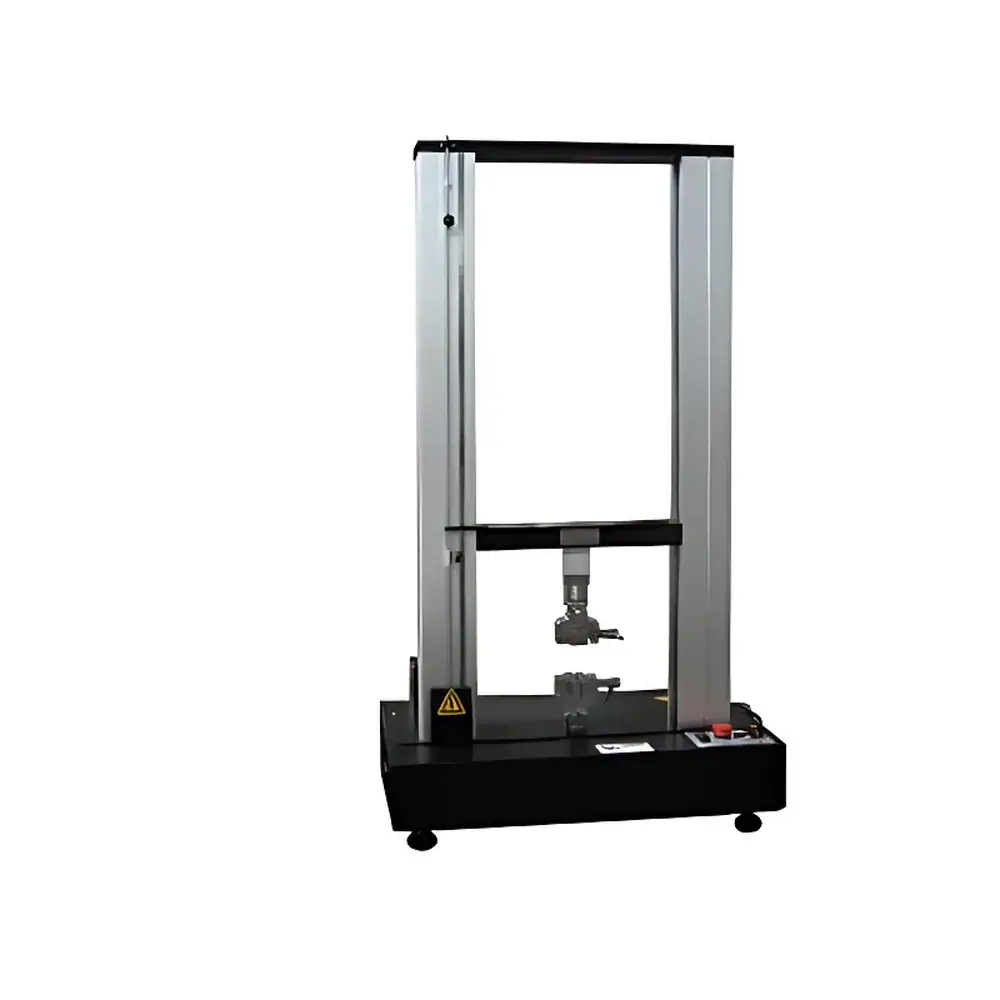
YL-1210 Universal Tensile Testing Machine
| Origin | Guangdong, China |
|---|---|
| Manufacturer Type | Authorized Distributor |
| Origin Category | Domestic (PRC) |
| Model | YL-1210 |
| Quotation | Available Upon Request |
| Load Capacity Options | 5 / 10 / 20 / 50 / 100 / 200 / 500 kgf |
| Force Resolution | 1/250,000 full scale |
| Force Accuracy | ≤ ±0.5% of reading |
| Displacement Resolution | 0.005 mm |
| Maximum Test Stroke | 700 mm (excluding fixtures) |
| Test Width | 420 mm |
| Speed Range | 0.5–500 mm/min |
| Force Unit Conversion | kgf, g, N, kN, lbf, ton (user-selectable) |
| Safety Stop Modes | Overload stop, specimen rupture detection, emergency stop button, upper/lower limit position stop, over-travel protection |
| Control Interface | PC-based closed-loop control system |
| Dimensions (W×D×H) | 62 × 50 × 140 cm |
| Net Weight | ~65 kg |
| Power Supply | AC 220 V, 50–60 Hz, 4 A |
| Standard Accessories | One set of universal tensile grips, dedicated test software, USB/RS232 interface cable, software installation disc |
Overview
The YL-1210 Universal Tensile Testing Machine is an electromechanical force-testing platform engineered for precision mechanical property evaluation of solid materials and components under uniaxial loading conditions. Based on servo-controlled linear actuation and high-fidelity load cell transduction, it implements ASTM E4, ISO 7500-1, and GB/T 228.1-compliant static tensile testing methodology. The system applies controlled displacement or load ramping to specimens while continuously acquiring synchronized force-displacement data—enabling quantitative determination of ultimate tensile strength (UTS), yield strength (YS), elongation at break, modulus of elasticity, and stress–strain behavior across diverse material classes. Its modular architecture supports both routine quality control verification and R&D-level mechanical characterization in regulated industrial environments.
Key Features
- High-resolution dual-circuit measurement: Force resolution of 1 part in 250,000 full scale ensures detection of subtle mechanical transitions during yielding or necking.
- Precision displacement tracking: 0.005 mm encoder resolution enables accurate strain calculation per ISO 527-1 and ASTM D638 protocols.
- Wide dynamic speed range: Adjustable crosshead velocity from 0.5 to 500 mm/min accommodates quasi-static ductile testing and rapid failure assessment per ASTM D882 (thin films) or ISO 179-1 (rigid plastics).
- Multi-unit force reporting: Real-time conversion among kgf, N, kN, lbf, and ton facilitates cross-laboratory data alignment and regulatory documentation.
- Comprehensive safety architecture: Integrated overload sensing, rupture-triggered auto-stop, hardware emergency cutoff, programmable travel limits, and mechanical over-travel buffers ensure operator and equipment protection per ISO 12100 requirements.
- PC-integrated control: Windows-based software provides closed-loop PID control, real-time curve plotting, automated parameter extraction (e.g., offset yield point, modulus slope), and export-ready reports compliant with GLP audit trails.
Sample Compatibility & Compliance
The YL-1210 accommodates standardized test specimens—including dog-bone, straight-bar, and strip geometries—as defined in ASTM E8/E8M (metals), ISO 527 (plastics), ISO 37 (elastomers), and ASTM D2256 (yarns). With a 420 mm test width and 700 mm effective stroke, it supports specimens up to 650 mm in length and accommodates custom fixtures for peel, shear, tear, and compression testing (e.g., ASTM D1876, ISO 11339). All firmware and software comply with ISO/IEC 17025 documentation integrity standards; data logging includes time-stamped metadata, user authentication logs, and immutable audit trails required under FDA 21 CFR Part 11 for pharmaceutical packaging validation and medical device component testing.
Software & Data Management
The bundled PC software delivers ISO 17025-aligned test management: users define test methods with configurable pre-load, rate-of-load, hold duration, and break criteria. Raw force–displacement data is acquired at ≥1 kHz sampling rate and stored in .csv and proprietary binary formats with embedded calibration coefficients. Automated calculations include Young’s modulus (via 0.1–0.3% strain linear region), proof stress (Rp0.2), total elongation (At), and reduction in area (Z%). Reports are exportable as PDF, Excel, or XML, supporting integration into LIMS and ERP systems. Software version history, electronic signatures, and change logs meet GMP Annex 11 and EU GMP Annex 11 traceability mandates.
Applications
This system serves cross-industry mechanical validation needs: tensile strength verification of aerospace fasteners (AMS 2300), elongation testing of automotive rubber bushings (SAE J2233), peel adhesion assessment of medical adhesive tapes (ISO 2932), breaking load analysis of textile fibers (ASTM D3822), and compressive yield evaluation of polymer foams (ISO 844). It is routinely deployed in QC labs for incoming raw material screening, in-process lot release, and final product conformance testing per IATF 16949 and ISO 9001 clause 8.5.2.
FAQ
What standards does the YL-1210 support for tensile testing?
It complies with ASTM E4 (load verification), ISO 7500-1 (calibration), ASTM E8/E8M (metals), ISO 527 (plastics), and GB/T 228.1 (Chinese national standard for metallic materials).
Can the system perform cyclic or fatigue tests?
No—the YL-1210 is designed exclusively for static monotonic testing. For dynamic or low-cycle fatigue applications, a servo-hydraulic or electrodynamic testing system is required.
Is the software compatible with Windows 10/11 and 64-bit architectures?
Yes—tested and certified for Windows 10 Pro (64-bit) and Windows 11 Enterprise (64-bit) with .NET Framework 4.8 and TLS 1.2 encryption.
Does the system include calibration certification?
A factory-issued certificate of conformity is supplied; optional UKAS-accredited calibration with uncertainty budget is available upon request.
How is traceability maintained for audit purposes?
All test sessions record operator ID, timestamp, environmental conditions (if external sensors are connected), calibration status, and digital signature—fully auditable per ISO/IEC 17025 clause 7.7 and FDA 21 CFR Part 11 §11.10(a).



