
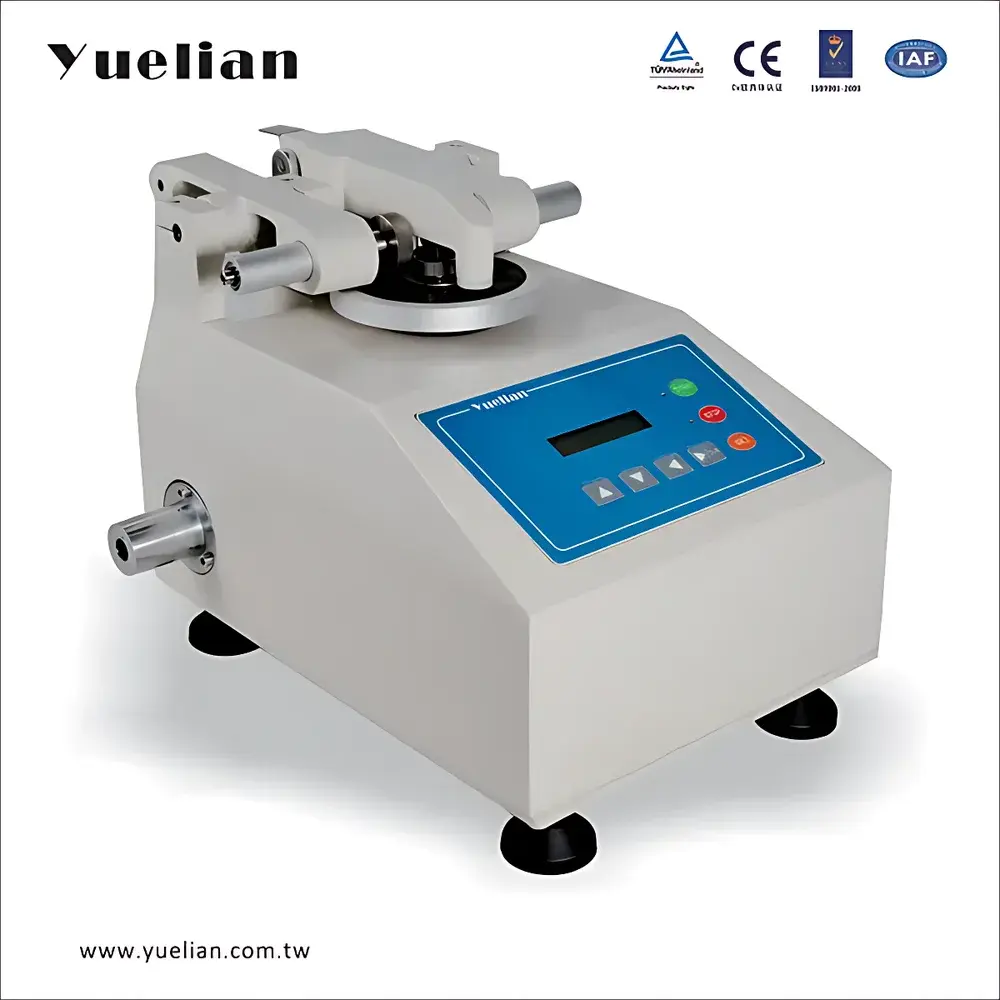
YL-3315T1 Taber Abraser for Automotive Headlamp Lens Wear Testing
| Brand | Yuelian |
|---|---|
| Origin | Guangdong, China |
| Model | YL-3315T1 |
| Counting Range | 0–999,999 cycles |
| Auto-Stop Function | Yes |
| Center-to-Center Distance Between Abrading Wheels | 63.5 mm |
| Distance from Abrading Wheel Center to Specimen Plate Center | 38 mm |
| Applied Loads | 250 g, 500 g, 1000 g (user-selectable) |
| Abrasive Wheel Specification | User-defined (compliant with ASTM D4060, JIS K7350) |
| Rotational Speed | 1–100 RPM (factory default: 60 RPM) |
| Dimensions (W×D×H) | 550 × 380 × 470 mm |
| Net Weight | ~30 kg |
| Power Supply | 220 V, 50/60 Hz |
Overview
The YL-3315T1 Taber Abraser is a precision-engineered tribological testing instrument designed specifically for evaluating the surface wear resistance of automotive headlamp lens materials—including polycarbonate (PC), acrylic (PMMA), and coated polymer substrates—under controlled rotary abrasion conditions. Based on the fundamental principles of the Taber Abrasion method, this tester applies calibrated mechanical stress via two counter-rotating abrasive wheels mounted on a rotating arm assembly. As the specimen rotates beneath the wheels under defined load and speed, material removal occurs through repetitive sliding contact, simulating real-world environmental abrasion such as road debris impact, wiper action, and fine particulate exposure. The system enables quantitative assessment of wear performance using standardized metrics including mass loss (mg), volume loss (mm³), or depth reduction (µm), all traceable to internationally recognized test protocols.
Key Features
- Compliant mechanical architecture engineered for high reproducibility across repeated test cycles, with rigid cast-iron base and precision-machined aluminum housing ensuring minimal vibration and positional drift.
- Dual-wheel abrasion configuration with adjustable center spacing (63.5 mm) and fixed radial offset (38 mm) to maintain consistent contact geometry per ASTM D4060 and JIS K7350 specifications.
- Three standard vertical loading options (250 g, 500 g, 1000 g) delivered via calibrated dead-weight assemblies—no pneumatic or electromagnetic interference—ensuring long-term force stability and traceability.
- Digitally programmable cycle counter (0–999,999) with automatic termination and audible alert upon completion; supports pre-set test duration or endpoint-based stopping logic.
- Variable rotational speed control (1–100 RPM) via integrated DC motor drive and digital speed regulator—enabling optimization for low-speed durability screening or high-speed accelerated wear profiling.
- Modular wheel-mounting interface compatible with industry-standard CS-10, CS-17, S-32, and H-18 abrasive wheels, allowing seamless adaptation to diverse material hardness and surface finish requirements.
Sample Compatibility & Compliance
The YL-3315T1 accommodates flat, rigid specimens up to 105 mm in diameter and 20 mm in thickness, making it suitable for both raw lens substrates and fully assembled lamp covers (with appropriate fixturing). Test specimens must be securely clamped using the standard vacuum chuck or optional mechanical clamp set to prevent slippage during rotation. The instrument meets essential mechanical and operational criteria outlined in ASTM D4060 (Standard Test Method for Abrasion Resistance of Organic Coatings by the Taber Abraser), JIS K7350 (Plastics—Determination of Abrasion Resistance Using the Taber Abrader), and ISO 9352 (Plastics—Determination of Resistance to Abrasion Using the Taber Abrader). While not certified to ISO/IEC 17025, its design facilitates integration into GLP-compliant laboratory workflows when paired with documented calibration procedures and operator training records.
Software & Data Management
The YL-3315T1 operates as a standalone electromechanical system without embedded firmware or proprietary software. All operational parameters—including cycle count, applied load, and rotational speed—are configured manually via front-panel dials and toggle switches. This analog-digital hybrid architecture ensures deterministic behavior, eliminates firmware update dependencies, and simplifies validation for regulated environments. Users are expected to record test parameters and post-test measurements (e.g., mass change via analytical balance, haze increase via hazemeter, or profilometric depth mapping) in external laboratory notebooks or LIMS-compatible spreadsheets. For audit readiness, laboratories may implement supplementary documentation controls—including equipment logbooks, calibration certificates for weights and tachometers, and SOPs aligned with ASTM E177 (Standard Practice for Use of the Terms Precision and Bias in ASTM Test Methods).
Applications
- Quantitative ranking of anti-scratch hardcoat formulations applied to polycarbonate headlamp lenses.
- Comparative evaluation of UV-stabilized vs. non-stabilized acrylic substrates under simulated roadside grit exposure.
- Validation of cleaning protocol efficacy on coated optical surfaces by measuring post-wipe abrasion resistance degradation.
- Pre-certification wear screening for OEM Tier-1 suppliers targeting compliance with SAE J576 (Lighting Devices) and ECE R112 (Headlamps for Motor Vehicles) durability clauses.
- Research-grade investigation of tribochemical wear mechanisms in transparent thermoplastics under variable humidity and temperature preconditioning.
FAQ
Is the YL-3315T1 compliant with FDA or ISO 13485 requirements?
No—this instrument is intended for materials R&D and quality control in automotive component manufacturing, not medical device production. It does not incorporate features required for 21 CFR Part 11 or ISO 13485 traceability (e.g., electronic signatures, audit trails, or user role management).
Can the unit be calibrated to NIST-traceable standards?
Yes—load cells, tachometers, and cycle counters can be externally verified using NIST-traceable reference instruments. Calibration intervals should follow internal SOPs or ISO/IEC 17025 guidelines if used in accredited labs.
What maintenance is required for long-term repeatability?
Monthly inspection of wheel mounting screws, quarterly verification of load weight accuracy, and annual lubrication of the main shaft bearing per manufacturer’s mechanical service manual.
Does the system support custom wheel profiles or non-standard specimen geometries?
Standard operation assumes flat, circular specimens. Custom fixtures (e.g., curved lens holders or edge-clamping jigs) may be fabricated externally but require full mechanical validation prior to use.
Is technical support available in English for international users?
Yes—Yuelian provides English-language operation manuals, dimensional drawings, and basic troubleshooting guides. Remote video-assisted commissioning is available upon request for qualified distributors.
Related Products



