
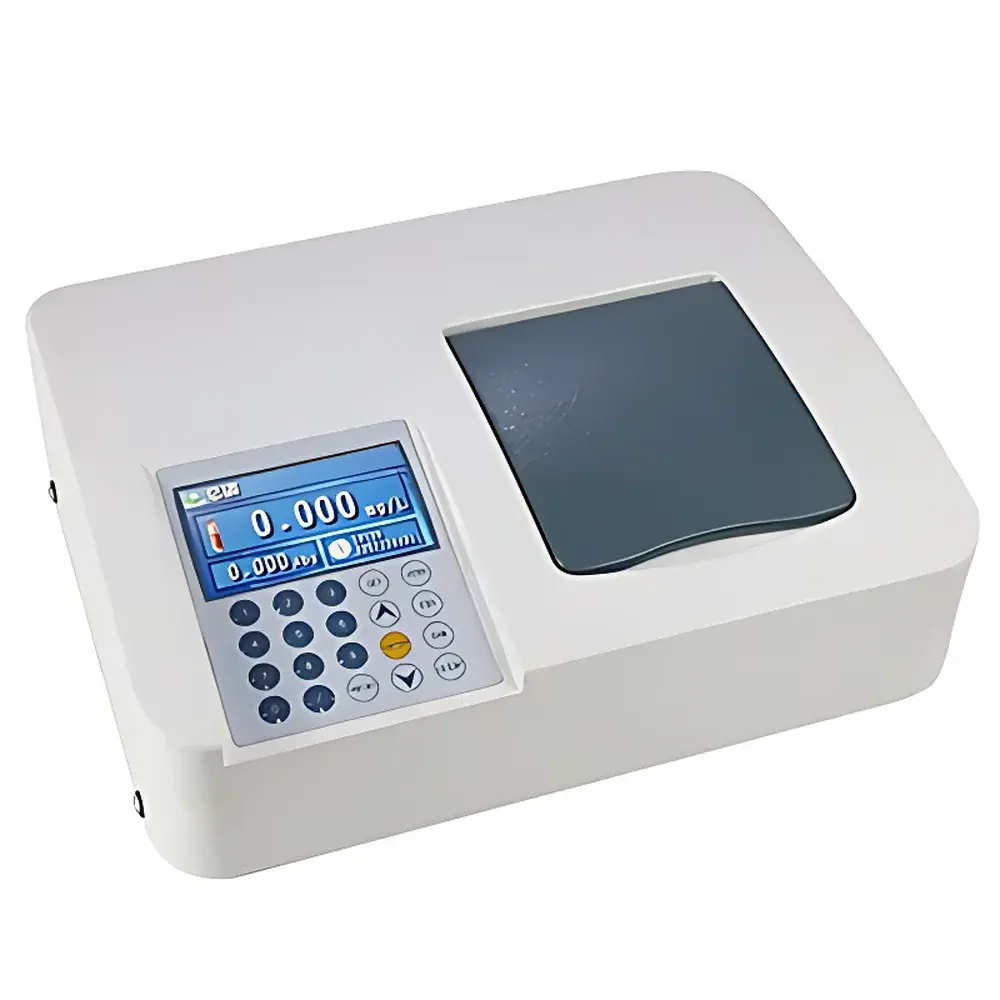
Yoke 5B-3NP Desktop Total Phosphorus Rapid Analyzer
| Brand | Yoke |
|---|---|
| Origin | Shanghai, China |
| Manufacturer Type | Manufacturer |
| Model | 5B-3NP |
| Measurement Principle | Spectrophotometry (Molybdenum Blue Method) |
| Measurement Range | 0.002–20 mg/L (multi-range segmented calibration) |
| Detection Limit | 0.002 mg/L |
| Accuracy | ≤5% |
| Repeatability | ≤±5% |
| Optical Stability | ≤0.001 A/10 min |
| Light Source | Cold LED with narrow-band interference filter, lifetime ≥100,000 h |
| Display | 4.3-inch color TFT LCD |
| Data Storage | Internal memory (500 MB), supports USB flash drive export |
| Curve Library | 200 programmable calibration curves (5 factory-default + 195 user-expandable), including segmented curve fitting with concentration-dependent K coefficients |
| Sample Throughput | 20 samples per batch |
| Measurement Time | 35–50 min per batch |
| Interface | USB 2.0 (standard), Bluetooth optional |
| Cuvette Compatibility | 10-mm rectangular cuvettes (high-precision mode) and 16-mm round test tubes (routine screening mode) |
| Compliance | Designed to meet ASTM D515-89 (Standard Test Method for Phosphorus in Water), ISO 6878:2004 (Water Quality — Determination of Phosphorus — Ammonium Molybdate Spectrophotometric Method), and supports GLP-compliant data traceability (audit trail via timestamped storage) |
Overview
The Yoke 5B-3NP Desktop Total Phosphorus Rapid Analyzer is a dedicated laboratory-grade spectrophotometric instrument engineered for accurate, reproducible quantification of total phosphorus (TP) in environmental water matrices—including wastewater, surface water, groundwater, and treated effluent. It implements the standardized molybdenum blue colorimetric method (per ASTM D515-89 and ISO 6878:2004), wherein orthophosphate—liberated from all phosphorus species via high-temperature persulfate digestion—is reacted with ammonium molybdate and ascorbic acid under controlled acidic conditions to form a stable phosphomolybdenum blue complex. Absorbance is measured at 700 nm using a precision narrow-band interference optical system, ensuring minimal spectral interference and high photometric fidelity. The analyzer’s segmented measurement range (0.002–20 mg/L P) enables optimal signal-to-noise ratio across low-level regulatory compliance testing (e.g., <0.1 mg/L discharge limits) and higher-concentration industrial effluent monitoring—without manual dilution or range switching.
Key Features
- High-stability cold LED light source with narrow-band interference filtering (center wavelength ±1 nm tolerance), eliminating thermal drift and delivering >100,000 h operational lifetime—significantly exceeding halogen lamp-based alternatives.
- ARM9-based embedded architecture with 500 MB internal memory, enabling smooth GUI navigation, real-time data processing, and secure local storage of up to 2,000 complete test records (including date, time, sample ID, calibration curve ID, raw absorbance, and final concentration).
- Dual-format sample compatibility: supports both 10-mm quartz/glass cuvettes (for trace-level accuracy per EPA Method 365.4) and standard 16-mm round glass test tubes (for rapid field-lab screening), with automatic pathlength compensation in firmware.
- 200-curve library architecture—including 5 pre-validated factory curves and 195 expandable slots—enabling users to store application-specific segmented calibrations where slope (K) and intercept vary dynamically across concentration sub-ranges, improving linearity and reducing relative error at extremes.
- Comprehensive data export: native USB 2.0 interface for direct transfer to Windows/Linux PCs; optional Bluetooth 4.2 module available for wireless synchronization with LIMS or QA/QC dashboards—supporting CSV and XML formats with embedded metadata (operator ID, instrument serial, digestion protocol version).
- GLP-ready operation: all measurements are timestamped and tagged with curve version, reagent lot number (manually entered), and digestion temperature/duration (if integrated with compatible digester); audit logs retain first-write integrity and prevent post-hoc editing.
Sample Compatibility & Compliance
The 5B-3NP is validated for use with aqueous samples meeting standard pretreatment requirements: homogenized, filtered (0.45 µm membrane), and digested using alkaline potassium persulfate (or alternative USP/ISO-recognized oxidants) at 120–124 °C for 30 minutes. It complies with key international regulatory frameworks—including U.S. EPA Clean Water Act reporting thresholds, EU Urban Wastewater Treatment Directive (91/271/EEC) Annex I phosphorus limits, and China’s GB 3838-2002 Class V surface water standards. While not an FDA 21 CFR Part 11-certified system out-of-box, its data structure and immutable storage logic align with ALCOA+ principles (Attributable, Legible, Contemporaneous, Original, Accurate, Complete, Consistent, Enduring, Available), facilitating validation for GMP-environmental monitoring programs when deployed with documented SOPs and periodic performance verification.
Software & Data Management
The instrument operates on a proprietary embedded OS with dual-language UI (English/Chinese selectable). All calibration curves—including user-generated segmented models—are stored with full parameter metadata (wavelength, blank type, polynomial order, R², RMSE). Raw absorbance values and derived concentrations are exported with ISO 8601 timestamps and UTC-aligned clocks. USB exports include a manifest file listing instrument firmware revision, calibration certificate expiry (if linked), and digestion protocol ID—enabling automated reconciliation with lab information management systems (LIMS). Optional PC software (Yoke LabLink v3.2) provides statistical QC charting (X-bar/R, Levey-Jennings), multi-instrument fleet monitoring, and PDF report generation compliant with ISO/IEC 17025 clause 7.8.2.
Applications
- Regulatory wastewater discharge monitoring (TP ≤ 1.0 mg/L for municipal plants; ≤0.5 mg/L for sensitive watersheds)
- Source water quality assessment in reservoirs and rivers prior to coagulation treatment
- Process control in tertiary phosphorus removal units (e.g., metal salt dosing, biological P-removal verification)
- Educational laboratories requiring robust, low-maintenance TP analysis for environmental chemistry curricula
- Contract environmental labs performing batch analysis for municipal clients under ISO/IEC 17025 accreditation
FAQ
Does the 5B-3NP include an integrated digestion unit?
No—the 5B-3NP is a dedicated spectrophotometer and requires external digestion (e.g., Yoke 5B-DIGEST or equivalent ISO 6878-compliant block digester) prior to analysis.
Can calibration curves be transferred between instruments?
Yes—curve files (.ycf format) are portable via USB and retain all mathematical parameters, enabling method harmonization across multi-site deployments.
Is NIST-traceable calibration verification supported?
The instrument accepts NIST SRM 3140a (phosphate standard) for daily verification; built-in “Check Standard” mode automates % recovery calculation and flags deviations >5% per ISO 8466-1.
What maintenance is required for long-term optical stability?
No routine optical alignment is needed; the sealed LED-optics module requires only quarterly cleaning of the cuvette chamber window with lint-free lens tissue and isopropyl alcohol.
How is data integrity ensured during power interruption?
All measurements in progress are auto-saved to non-volatile memory every 5 seconds; incomplete runs resume from last valid absorbance reading upon reboot.







