
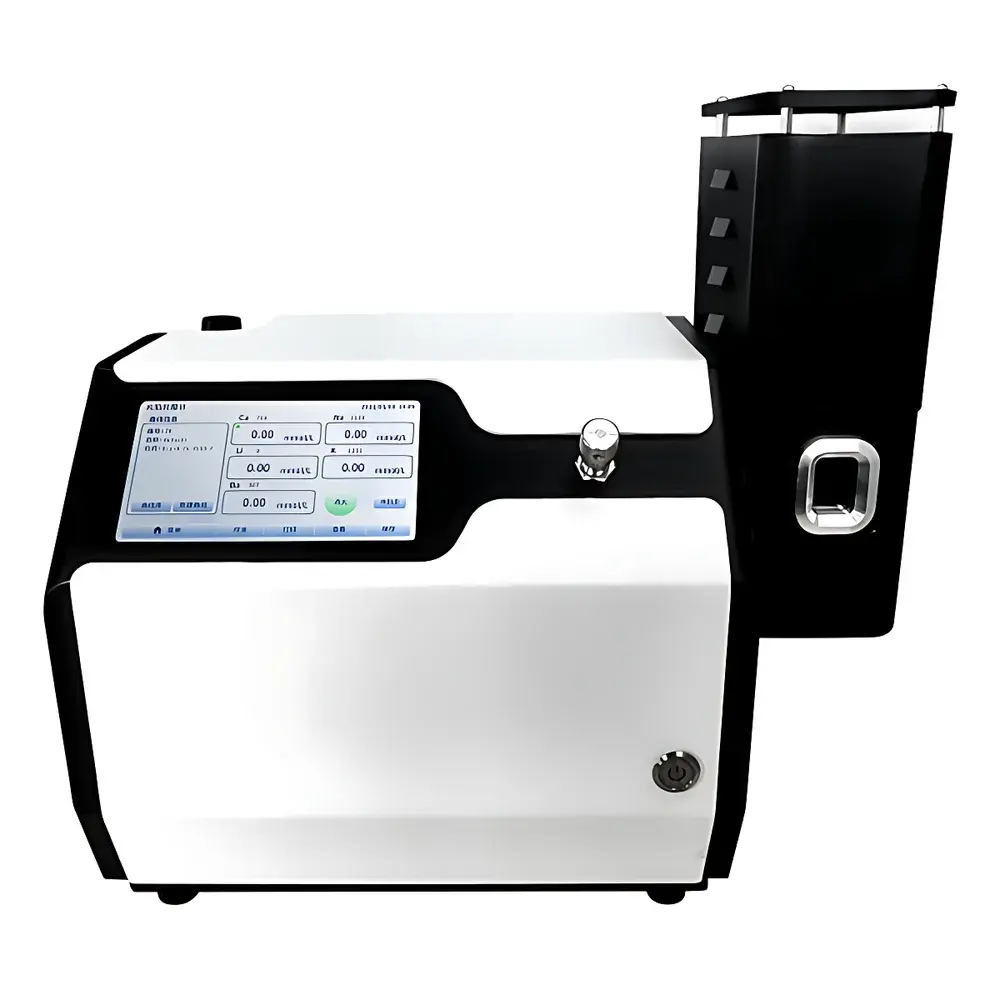
Yoke FP6410 Multi-Element Flame Photometer
| Brand | Yoke |
|---|---|
| Origin | Shanghai, China |
| Manufacturer Type | Direct Manufacturer |
| Country of Origin | China |
| Model | FP6410 |
| Detection Limit (K) | ≤0.004 mmol/L |
| Response Time | ≤8 s |
| Repeatability | ≤3% |
| Sample Introduction Rate | ≤6 mL/min |
| Display | 7-inch capacitive touchscreen LCD |
| Simultaneous Analysis | K and Na |
| Safety Features | Flame-out protection, gas leakage alarm |
| Data Export | USB port + U-disk support |
| Connectivity | Cloud-enabled interface |
| Operating Temperature | 10–35 °C |
| Relative Humidity | ≤85% RH |
| Built-in Calibration Curve Fitting | Automatic correlation coefficient calculation |
Overview
The Yoke FP6410 Multi-Element Flame Photometer is a compact, benchtop analytical instrument engineered for the quantitative determination of alkali and alkaline earth metals—primarily potassium (K) and sodium (Na)—in aqueous solutions via atomic emission spectroscopy. It operates on the fundamental principle of flame photometry: sample aerosols are introduced into a stable air-propane or air-butane flame, where thermal energy excites valence electrons of target metal atoms; upon relaxation, characteristic wavelengths of visible light (e.g., 766.5 nm for K, 589.0 nm for Na) are emitted and measured by a high-stability optical system with interference filters and a low-noise photodetector. The FP6410 is designed for routine quality control in environmental laboratories, clinical chemistry units, agricultural soil testing facilities, and industrial water treatment plants where rapid, cost-effective, and robust elemental analysis is required without the complexity or cost of ICP-OES.
Key Features
- Integrated 7-inch capacitive touchscreen LCD interface enabling intuitive navigation, real-time signal monitoring, and on-device calibration curve management;
- Dual-channel simultaneous detection capability for potassium and sodium, eliminating sequential measurement delays and improving throughput in high-volume sample workflows;
- Comprehensive safety architecture including automatic flame-out detection, propane/butane gas leakage sensing with audible/visual alerts, and interlocked ignition sequence to prevent uncontrolled fuel release;
- Onboard statistical engine supporting automatic linear regression analysis with real-time R² (correlation coefficient) calculation for calibration curves per element;
- Dual data connectivity: native USB 2.0 host port for direct connection to external printers or PCs, plus plug-and-play USB flash drive support for secure, offline data archiving in CSV format;
- Cloud-ready firmware architecture compatible with secure TLS 1.2–enabled remote data synchronization and centralized instrument fleet monitoring (requires optional Yoke Cloud Gateway module and enterprise network configuration);
- Compact footprint (W × D × H ≈ 320 × 350 × 420 mm) and low power consumption (<80 W), suitable for shared lab benches and mobile field labs with regulated AC supply.
Sample Compatibility & Compliance
The FP6410 accepts clarified, low-turbidity aqueous samples—including serum, urine, plant digests, fertilizer extracts, boiler water, and wastewater effluents—with minimal pretreatment (typically 0.45 µm filtration and dilution to fit the linear dynamic range). It complies with core methodological standards underpinning flame photometric analysis, including ASTM D1293 (electrical conductivity and pH of water), ISO 11885 (water quality — determination of selected elements by ICP-AES, with flame photometry cited as an acceptable alternative for Na/K in Annex B), and USP (Sodium and Potassium in pharmaceutical excipients). While not inherently 21 CFR Part 11 compliant out-of-the-box, audit-trail functionality—including operator ID logging, timestamped calibration records, and immutable result export metadata—can be enabled via firmware update and integrated with validated LIMS environments meeting GLP/GMP documentation requirements.
Software & Data Management
Data acquisition and reporting are managed through embedded firmware (v3.2+), supporting up to 200 user-defined calibration sets with slope/intercept recall, drift correction prompts, and QC check sample flagging. All measurements are time-stamped and tagged with operator ID (via optional RFID badge reader integration). Raw intensity values, concentration results, and calibration parameters are exportable in comma-separated values (CSV) format, preserving full traceability for internal QA review or external accreditation audits. USB mass storage mode allows direct drag-and-drop file transfer without proprietary software dependencies. For enterprise deployment, the optional Yoke Instrument Manager desktop application (Windows 10/11, .NET 6+) provides centralized configuration backup, remote firmware updates, and batch report generation aligned with ISO/IEC 17025 clause 7.8 reporting requirements.
Applications
- Clinical diagnostics: Quantitative assessment of serum and urine Na⁺/K⁺ ratios for electrolyte imbalance evaluation;
- Agricultural science: Rapid screening of K and Na content in soil extracts and foliar sprays to guide fertilizer formulation;
- Food & beverage QA: Monitoring salt (NaCl) levels in processed foods, dairy products, and brewing wort;
- Environmental monitoring: Determination of alkali metal concentrations in surface water, groundwater, and desalination brines;
- Pharmaceutical manufacturing: In-process testing of buffer solutions and final product electrolyte composition per pharmacopoeial monographs;
- Academic teaching labs: Hands-on instruction in atomic spectroscopy fundamentals, calibration theory, and analytical validation concepts (LOD, precision, linearity).
FAQ
What gases are compatible with the FP6410 flame system?
Propane or butane with compressed air as the oxidant; cylinder regulators must provide stable 0.15–0.25 MPa fuel pressure and ≥20 L/min airflow. Natural gas is not supported.
Is method validation support provided with the instrument?
Yes—Yoke supplies a comprehensive validation protocol package including blank response assessment, LOD/LOQ verification templates, repeatability test worksheets, and linearity evaluation guides aligned with ICH Q2(R2) principles.
Can the FP6410 be integrated into a laboratory information management system (LIMS)?
Direct LIMS integration is achievable via ASCII-based RS-232 or TCP/IP socket communication (optional module); CSV exports also enable seamless ingestion into most modern LIMS platforms via scheduled import scripts.
What maintenance intervals are recommended for optimal performance?
Nebulizer cleaning every 50 hours of operation; burner head inspection and alignment quarterly; optical filter verification annually using NIST-traceable emission sources.
Does the instrument meet CE or UKCA marking requirements?
The FP6410 conforms to EU Directive 2014/30/EU (EMC) and 2014/35/EU (LVD); CE marking is affixed to the rear panel. UKCA compliance is maintained via identical technical documentation and notified body assessment (Certificate No. YK-EMC-LVD-2023-0872).





