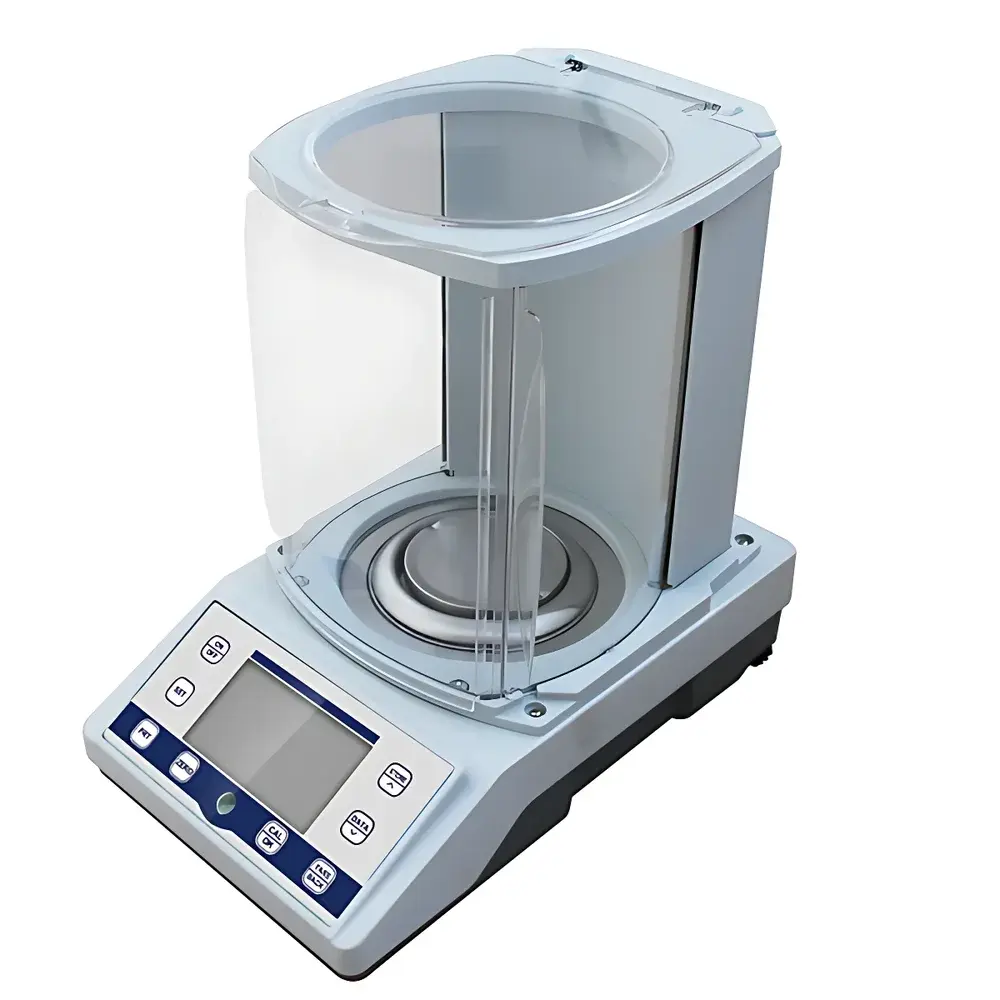
Yoke GC-C Series Internal Calibration Precision Balance
| Brand | Yoke |
|---|---|
| Origin | Shanghai, China |
| Manufacturer | Yoke Instrument Co., Ltd. |
| Type | Precision Balance |
| Capacity Range | 100–500 g |
| Readability | 1 mg |
| Accuracy Class | Class II (per OIML R76) |
| Repeatability | ±1 mg |
| Pan Diameter | 90 mm |
| Dimensions (W×D×H) | 360 × 220 × 350 mm |
| Net Weight (incl. packaging) | 7.5 kg |
| Power Supply | DC 9 V / 1 A |
Overview
The Yoke GC-C Series Internal Calibration Precision Balance is an OIML Class II-compliant analytical-grade weighing instrument engineered for laboratories requiring reliable 1 mg readability across capacities from 100 g to 500 g. Built upon electromagnetic force compensation (EMFC) technology, the GC-C series delivers high reproducibility and long-term stability by leveraging precision-machined sensor components manufactured in CNC-controlled environments. Its core architecture integrates a 32-bit ARM microprocessor with adaptive digital filtering algorithms, enabling optimized response dynamics without compromising metrological integrity. The balance operates under ISO/IEC 17025-aligned environmental conditions (20 ± 5 °C, <70% RH, minimal air turbulence) and meets the performance requirements defined in ASTM E898, USP <41>, and EN 45501 for routine quality control, formulation, and sample preparation workflows.
Key Features
- Internal calibration system with motor-driven calibration mass actuation—eliminates manual handling of external weights and ensures traceable, repeatable recalibration at user-defined intervals or upon power-up.
- EMFC transducer assembly fabricated using high-precision CNC machining to minimize thermal drift and mechanical hysteresis; validated for ≥100,000 load cycles under nominal operating conditions.
- Sealed draft shield design with ergonomic front-access door and integrated anti-static coating—reduces convective interference and electrostatic perturbation during low-mass measurements.
- Multi-function operation modes including piece counting, checkweighing, density determination (with optional density kit), and animal/weighing-in-motion mode—each configured with independent zero-tracking thresholds and stabilization criteria.
- SMT-assembled PCB architecture with conformal coating protection against humidity and particulate ingress—enhancing MTBF beyond 50,000 hours per IEC 62304 Class B software safety standards.
- Backlit BTN black-on-gray LCD display (128 × 64 pixels) with adjustable contrast and auto-dimming—optimized for readability under varied ambient lighting, including ISO 15197-compliant clinical lab settings.
Sample Compatibility & Compliance
The GC-C series accommodates standard laboratory samples ranging from powders and granules to small solid components and pre-weighed vials. With a 90 mm stainless-steel weighing pan and clearance height of 220 mm, it supports compatibility with common volumetric flasks (up to 1000 mL), crucibles, and weigh boats. All models comply with OIML R76-1 (2021 edition) for Class II accuracy, satisfy EU Measuring Instruments Directive (MID) Annex MI-001 essential requirements, and are designed to support GLP/GMP documentation workflows. Internal calibration traceability is maintained via factory-assigned certificate of conformity (CoC), referencing NIST-traceable master standards used during final verification. Optional audit trail logging (via RS232/USB interface) enables alignment with FDA 21 CFR Part 11 requirements when paired with compliant third-party data acquisition software.
Software & Data Management
Data output is supported via bidirectional RS232 and USB virtual COM port interfaces, compatible with Windows/macOS/Linux platforms. The balance transmits stable weight values in ASCII format (e.g., “S+000.1234 g”) with programmable transmission timing (1–10 s intervals) and configurable prefix/suffix identifiers. Optional YokeBalance PC Suite (v3.2+) provides real-time graphing, statistical analysis (mean, SD, CV%), batch export to CSV/XLSX, and electronic signature-enabled report generation. All firmware updates are delivered as signed binaries verified against SHA-256 checksums, ensuring secure field deployment without hardware modification.
Applications
- Pharmaceutical QC labs: Active pharmaceutical ingredient (API) dispensing, excipient blending verification, and tablet weight uniformity testing per USP <905>.
- Academic research: Gravimetric preparation of standard solutions, catalyst loading quantification, and thermogravimetric analysis (TGA) sample tare procedures.
- Food & beverage testing: Nutrient fortification validation, moisture content determination (with halogen moisture analyzer integration), and net content compliance checks per EU Regulation 76/211/EEC.
- Materials science: Powder flow characterization (via loss-in-weight feeding calibration), thin-film deposition mass monitoring, and ceramic green-body density profiling.
- Environmental labs: Filter weighing for PM2.5/PM10 gravimetric analysis (EPA Method IO-4.2), and reagent aliquoting for ICP-MS sample digestion protocols.
FAQ
What calibration standards does the internal calibration mechanism reference?
The internal calibration mass is factory-adjusted against NIST-traceable reference weights (Class E2) and certified per ISO/IEC 17025 by an ILAC-MRA accredited calibration laboratory.
Is the GC-C series suitable for use in regulated GxP environments?
Yes—when operated with enabled audit trail logging, password-protected configuration access, and periodic verification using external Class M2 weights, it fulfills baseline requirements for ALCOA+ data integrity principles.
Can the balance be integrated into LIMS or ELN systems?
Yes—ASCII-formatted serial output is natively supported by most major LIMS vendors (e.g., LabWare, Thermo Fisher SampleManager); custom drivers available upon request.
What is the warm-up time required to achieve full specification accuracy?
Stabilization to ±1 mg repeatability is achieved within 30 minutes after power-on under controlled lab conditions (23 ± 2 °C, no drafts).
Does the device support automatic environmental compensation?
No—ambient temperature and barometric pressure compensation are not implemented; users must maintain stable environmental conditions per OIML R76 guidance for Class II instruments.