Yoke GC Series Precision Balance (1 mg readability)
| Brand | Yoke |
|---|---|
| Origin | Shanghai, China |
| Manufacturer | Yoke Instrument Co., Ltd. |
| Type | Precision Balance |
| Capacity Range | 100–500 g |
| Readability | 1 mg |
| Accuracy Class | Class II (per OIML R76) |
| Calibration | External |
| Repeatability | ±1 mg |
| Pan Diameter | 90 mm |
| Dimensions (W×D×H) | 360 × 220 × 350 mm |
| Net Weight (incl. packaging) | 7.5 kg |
| Power Supply | DC 9 V / 1 A |
Overview
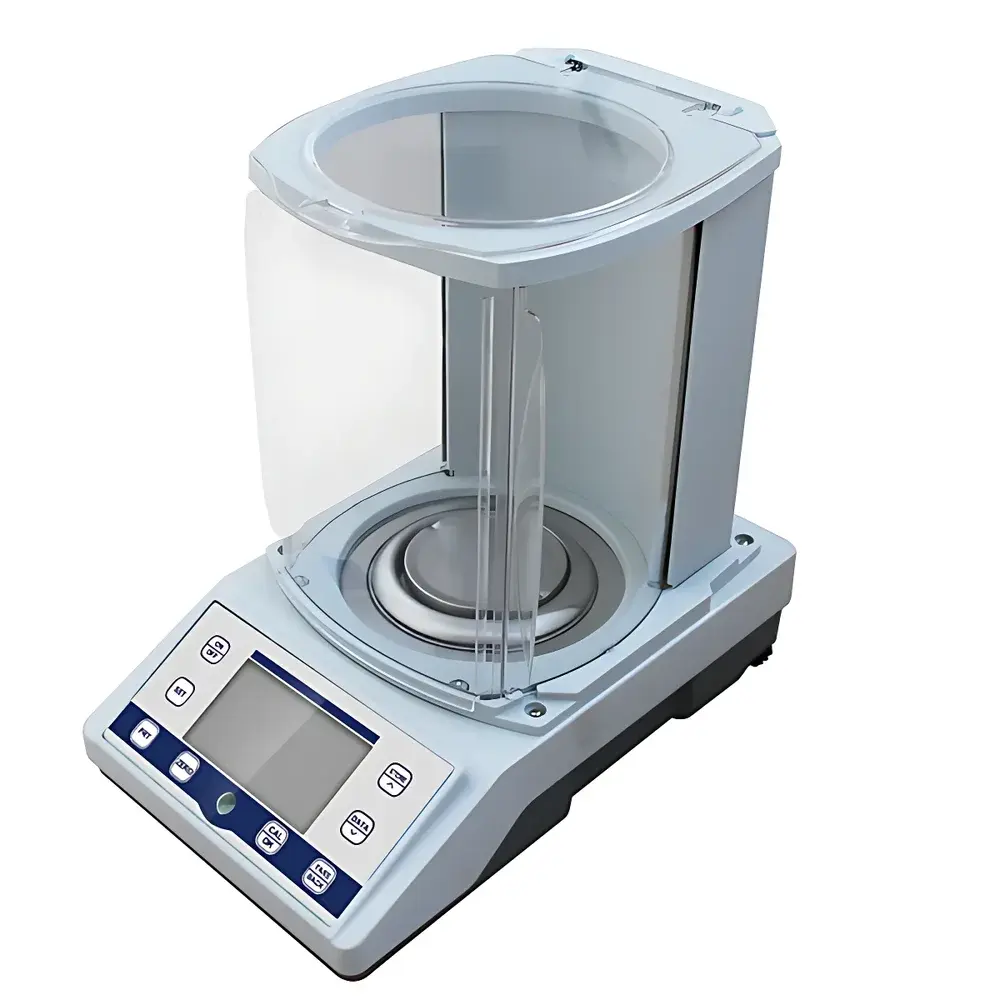
The Yoke GC Series Precision Balance is an OIML Class II-compliant analytical-grade weighing instrument engineered for laboratory, quality control, and educational applications requiring reliable 1 mg readability across capacities from 100 g to 500 g. Utilizing high-stability electromagnetic force compensation (EMFC) technology, the GC Series delivers consistent mass measurement performance under variable environmental conditions. Each unit integrates a precision-machined electromagnetic sensor assembly manufactured using CNC-controlled metrology-grade processes—ensuring long-term linearity, thermal drift resistance, and mechanical robustness. The balance operates on a dedicated 32-bit ARM microcontroller architecture, enabling real-time digital signal processing with adaptive filtering algorithms that suppress vibration-induced noise and optimize settling time without compromising resolution. Designed for ISO/IEC 17025-aligned workflows, the GC Series supports traceable calibration via certified external weights and meets fundamental metrological requirements for routine verification in GLP environments.
Key Features
- Electromagnetic force compensation (EMFC) sensor system with CNC-fabricated core components for enhanced stability and longevity
- 32-bit ARM microprocessor with embedded digital filtering and dynamic response optimization
- Class II accuracy per OIML R76 and EN 45501 standards; verified repeatability of ±1 mg across full capacity range
- Sealed draft shield enclosure with ergonomic access and optical clarity for contamination-sensitive operations
- Multi-function operating modes: counting, checkweighing, density determination (with optional kit), and animal/dynamic weighing
- SMT-assembled PCBs for improved thermal management, signal integrity, and long-term reliability
- Backlit BTN black-on-gray LCD display with 18 mm character height for high-contrast readability under low ambient light
Sample Compatibility & Compliance
The GC Series accommodates standard laboratory samples up to 500 g on its 90 mm diameter stainless steel weighing pan. Its sealed draft shield design minimizes air current interference, making it suitable for powders, granules, small components, and non-volatile liquid containers. All models comply with OIML R76-1 (2017) Class II tolerances and satisfy essential requirements of EN 45501:2015 for non-automatic weighing instruments. While not inherently 21 CFR Part 11 compliant, the balance supports audit-ready documentation when integrated into validated workflows—external calibration records, user-defined SOPs, and manual entry logs can be maintained in accordance with ISO/IEC 17025 clause 7.7 and FDA guidance for laboratory equipment qualification. No built-in connectivity or electronic signature capability is provided; data export requires manual transcription or optional RS-232 interface (not included).
Software & Data Management
The GC Series operates via standalone firmware with no proprietary software dependency. All configuration, unit selection (g, oz, ct, etc.), and mode switching are performed directly through front-panel keys. Measurement data is displayed in real time but not stored internally. Optional RS-232 serial output (available as accessory) enables ASCII-formatted weight transmission to PCs, LIMS, or Excel-based logging systems at 9600 baud. Users must implement external validation protocols—including interface testing, cable certification, and transmission error checks—when integrating into regulated environments. Firmware updates are not field-upgradable; maintenance is limited to recalibration and mechanical inspection per manufacturer-recommended intervals (typically every 6–12 months depending on usage intensity and environmental conditions).
Applications
- Pharmaceutical QC: tablet weight uniformity testing, active ingredient dispensing verification, and excipient batch reconciliation
- Chemical laboratories: reagent preparation, titrant standardization, and gravimetric analysis of precipitates
- Materials science: powder density profiling, catalyst loading consistency checks, and composite formulation batching
- Food & beverage: portion control auditing, nutritional labeling compliance (e.g., FDA 21 CFR 101.9), and raw material intake verification
- Educational institutions: undergraduate physics and chemistry labs requiring repeatable, entry-level precision measurement platforms
- Manufacturing QA: component count verification, small-part inventory reconciliation, and tolerance-boundary sampling
FAQ
What calibration weights are required for each GC model?
GC103/GC123 require a 100 g Class M2 or better certified weight; GC203/GC263 require 200 g; GC303 requires 300 g; GC503 requires 500 g. All calibrations must follow the manufacturer’s sequence and be performed at stable ambient temperature (18–23 °C) with minimal air movement.
Is internal calibration available?
No—the GC Series supports external calibration only. No motorized or automatic internal calibration mechanism is integrated.
Can this balance be used in a fume hood?
Not recommended. The sealed draft shield is designed for ambient lab use; operation inside a fume hood introduces airflow turbulence and temperature gradients that degrade repeatability and increase settling time.
Does the balance meet USP <41> requirements for analytical weighing?
It satisfies minimum readability (0.001 g) and repeatability criteria for non-critical applications under USP <41>, but users must perform risk-based suitability testing—including location-specific repeatability, eccentricity, and sensitivity tests—prior to GMP-relevant use.
What is the warm-up time before first use?
Minimum 30 minutes after power-on is recommended to stabilize internal electronics and sensor thermal equilibrium, especially after transport or storage at non-laboratory temperatures.