
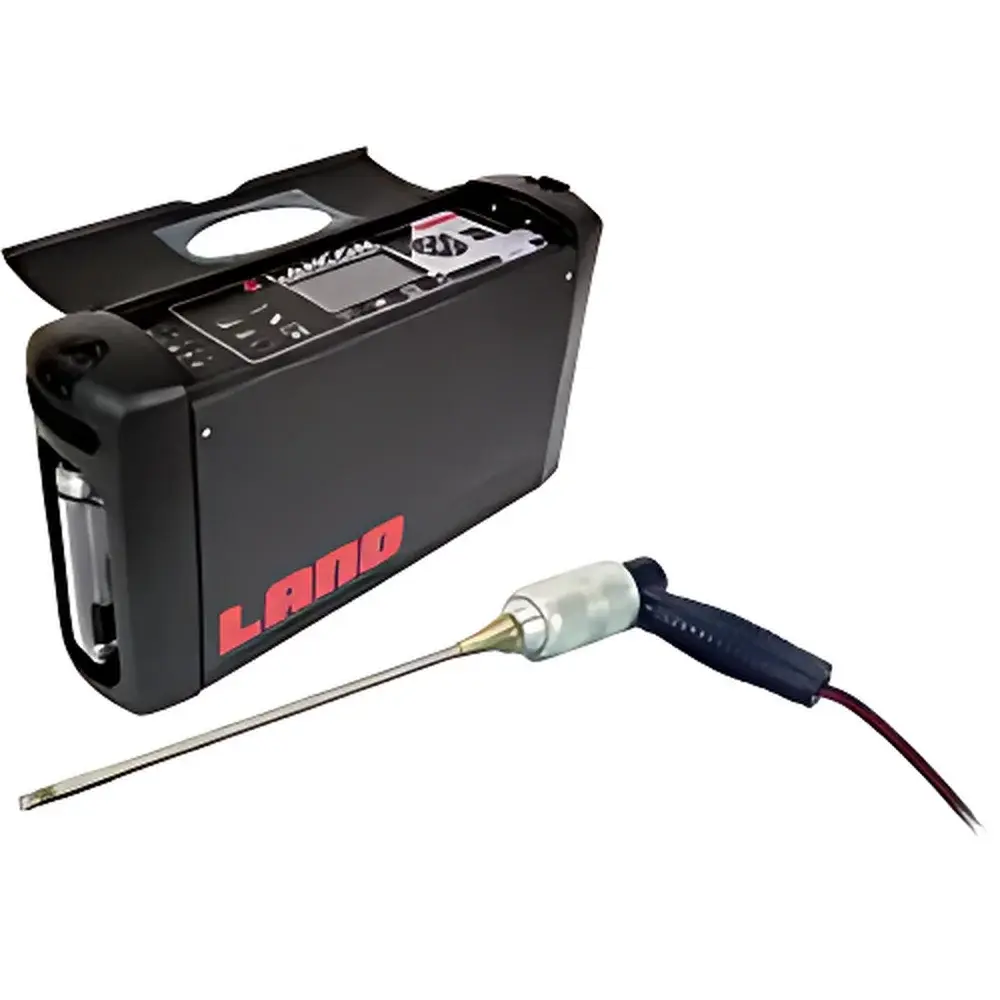
LAND Lancom 4 Portable Flue Gas Analyzer
| Brand | LAND |
|---|---|
| Origin | United Kingdom |
| Manufacturer Type | Authorized Distributor |
| Origin Category | Imported |
| Model | Lancom 4 |
| Instrument Type | Portable Flue Gas Analyzer |
| Measurement Accuracy (Full Scale) | ±2% |
| Repeatability | ±2% |
| Response Time (T90) | 60 s |
| Long-Term Stability (24 h) | ±2% |
| Measurable Gases | CO, O₂, NO, NO₂, CO₂, H₂S, SO₂, CₓHᵧ (up to 9 gases simultaneously) |
| Display | High-Resolution Color TFT Screen |
| Language Support | English, French, German, Italian, Spanish, Chinese (custom languages available on request) |
| Data Interface | USB 2.0 (PC connectivity & USB flash drive support) |
| Weight | 6 kg (13.2 lbs) |
| Compliance | ASTM D6522 (when used with integrated sample drying probe) |
Overview
The LAND Lancom 4 Portable Flue Gas Analyzer is a field-deployable, electrochemical and infrared-based gas measurement platform engineered for precision, reliability, and operational flexibility in industrial combustion monitoring and environmental compliance applications. Utilizing a combination of high-selectivity electrochemical sensors for reactive gases (CO, NO, NO₂, SO₂, H₂S) and non-dispersive infrared (NDIR) detection for CO₂ and hydrocarbons (CₓHᵧ), the Lancom 4 delivers trace-level quantification under real-world flue gas conditions. Its dual-sensor architecture enables simultaneous, independent measurement of up to nine gas species—configured per application requirements—while maintaining full traceability and metrological integrity. Designed for continuous operation in ambient temperatures ranging from –10 °C to +50 °C and relative humidity up to 95% non-condensing, the instrument meets the mechanical and environmental robustness criteria defined in IEC 60529 (IP54 enclosure rating) and EN 61000-6-2/6-3 for electromagnetic compatibility.
Key Features
- Modular sensor configuration: Select from eight standard gas channels (CO, O₂, NO, NO₂, CO₂, SO₂, H₂S, CₓHᵧ) with optional expansion to 17 total parameters—including dew point, temperature, pressure, flow velocity, and efficiency calculations.
- Integrated sample conditioning system: Built-in heated sampling probe (optional), Peltier-cooled condensate separator, and particulate filtration ensure representative, dry, and particle-free gas delivery to sensors—critical for adherence to ASTM D6522 methodology for NOₓ and SO₂ analysis in coal- and oil-fired boilers.
- High-resolution 5.7″ color TFT display with intuitive icon-driven menu navigation and real-time trend plotting; supports six preloaded UI languages (English, French, German, Italian, Spanish, Chinese), with additional language packs deployable via firmware update.
- Low-power semi-continuous operating mode: Enables unattended periodic measurements (e.g., every 5–60 minutes) over extended durations, minimizing battery consumption while preserving data continuity for regulatory log generation.
- Field-upgradable architecture: Firmware updates, calibration certificate import, and new sensor module activation performed locally via USB interface—no return-to-factory requirement.
- Robust mechanical design: Aluminum-magnesium alloy housing, shock-absorbing rubber overmolding, and IP54-rated ingress protection validated per MIL-STD-810G for vibration, drop, and thermal shock resilience.
Sample Compatibility & Compliance
The Lancom 4 is validated for use across diverse combustion sources including natural gas, diesel, heavy fuel oil, biomass, and municipal waste incinerators. Sample gas inlet temperature tolerance spans 0–200 °C (standard probe), extendable to 600 °C with optional high-temperature probe variants. When equipped with the certified sample drying probe and calibrated per manufacturer’s procedure, the system satisfies data quality objectives outlined in ASTM D6522 (Standard Test Method for Determination of Nitrogen Oxides and Sulfur Dioxide in Stack Gases), as well as EN 15267-3 (performance certification of automated measuring systems). All measurement records include embedded timestamps, sensor serial numbers, calibration due dates, and operator ID fields—supporting audit readiness under ISO 17025, EPA Method 7E, and EU Directive 2010/75/EU (IED) reporting frameworks.
Software & Data Management
LAND’s proprietary LancomView PC software provides full bidirectional communication via USB 2.0. It enables real-time remote monitoring, batch download of stored measurement sessions (up to 10,000 records internal memory), automated report generation in PDF/CSV formats compliant with EN 14181 QAL1/QAL2 requirements, and GLP/GMP-compliant audit trail logging—including user login history, parameter change logs, and electronic signature capture. Data export supports integration into enterprise LIMS or SCADA platforms via configurable ASCII or XML schema. Firmware updates and sensor calibration coefficient loading are performed securely within the software environment, with cryptographic hash verification ensuring firmware integrity.
Applications
- Combustion efficiency optimization and excess air control in industrial boilers and thermal oxidizers
- Emissions monitoring for regulatory reporting under EPA 40 CFR Part 60, EU IED, and China GB 13271
- Pre-commissioning and periodic performance testing of flue gas desulfurization (FGD) and selective catalytic reduction (SCR) systems
- Stack testing and source emission characterization during environmental impact assessments
- Technical service and maintenance diagnostics for HVAC combustion appliances and emergency generators
- Academic and vocational training in air pollution control engineering and energy management curricula
FAQ
What calibration standards are required for routine operation?
Certified span gases traceable to NIST or UKAS standards are recommended for daily zero/span verification; factory-calibrated electrochemical cells require annual recalibration, while NDIR modules retain calibration stability for 24 months under normal use.
Can the Lancom 4 be used for continuous emissions monitoring (CEMS) applications?
It is designed for periodic manual stack testing—not permanent installation—but may serve as a QA/QC reference analyzer for CEMS validation per EN 14181 Annex B and EPA PS-11 protocols.
Is the instrument compatible with third-party data acquisition systems?
Yes—via Modbus RTU over USB-to-serial adapter or custom ASCII protocol scripting using LancomView’s command-line interface (CLI) mode.
How is measurement uncertainty quantified across the operating range?
Total expanded uncertainty (k=2) is calculated per ISO/IEC 17025:2017 Annex A.3, incorporating sensor accuracy, temperature/pressure compensation error, and calibration drift contribution—documented in the instrument’s Certificate of Conformance.
Does the Lancom 4 support remote firmware updates over network connection?
No—firmware updates require direct USB connection to a Windows PC running LancomView; no cloud or OTA functionality is implemented to preserve data security and regulatory compliance integrity.
Related Products







