
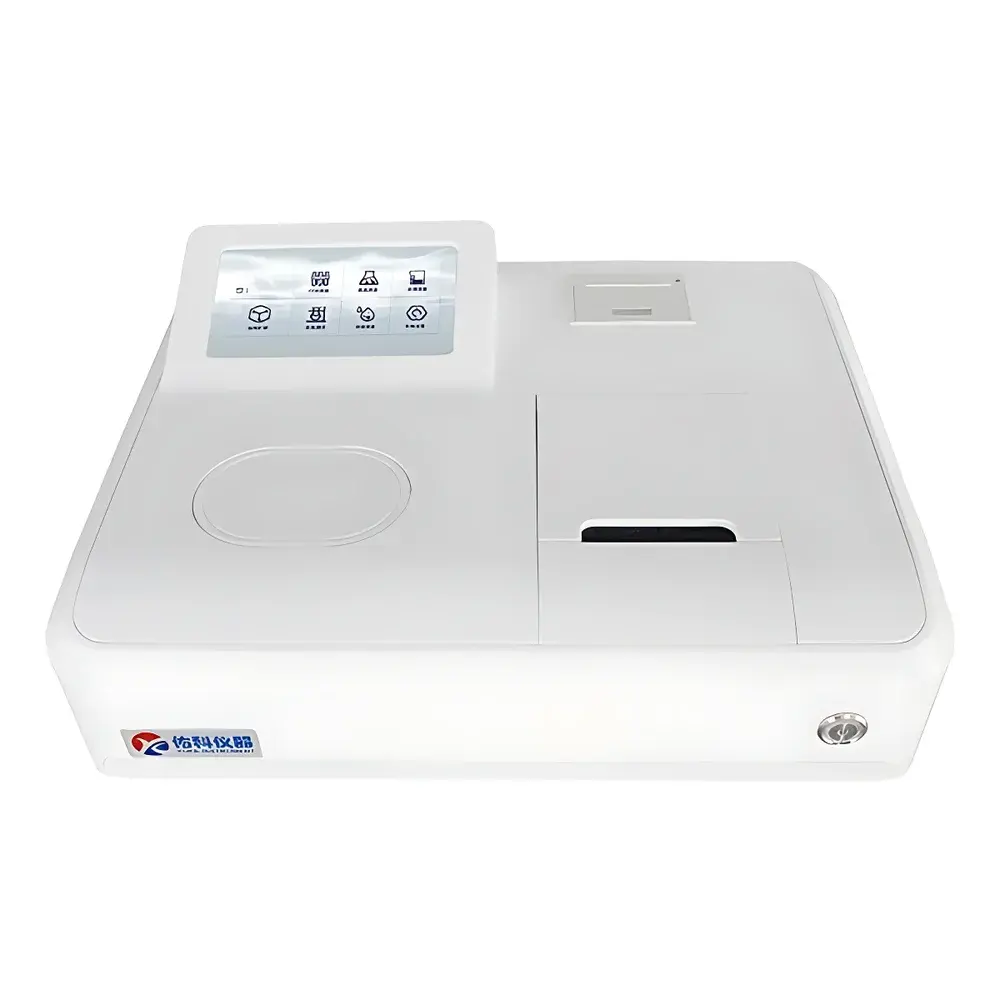
Yoke IT1030 Multi-Parameter Water Quality Analyzer
| Brand | Yoke |
|---|---|
| Origin | Shanghai, China |
| Manufacturer Type | Original Equipment Manufacturer (OEM) |
| Product Category | Domestic Laboratory Water Quality Analyzer |
| Model | IT1030 |
| Price Range | USD 1,400 – 4,200 |
| Instrument Type | Benchtop Laboratory Water Quality Analyzer |
| Measurable Parameters | 52 EPA- and ISO-aligned parameters |
| Display | 5.6-inch color capacitive touchscreen |
| Data Storage | ≥5,000 test records |
| Calibration | 9-point non-linear calibration support |
| Optical System | Narrow-band interference filters with cold LED light source (rated lifetime: 100,000 hours) |
| Processor | ARM9 core with 512 MB internal memory |
| Connectivity | USB 2.0 host/device, RS-232 serial port |
| Printer | Integrated thermal printer |
| Compliance | Methods aligned with GB/T, HJ, ISO 7027, ISO 6060, ISO 8467, ISO 15704, ASTM D1253, ASTM D3370, USP <643>, and EPA Method 410.4, 365.2, 354.1, 365.3, etc. |
| Software Features | User-defined curve building with segmented K-coefficients, 195 expandable method curves + 5 factory preloaded curves |
| Reagent Compatibility | Optimized for Lab-YY certified pre-filled reagent vials |
Overview
The Yoke IT1030 Multi-Parameter Water Quality Analyzer is a benchtop spectrophotometric analyzer engineered for precise, trace-level quantification of inorganic and organic contaminants in drinking water, wastewater, surface water, and industrial effluents. It operates on the principle of absorption photometry—utilizing narrow-band interference optical filters and stable cold LED light sources across the visible spectrum (420–850 nm)—to implement standardized colorimetric and spectrophotometric methods. Designed for compliance-driven laboratories, the IT1030 supports method validation per ISO/IEC 17025 requirements and integrates seamlessly into GLP- and GMP-aligned workflows through audit-ready data handling, traceable calibration logs, and instrument performance verification protocols.
Key Features
- 5.6-inch high-resolution capacitive touchscreen with intuitive GUI navigation—designed to minimize operator training time and reduce procedural errors.
- Modular parameter selection: Users configure any combination of four parameters from a validated library of 52 analytes—including COD, ammonia nitrogen, total phosphorus, turbidity, residual chlorine, heavy metals (Cr⁶⁺, Pb²⁺, Cd²⁺, Ni²⁺, Cu²⁺, Zn²⁺, Mn²⁺), and priority pollutants (formaldehyde, cyanide, arsenic, fluoride, sulfide, phenol).
- Dual-range measurement capability for critical parameters (e.g., COD: 0–100 mg/L and 100–1000 mg/L; turbidity: 0.5–4000 NTU across four optical ranges), enabling accurate analysis across diverse sample matrices without manual dilution.
- Optical architecture featuring thermally stabilized narrow-band interference filters and drift-compensated LED illumination ensures ≤±8% absorbance linearity error across full dynamic range and long-term repeatability (RSD <3% at mid-range concentrations).
- Onboard ARM9 processor with 512 MB flash memory enables rapid spectral processing, real-time curve fitting, and storage of ≥5,000 complete test records—including date/time stamps, operator ID, calibration history, and raw absorbance values.
- Built-in thermal printer outputs compliant hardcopy reports with embedded method ID, lot numbers of reagents used, and pass/fail status against defined acceptance criteria.
- USB 2.0 and RS-232 interfaces support bidirectional data transfer to LIMS or Excel-based QA/QC tracking systems; firmware updates and method imports are performed via plug-and-play USB drive.
Sample Compatibility & Compliance
The IT1030 accepts standard 10 mm, 25 mm, and 50 mm rectangular cuvettes and is compatible with Lab-YY pre-dosed reagent vials (certified to ISO 17034 and traceable to NIST SRMs). All built-in methods adhere to national and international regulatory frameworks: Chinese standards (GB/T 5750, HJ 505, HJ 535, HJ 636, HJ 665–666); ISO standards (ISO 7027 for turbidity, ISO 6060 for COD, ISO 15704 for ammonia nitrogen); and U.S. EPA methods (410.4 for COD, 365.2 for total phosphorus, 354.1 for nitrate, 365.3 for fluoride). The system supports method verification per ISO 8467 (permanganate index), ISO 11923 (suspended solids), and ASTM D1253 (residual chlorine), with documented uncertainty budgets available upon request.
Software & Data Management
The embedded operating system provides full traceability per FDA 21 CFR Part 11 requirements: electronic signatures, role-based access control (admin/operator modes), immutable audit trails for all calibrations and measurements, and automatic timestamping of every action. Users may build custom calibration curves using up to five concentration points per segment, with adjustable slope (K) coefficients to accommodate non-linear response behaviors. The instrument stores 5 factory-certified curves and up to 195 user-expanded curves—each tagged with creation date, analyst ID, and reference standard batch number. Exported CSV files include metadata fields required for ISO 17025 accreditation reporting.
Applications
The IT1030 serves municipal water treatment plants conducting daily compliance monitoring per GB 5749-2022; environmental testing labs performing third-party verification of industrial discharge permits; academic research groups studying nutrient cycling in aquatic ecosystems; and food & beverage facilities validating process water quality against Codex Alimentarius Annex I specifications. Its modular design allows rapid reconfiguration between routine screening (e.g., COD + NH₃-N + TP + turbidity) and targeted contaminant investigation (e.g., Cr⁶⁺ + As + CN⁻ + formaldehyde), reducing cross-contamination risk and minimizing downtime between analyses.
FAQ
Does the IT1030 support GLP-compliant data archiving?
Yes—the system maintains full electronic audit trails, including calibration logs, measurement histories, user authentication events, and firmware revision timestamps, meeting GLP Annex 11 and ISO/IEC 17025 clause 7.7 requirements.
Can I import external calibration curves from my laboratory’s reference database?
Yes—via USB drive, users may load CSV-formatted curves with defined wavelength, concentration, and absorbance columns; the system validates format integrity before installation.
What is the typical measurement repeatability for low-concentration ammonia nitrogen (0.1 mg/L)?
Under controlled lab conditions (25°C ±1°C, calibrated cuvettes, Lab-YY reagents Lot #), RSD is ≤2.4% (n=6), consistent with ISO 5667-3 precision targets.
Is the thermal printer compatible with continuous label stock for sample logbook integration?
The integrated printer supports standard 57 mm thermal paper rolls only; label stock compatibility requires external thermal label printers connected via RS-232.
How frequently must optical alignment be verified?
No routine optical alignment is required; the fixed-pathlength, filter-based optical train is factory-validated and drift-stabilized. Annual performance verification using NIST-traceable neutral density filters is recommended.







