
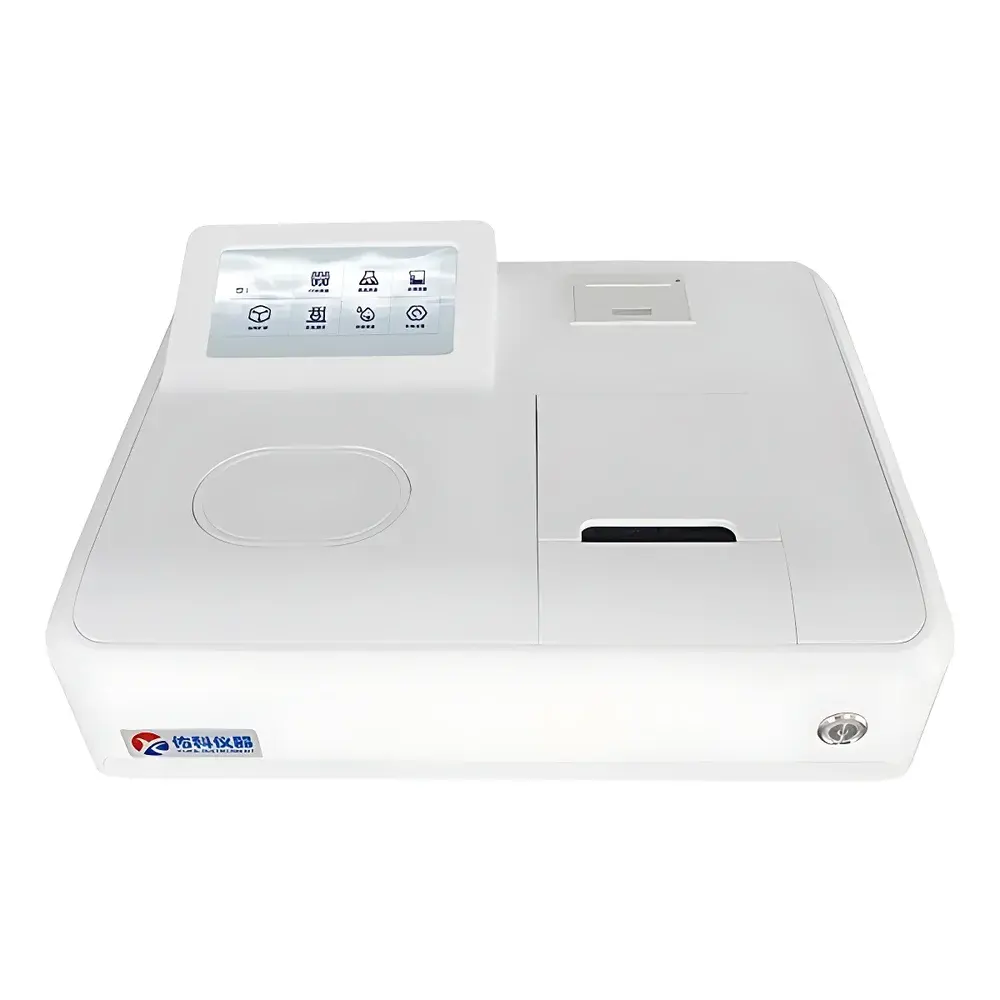
Yoke ITS2000Z Heavy Metal Ion Analyzer
| Brand | Yoke |
|---|---|
| Origin | Shanghai, China |
| Manufacturer Type | Direct Manufacturer |
| Product Category | Domestic Lab-Based Water Quality Analyzer |
| Model | ITS2000Z |
| Price Range | USD 1,400 – 4,200 (FOB Shanghai) |
| Instrument Type | Benchtop Spectrophotometric Heavy Metal Analyzer |
| Detection Parameters | Hexavalent Chromium (Cr⁶⁺), Total Chromium (Crₜₒₜ), Copper (Cu²⁺), Zinc (Zn²⁺), Nickel (Ni²⁺), Iron (Fe²⁺/Fe³⁺), Lead (Pb²⁺) |
| Wavelength Accuracy | ±0.5 nm |
| Display | 5.6-inch Color TFT Touchscreen GUI |
| Data Storage | ≥5,000 measurement records |
| Preloaded Calibration Curves | 5 factory curves + 195 user-expandable curves |
| Light Source | Long-life Cold LED (≥100,000 h) with Narrow-band Interference Filters |
| Optical System | Fixed-wavelength Photometric Platform (7 discrete wavelengths optimized per analyte) |
| Microprocessor | ARM9 Core with 512 MB Flash Memory |
| Connectivity | USB 2.0 Host/Device, RS-232 Serial Port |
| Integrated Printer | Thermal Dot-Matrix Printer (58 mm roll) |
| Reagent Compatibility | Compatible with Yoke Lab-YY Pre-formulated Reagent Kits (ASTM D1688, ISO 11047, EPA 7196A/7199/7000B compliant) |
Overview
The Yoke ITS2000Z Heavy Metal Ion Analyzer is a benchtop, fixed-wavelength spectrophotometer engineered for precise, standardized quantification of priority heavy metal ions in environmental water matrices—including surface water, groundwater, wastewater effluent, and drinking water sources. It operates on the principle of absorbance photometry using narrow-band interference filter-based optical detection at pre-optimized wavelengths (e.g., 540 nm for Cr⁶⁺, 510 nm for Ni²⁺, 560 nm for Pb²⁺), enabling selective quantification without spectral scanning. Each analytical method implemented—such as the diphenylcarbazide method for hexavalent chromium (EPA Method 7196A), the 1,10-phenanthroline method for total iron (ISO 11047), or the dithizone-based assay for lead (EPA Method 7000B)—is rigorously aligned with internationally recognized standard protocols. The instrument’s cold LED light source ensures thermal stability and eliminates lamp drift, while its high-precision optical filtering system delivers repeatability ≤±1.5% RSD across calibrated ranges. Designed for routine compliance testing in municipal labs, third-party environmental testing facilities, and industrial EHS departments, the ITS2000Z meets functional requirements for ISO/IEC 17025-compliant data generation when operated within validated procedural controls.
Key Features
- 5.6-inch capacitive touchscreen interface with intuitive, icon-driven navigation—designed for rapid method selection, calibration, and result review without keyboard input.
- Dedicated photometric channels for seven regulated metals: Cr⁶⁺ (0.0–5.0 mg/L), Crtot (0.05–100 mg/L, segmented range), Cu²⁺ (0.0–3.00 mg/L), Zn²⁺ (0.4–5.0 mg/L), Ni²⁺ (0.05–3.00 mg/L), Fe (0.05–3.00 mg/L), and Pb²⁺ (0.0–4.00 mg/L).
- Onboard memory supporting ≥5,000 timestamped measurements with full metadata (date/time, operator ID, method ID, curve ID, raw absorbance, concentration).
- Preloaded calibration library: five NIST-traceable factory curves plus 195 expandable slots for user-defined or regulatory-method-specific curves—including slope-intercept and multi-point non-linear options.
- Integrated thermal printer (58 mm width) capable of exporting real-time results, batch summaries, and historical queries—output includes QR-coded report headers for audit trail linkage.
- ARM9-based embedded controller with 512 MB flash storage and deterministic real-time response; supports firmware updates via USB mass storage mode.
- Cold LED illumination (lifetime ≥100,000 h) coupled with temperature-compensated interference filters to minimize wavelength drift and photometric noise.
- USB 2.0 host port for direct connection to flash drives (FAT32 formatted); RS-232 interface for legacy LIMS integration or remote command control (SCPI-compatible syntax).
Sample Compatibility & Compliance
The ITS2000Z accepts standard 10–25 mm round glass or quartz cuvettes (10 mm pathlength recommended). Sample volume requirement is 2.5–5.0 mL per analysis, compatible with filtered (0.45 µm membrane), acid-preserved (HNO₃, pH <2), or unfiltered grab samples depending on target analyte and matrix turbidity. All built-in methods conform to applicable sections of ASTM D1688 (copper), ISO 11047 (iron), ISO 8288 (nickel), EPA 7196A (Cr⁶⁺), EPA 7199 (total chromium), and EPA 7000B (lead). The analyzer supports GLP-aligned operation through mandatory field entry of analyst ID, sample ID, and reagent lot number prior to measurement. While not inherently 21 CFR Part 11 compliant out-of-the-box, its audit-ready data structure (immutable timestamps, no post-hoc editing of raw absorbance values) enables validation for GMP-regulated environmental monitoring programs when paired with documented SOPs and electronic signature workflows.
Software & Data Management
Data are stored internally in a relational SQLite database with automatic indexing by date, method, and sample ID. Export formats include CSV (UTF-8 encoded, tab-delimited), PDF reports (with embedded device serial number and firmware version), and XML (for LIMS ingestion). USB exports retain full traceability: each file contains a SHA-256 checksum, creation timestamp, and cryptographic hash of the originating instrument session log. No cloud connectivity or proprietary software installation is required—data retrieval is fully file-system based. For enterprise deployment, optional Yoke DataBridge utility (Windows/Linux/macOS) enables scheduled automated sync, role-based access control, and export to SQL Server or PostgreSQL databases. All calibration and validation records—including blank checks, spike recoveries, and QC sample logs—are retained alongside analytical results.
Applications
- Regulatory compliance monitoring for discharge permits (e.g., NPDES, EU Urban Wastewater Treatment Directive Annex I parameters).
- Drinking water safety verification per WHO Guidelines and national standards (e.g., China GB 5749-2022, US EPA Lead and Copper Rule).
- Industrial pretreatment program oversight in electroplating, metal finishing, and battery manufacturing facilities.
- Field-deployable lab support for mobile environmental assessment teams requiring rapid, on-site metal speciation (Cr⁶⁺ vs. Crtot).
- Educational laboratories performing AP Chemistry or environmental science curricula aligned with EPA-approved methodologies.
- Research applications requiring high-throughput screening of metal bioavailability in sediment porewater or leachate extracts.
FAQ
Does the ITS2000Z support method validation per ISO 8466-1?
Yes—the instrument provides raw absorbance output, multi-point calibration tools, and residual error reporting required for linear/nonlinear model validation.
Can custom reagents from other vendors be used?
Yes, provided they follow the same chemistry and stoichiometry; however, Yoke Lab-YY kits are pre-qualified for inter-lot consistency and include certified reference material (CRM)-matched calibration standards.
Is firmware upgrade performed in-field?
Yes—via USB drive using signed .bin files; upgrade process preserves all stored data and calibration curves.
What is the warm-up time before first measurement?
Less than 60 seconds; the LED source reaches thermal equilibrium within 30 s, and the system performs automatic dark-current compensation on power-on.
How is photometric accuracy verified during routine use?
Using supplied NIST-traceable neutral density filters (OD 0.5, 1.0, 2.0) and certified liquid standards (e.g., Inorganic Ventures ICV kits); verification logs are auto-recorded in the audit trail.







