
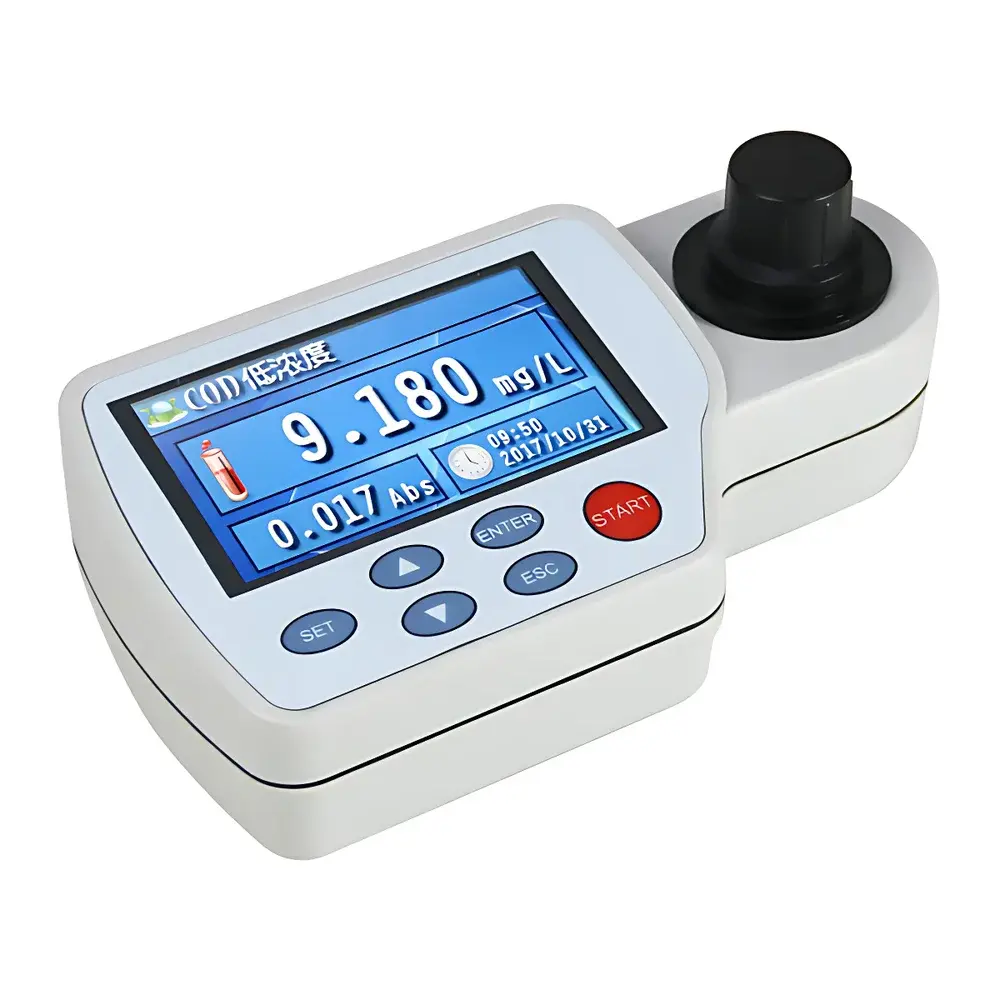
Yoke YKM-BC Portable Smart COD Analyzer
| Brand | Yoke |
|---|---|
| Origin | Shanghai, China |
| Manufacturer Type | Manufacturer |
| Product Category | Domestic |
| Model | YKM-BC |
| Instrument Type | Portable |
| Measurement Principle | Rapid Digestion Method (Laboratory-grade) |
| Measurement Range | 0.1–160 mg/L and 20–5000 mg/L |
| Accuracy | ≤ ±5% |
| Repeatability | ≤ ±5% |
| Detection Limit | 0.1 mg/L |
| Measurement Time | 10–20 minutes |
| Batch Capacity | 20 samples |
| Display | 4.3-inch color TFT touchscreen |
| Data Storage | 5000 measurement records |
| Calibration Curves | 200 preloaded & user-definable curves (5 factory-default + 195 expandable) |
| Optical System | Cold LED light source with narrow-band interference filters |
| Photometric Stability | ≤ 0.001 A/10 min |
| Power Management | Rechargeable lithium battery with real-time SOC display and dual-mode USB charging (PC or vehicle) |
| Communication | USB interface |
| Sample Vessel Compatibility | Cuvette and test tube |
| Language Interface | Switchable Chinese/English |
Overview
The Yoke YKM-BC Portable Smart COD Analyzer is a field-deployable, laboratory-validated instrument engineered for rapid, reliable quantification of Chemical Oxygen Demand (COD) in wastewater, surface water, and industrial effluents. It implements the standardized rapid digestion method—aligned with ISO 6060 and APHA Standard Methods 5220D—using precisely controlled thermal oxidation in acidic dichromate medium, followed by photometric determination of residual Cr(VI) at 610 nm. Unlike benchtop spectrophotometers requiring external digesters, the YKM-BC integrates digestion control logic and optical detection into a single ruggedized platform, enabling on-site analysis without compromising metrological integrity. Its design prioritizes operational robustness in variable environmental conditions—featuring shock-resistant housing, wide operating temperature range (5–40 °C), and humidity tolerance up to 85% RH non-condensing—making it suitable for municipal utilities, environmental inspection teams, and third-party testing laboratories conducting GLP-compliant field campaigns.
Key Features
- High-stability optical architecture: Cold LED light source (100,000-hour lifetime) coupled with narrow-band interference filters ensures minimal spectral drift and long-term photometric repeatability (≤ 0.001 A/10 min).
- Intelligent calibration engine: Supports 200 programmable absorbance-concentration curves—including 5 factory-verified reference curves and 195 user-expandable segments—with automatic K-factor adjustment per concentration zone to minimize nonlinearity errors across dual-range operation (0.1–160 mg/L and 20–5000 mg/L).
- Dual-format sample compatibility: Accepts both 16-mm round cuvettes and standard 16×100 mm test tubes, accommodating diverse lab protocols and minimizing cross-contamination risk via dedicated optical path alignment.
- Embedded ARM9 processing core: Enables responsive GUI navigation on the 4.3-inch high-resolution TFT touchscreen, real-time data visualization, and seamless background execution of curve auto-calibration routines.
- Comprehensive power management system: Integrated lithium-ion battery with state-of-charge (SOC) monitoring delivers >8 hours of continuous operation; USB-powered charging supports field recharging from PCs, power banks, or 12V vehicle ports—no proprietary adapters required.
- Regulatory-ready data handling: All measurements are timestamped (date/time), tagged with operator ID (configurable), and stored with full audit trail metadata (digestion time, temperature profile, blank correction values).
Sample Compatibility & Compliance
The YKM-BC accommodates raw, filtered, or centrifuged aqueous matrices including domestic sewage, leachate, textile effluent, and food-processing wastewater. Chloride interference is mitigated via built-in mercury sulfate compensation (per ISO 6060 Annex B). The instrument meets CE marking requirements for electromagnetic compatibility (EN 61326-1) and safety (EN 61010-1). Its measurement methodology conforms to ISO 6060:1989 and is functionally equivalent to EPA Method 410.4 for COD determination. For regulated environments, data export via USB supports traceable transfer to LIMS platforms compliant with 21 CFR Part 11 when paired with validated software clients.
Software & Data Management
Internal storage retains up to 5000 complete measurement records—including raw absorbance values, calculated COD concentrations, curve identifiers, digestion parameters, and operator notes. Data export is performed via USB mass-storage mode: no drivers required. Files are saved in CSV format with UTF-8 encoding, preserving international character support for multi-language reporting. Curve libraries may be imported/exported as encrypted .ykc files to ensure version control and prevent unauthorized modification. Firmware updates are delivered through signed binary packages verified via SHA-256 checksums to maintain device integrity during maintenance cycles.
Applications
- Real-time process monitoring at wastewater treatment plants (influent, bioreactor, effluent points)
- Regulatory compliance verification during environmental inspections (e.g., China’s HJ 828-2017, EU WFD reporting)
- Industrial pretreatment audits for electroplating, pharmaceutical, and petrochemical facilities
- Field validation of online COD sensors and SCADA system calibration checks
- Educational use in environmental engineering labs for method comparison studies (e.g., COD vs. TOC correlation)
FAQ
Does the YKM-BC require external digestion equipment?
No—the instrument incorporates integrated heating blocks with precise temperature control (165 ± 1 °C) and timing logic to execute the full digestion step autonomously.
Can calibration curves be modified or deleted in the field?
Yes—users may edit, duplicate, or delete any of the 195 expandable curves; factory-default curves are write-protected to preserve method integrity.
Is the USB interface compatible with macOS and Linux systems?
Yes—USB mass-storage mode operates natively on macOS (10.15+), Linux (kernel 4.4+), and Windows 10/11 without driver installation.
How is blank correction handled during measurement?
A dedicated blank measurement cycle is executed before each batch, and the resulting baseline absorbance is subtracted from all subsequent sample readings in real time.
What is the recommended maintenance interval for optical components?
No routine optical maintenance is required; the cold LED source and interference filters are sealed and rated for 100,000 hours—equivalent to >11 years of continuous daily use.







