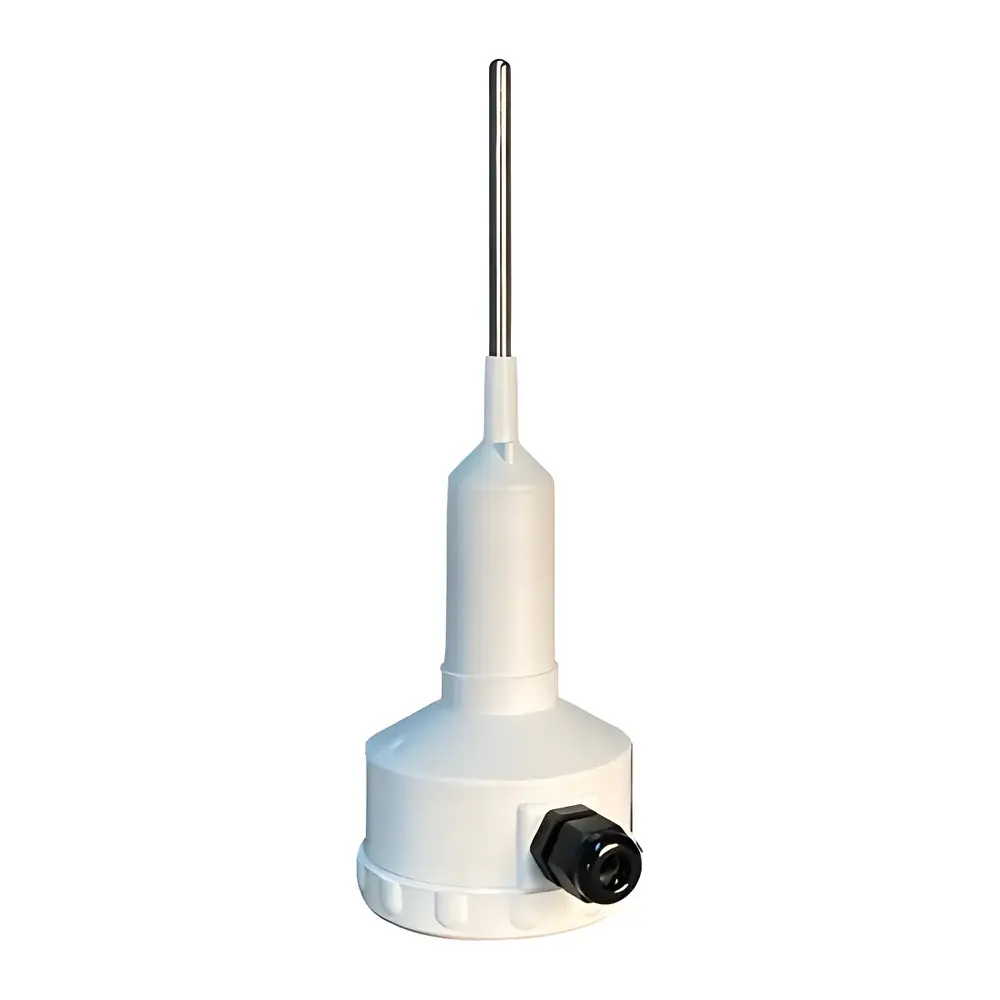
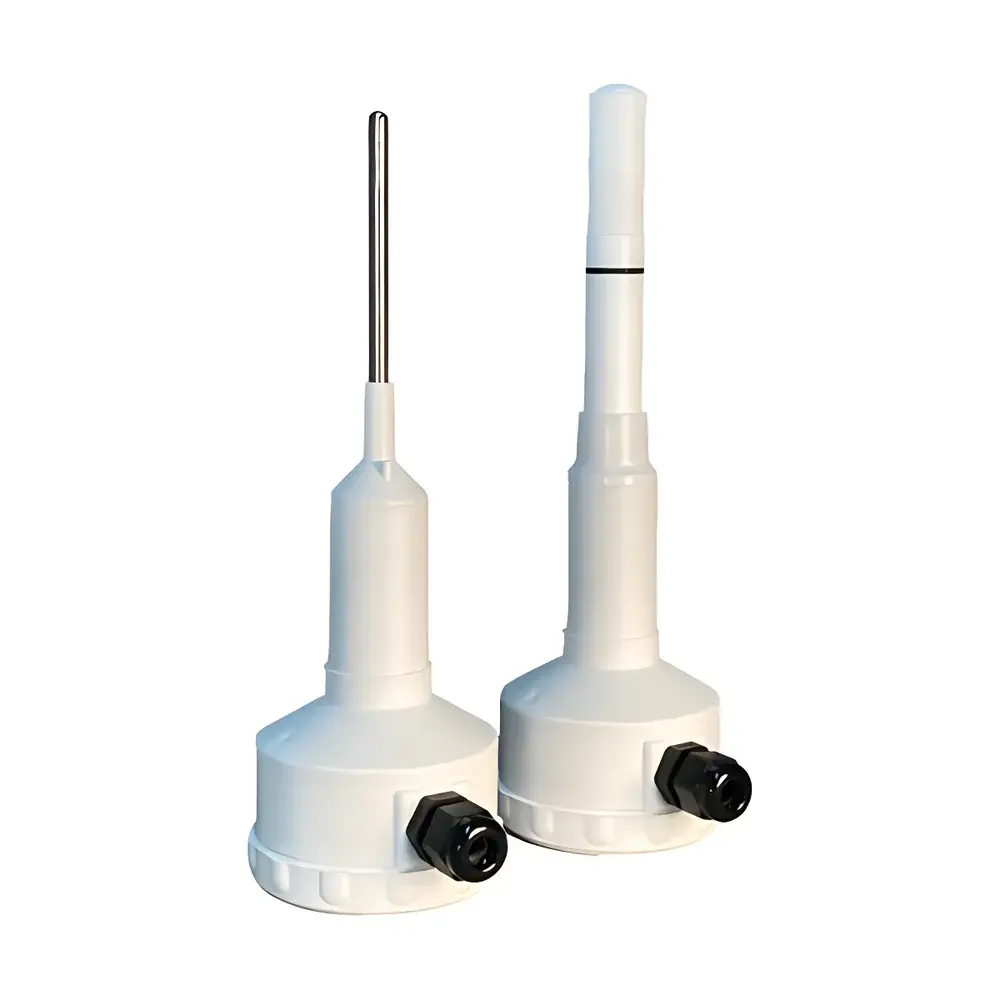
R.M. Young 41342VC Precision Platinum RTD Temperature Sensor with 0–1 VDC Output
| Brand | R.M. Young |
|---|---|
| Origin | USA |
| Model | 41342VC |
| Output Signal | 0–1 VDC |
| Sensor Type | Pt1000 RTD (4-wire) |
| Measurement Range | −50 to +50 °C |
| Accuracy @ 0 °C | ±0.3 °C (standard), ±0.1 °C (optional) |
| Time Constant | 42 s (with Model 43408 radiation shield) |
| Calibration Options | °C or °F |
| Enclosure | Weatherproof terminal housing |
| Recommended Radiation Shield | Model 43502 (aspirated) or Model 41003P (multi-plate passive) |
| Recommended Cable | 2-pair shielded, 22 AWG (e.g., Part #18641) |
Overview
The R.M. Young 41342VC is a high-stability, precision-grade platinum resistance temperature detector (RTD) sensor engineered for meteorological and environmental monitoring applications requiring long-term drift resistance and traceable thermal accuracy. Based on the IEC 60751 Class A Pt1000 element, it utilizes a true 4-wire configuration to eliminate lead resistance errors—ensuring measurement integrity across extended cable runs typical in field-deployed weather stations. Unlike thermistor- or thermocouple-based alternatives, the 41342VC delivers inherently linear response over its full operating range (−50 to +50 °C), with minimal self-heating effects due to low excitation current design. Its 0–1 VDC analog output is directly compatible with most industrial data loggers, SCADA systems, and PLC analog input modules without external signal conditioning. The sensor is housed in a NEMA 4X-rated, UV-stabilized polycarbonate terminal enclosure, providing IP66-level protection against rain, dust, and corrosion—critical for unattended outdoor deployment.
Key Features
- Pt1000 RTD sensing element conforming to IEC 60751 Class A tolerance (±0.15 °C at 0 °C standard; optional ±0.06 °C version available)
- True 4-wire configuration for uncompensated lead-wire error elimination
- Stable 0–1 VDC output scaled linearly to temperature (e.g., 0 V = −50 °C, 1 V = +50 °C), enabling direct voltage-to-temperature conversion with known gain/offset
- Weatherproof, field-serviceable terminal housing with stainless steel mounting hardware
- Optimized mechanical interface for seamless integration with R.M. Young’s passive multi-plate radiation shields (e.g., Model 41003P) and aspirated shields (e.g., Model 43502)
- Low thermal mass probe design achieving a documented time constant of 42 seconds when installed in Model 43408 natural-ventilation radiation shield
- Factory-calibrated and supplied with NIST-traceable calibration certificate (standard)
Sample Compatibility & Compliance
The 41342VC is designed exclusively for ambient air temperature measurement in atmospheric science, climatology, agricultural microclimate networks, and regulatory environmental monitoring. It complies with WMO Guide to Meteorological Instruments and Methods of Observation (CIMO Guide) requirements for radiation-shielded air temperature sensors. Its performance meets or exceeds ASTM E745-22 (Standard Practice for Selecting and Calibrating Temperature Sensors for Use in Atmospheric Measurements) and ISO 9060:2018 (Solar Energy – Specification and Classification of Instruments for Measuring Hemispherical Solar and Direct Solar Radiation) for auxiliary temperature compensation in radiometric systems. The sensor’s construction materials and sealing meet UL 50E and IEC 60529 IP66 specifications. No hazardous substances are used per RoHS Directive 2011/65/EU.
Software & Data Management
While the 41342VC is an analog-output sensor and does not embed firmware or onboard processing, its output integrates transparently into industry-standard data acquisition ecosystems. When paired with compliant loggers (e.g., Campbell Scientific CR6, Onset HOBO RX3000, or Delta-T DL2e), the 0–1 VDC signal supports automated linear scaling using user-defined equations (e.g., T(°C) = 100 × Vout − 50). All major environmental data platforms—including NOAA’s MADIS, EPA’s AirNow, and EEA’s Eionet—accept calibrated voltage inputs from certified RTDs like the 41342VC. For GLP/GMP-aligned deployments, the sensor’s NIST-traceable calibration certificate supports audit-ready documentation, and its stable analog output avoids timestamp jitter or packet loss associated with digital protocols—ensuring continuity in FDA 21 CFR Part 11-compliant validation records.
Applications
- Ambient air temperature monitoring in WMO-compliant weather stations
- Temperature compensation for pyranometers, pyrgeometers, and net radiometers
- Long-term climate observation networks (e.g., USCRN, GCOS reference stations)
- Agricultural irrigation scheduling and frost warning systems
- Indoor/outdoor HVAC performance verification in LEED-certified buildings
- Calibration reference for secondary temperature sensors in field laboratories
FAQ
What is the recommended radiation shield for optimal performance?
The Model 41003P multi-plate passive shield is standard for general-purpose use; for higher accuracy under low-wind conditions, the aspirated Model 43502 is recommended.
Can the 41342VC be used without a radiation shield?
No—direct solar loading will cause significant positive bias (>5 °C); installation in a WMO-compliant shield is mandatory for meteorological accuracy.
Is the 0–1 VDC output ratiometric or referenced to system ground?
The output is referenced to the sensor’s internal circuit common and requires a differential or single-ended input with appropriate common-mode rejection; floating inputs are not supported.
Does the sensor support custom calibration ranges outside −50 to +50 °C?
No—the Pt1000 element and analog scaling are factory-set for this range; operation beyond these limits voids accuracy specifications and may damage the RTD.
What maintenance is required for long-term stability?
Annual visual inspection of housing seals and terminal block integrity is recommended; no recalibration is needed unless physical damage or electrical fault is suspected.