
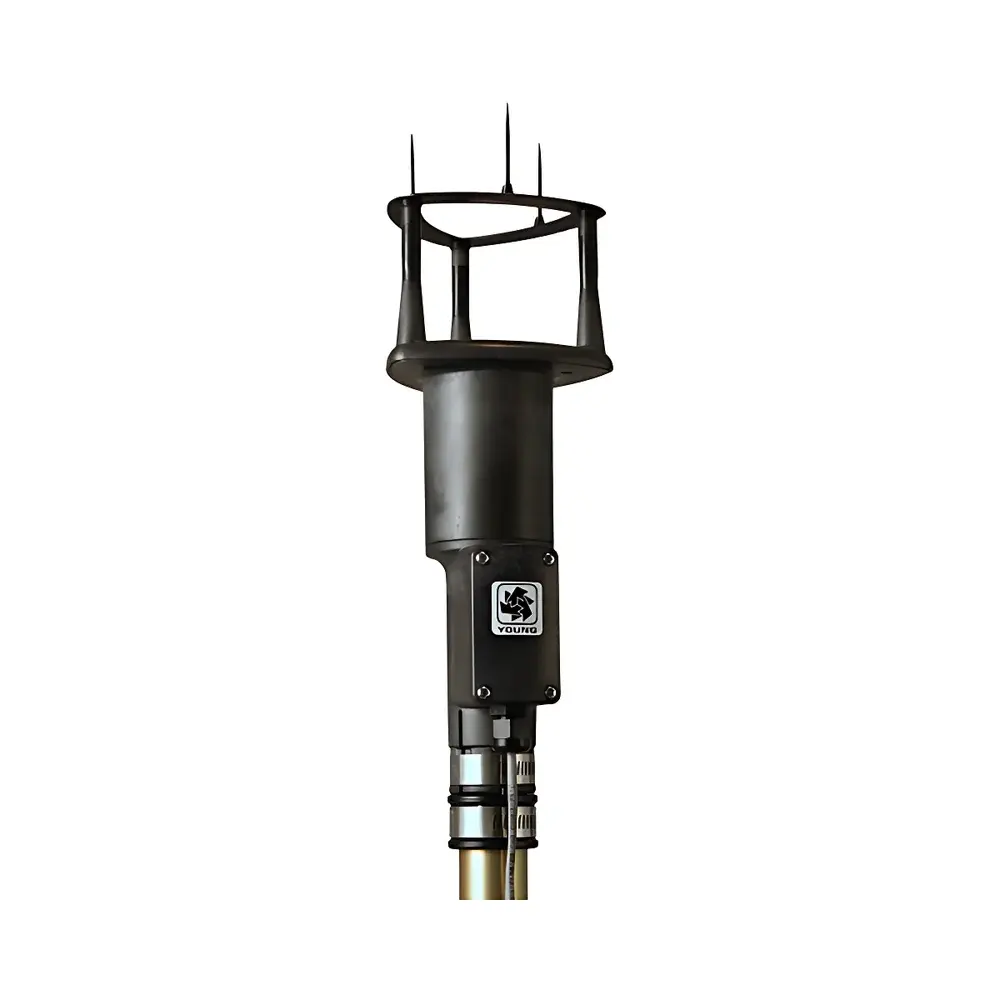
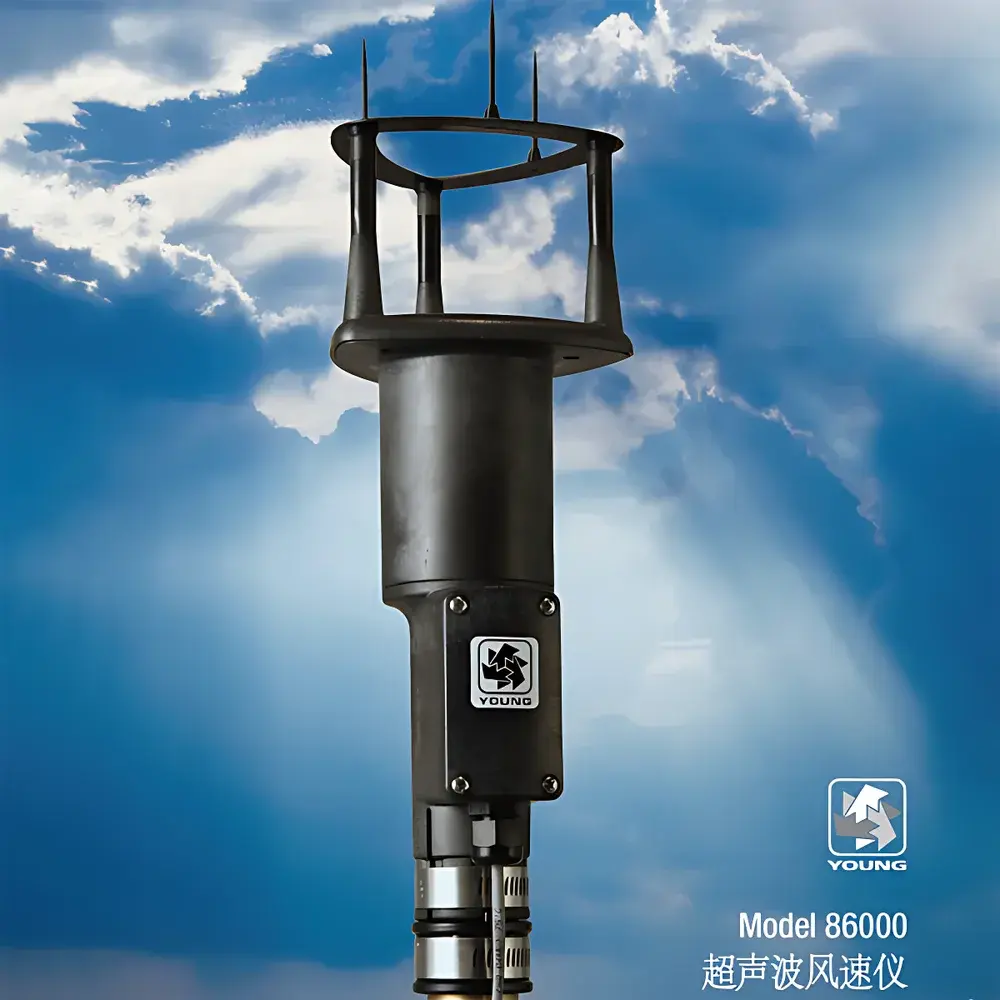
R.M. Young 86000 Two-Dimensional Ultrasonic Anemometer
| Brand | R.M. Young |
|---|---|
| Origin | USA |
| Model | 86000 |
| Instrument Type | Ultrasonic Anemometer |
| Resolution | 0.01 m/s |
| Wind Speed Range | 0–75 m/s |
| Accuracy | ±2% (0–30 m/s), ±3% (30–70 m/s), or ±0.1 m/s (whichever is greater) |
| Wind Direction Range | 0–360° |
| Wind Direction Resolution | 0.1° |
| Wind Direction Accuracy | ±2° |
| Startup Threshold | 0.01 m/s |
| Response Time | <0.25 s |
| Operating Temperature | −40°C to +60°C |
| Humidity Range | 0–100% RH |
| Output Options | RS-232/RS-485, 0–5 VDC analog, 4–20 mA current loop, SDI-12 |
| Enclosure Rating | IP65 |
| Dimensions | 29 cm H × 11 cm W |
| Weight | 0.4 kg |
| Power Supply | 10–30 VDC (standard), 24 VDC/2.5 A (heated model 86004) |
Overview
The R.M. Young 86000 is a two-dimensional ultrasonic anemometer engineered for high-fidelity wind vector measurement in demanding environmental and industrial applications. Unlike mechanical cup-and-vane sensors, the 86000 employs time-of-flight ultrasonic transit-time principle across two orthogonal acoustic paths to compute horizontal wind speed and direction without moving parts. This solid-state architecture eliminates mechanical wear, inertia-induced lag, and ice accumulation susceptibility—making it particularly suitable for long-term unattended deployment in remote meteorological stations, air quality monitoring networks, wind energy assessment sites, and boundary-layer research campaigns. Its compact form factor (29 cm × 11 cm), low mass (0.4 kg), and IP65-rated enclosure ensure robust performance under harsh outdoor conditions—from Arctic tundra (-40°C) to desert environments (+60°C) with full humidity exposure (0–100% RH).
Key Features
- Two-axis ultrasonic transduction with precision-machined transducers mounted in a streamlined, aerodynamically optimized housing—validated via NIST-traceable wind tunnel calibration.
- Multiple output interfaces standard: RS-232 and RS-485 serial (supporting ASCII, RMYT, NMEA 0183, and SDI-12 protocols), 0–5 VDC analog, and isolated 4–20 mA current loop—enabling seamless integration into SCADA systems, data loggers (e.g., Campbell Scientific CR series), and industrial PLCs.
- Configurable baud rates (1200–38400 bps) and user-selectable output modes: continuous streaming, polled response, or event-triggered transmission.
- Low power consumption (<20 mA @ 12 VDC) supports solar-battery operation; optional heated variant (Model 86004) integrates thermostatically controlled 24 VDC/2.5 A heating to prevent frost formation on transducer surfaces—critical for cold-climate continuity of measurement.
- Universal mounting compatibility: direct attachment to standard 1-inch IPS (Iron Pipe Size) mast using included hardware; no proprietary adapters or specialized cabling required.
- Factory-calibrated wind vector accuracy: ±2° for direction, ±2% of reading (or ±0.1 m/s, whichever dominates) within 0–30 m/s range, and ±3% up to 70 m/s—fully compliant with WMO Guide to Instruments and Methods of Observation (CIMO Guide, Chapter 6) recommendations for Class II anemometers.
Sample Compatibility & Compliance
The 86000 is designed for atmospheric sampling in open-air environments where accurate, real-time horizontal wind components (U and V) are required. It meets IEC 61326-1 (EMC for measurement equipment) and complies with FCC Part 15 Subpart B for unintentional radiators. Its analog and digital outputs support traceable data acquisition per ISO/IEC 17025 requirements when integrated with accredited data logging systems. While not intrinsically safe, its low-voltage DC operation and IP65 ingress protection make it suitable for Class I, Division 2 hazardous locations when installed per NEC Article 500 guidelines. Optional marine-grade variant (86106) includes NMEA 0183 v3.01 compliance for vessel-based deployment and coastal observatories.
Software & Data Management
No proprietary software is required for basic operation—the 86000 communicates natively via industry-standard serial protocols. ASCII-formatted output provides human-readable wind speed (m/s, knots, mph, km/h), wind direction (0–360°), and status codes (e.g., “OK”, “LOWBATT”, “ERROR”). RMYT format ensures plug-and-play interoperability with R.M. Young’s legacy display units (e.g., Model 2000). SDI-12 implementation (86000-SDI) conforms to SDI-12 v1.4 specification, enabling multi-sensor daisy-chaining on a single data line with microsecond-level timing resolution. All digital outputs include built-in error-checking (parity, checksum) and support audit-ready timestamping when paired with time-synchronized dataloggers—facilitating GLP-aligned environmental reporting and regulatory submissions (e.g., EPA 40 CFR Part 58, EN 12341).
Applications
- Meteorological surface networks (ASOS, AWOS, and mesonet deployments)
- Wind resource assessment for utility-scale and distributed wind energy projects
- Urban air quality modeling requiring turbulence-informed dispersion inputs
- Fire weather monitoring and wildland fire behavior prediction systems
- Boundary-layer flux studies (in combination with eddy covariance systems)
- Oceanographic buoys and offshore platforms (via 86106 NMEA variant)
- Industrial stack emission monitoring and fugitive dust control verification
- Academic atmospheric science laboratories and field courses
FAQ
Does the 86000 require periodic recalibration?
No scheduled recalibration is mandated by R.M. Young under normal operating conditions; however, annual verification against a reference anemometer (e.g., rotating vane or pitot tube in controlled wind tunnel) is recommended per ISO 17025 and WMO CIMO guidance for metrological traceability.
Can the 86000 measure vertical wind velocity?
No—it is strictly a two-dimensional (horizontal plane) sensor. For 3D turbulence measurements, consider the R.M. Young 81000 three-axis ultrasonic anemometer.
Is the 4–20 mA output isolated?
Yes—the current loop output is galvanically isolated from power and signal grounds, minimizing ground-loop interference in electrically noisy industrial settings.
What is the minimum detectable wind speed?
The startup threshold is 0.01 m/s, with full resolution maintained across the entire 0–75 m/s range.
How does the heated version (86004) affect measurement range?
Heating reduces maximum operational wind speed to 60 m/s due to thermal management constraints; all other specifications—including accuracy and resolution—remain unchanged.
Related Products







