
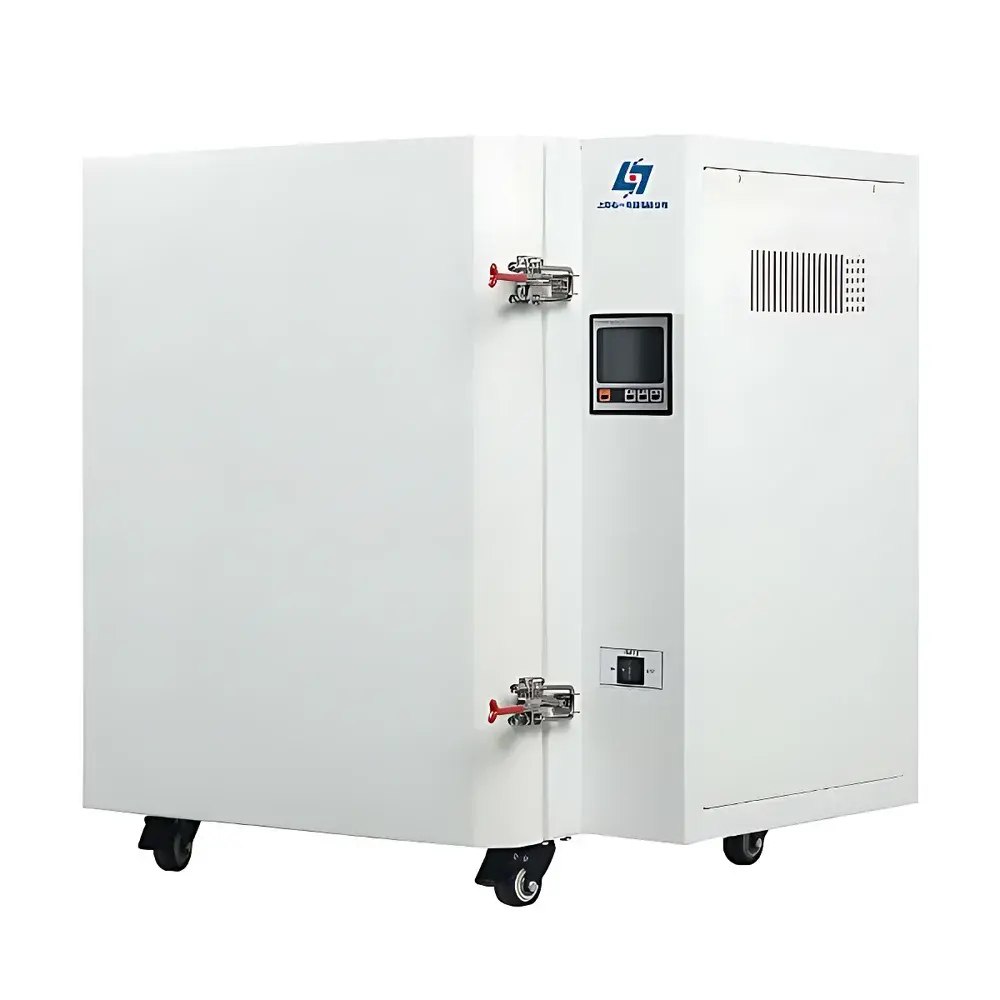
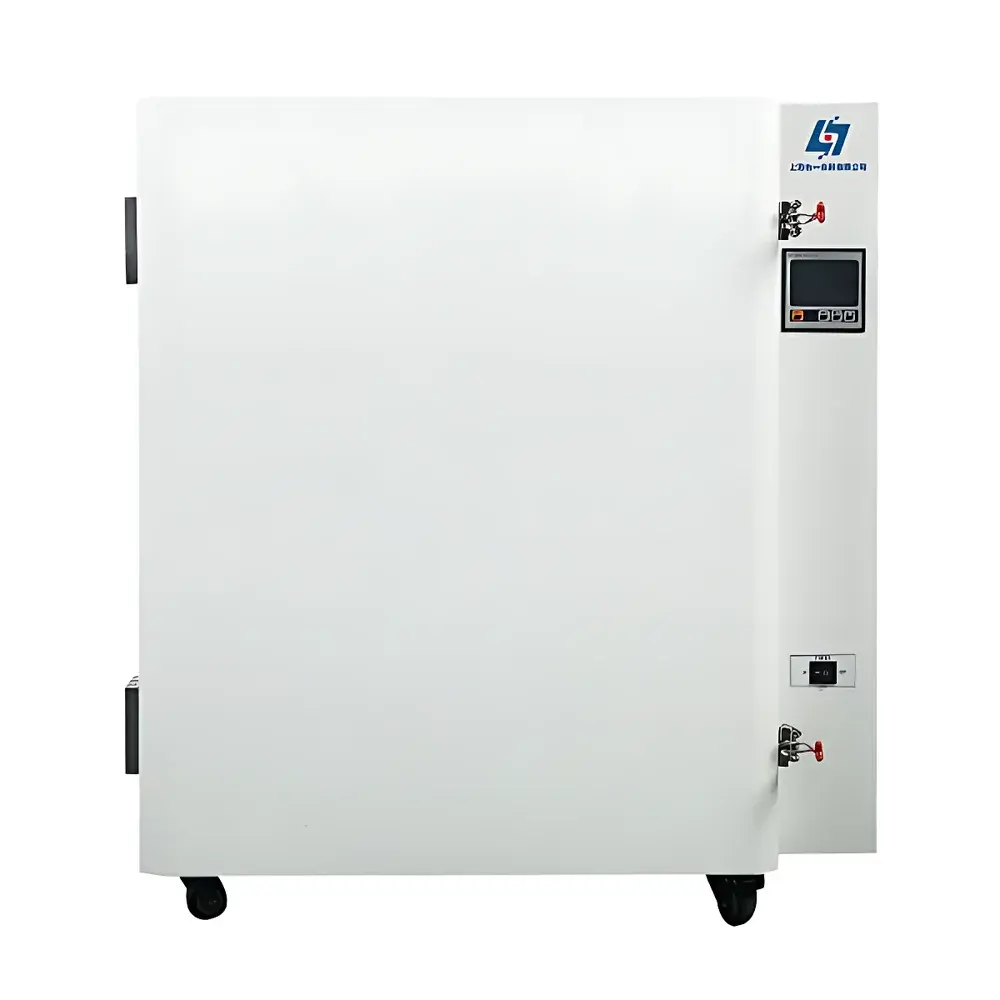
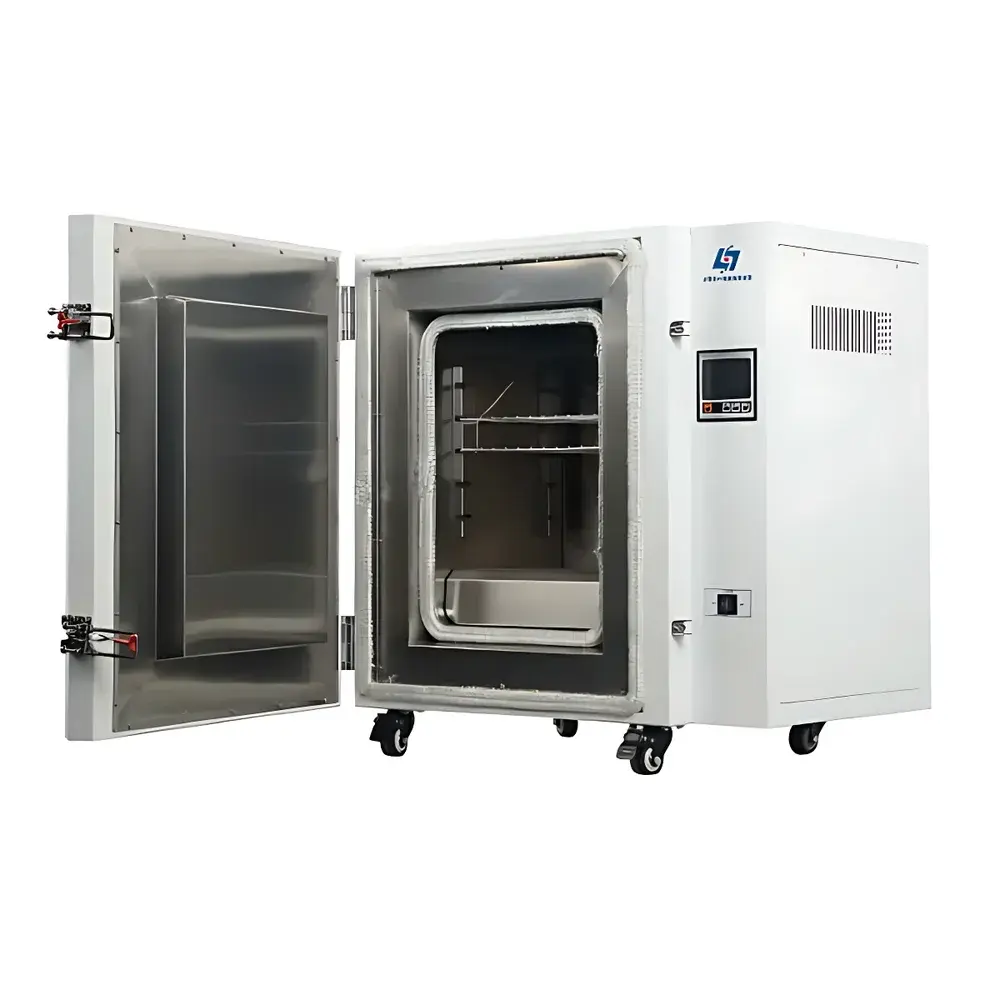
Yoyi DGG-248C High-Temperature Nitrogen-Purged Forced-Air Oven
| Brand | Yoyi |
|---|---|
| Origin | Shanghai, China |
| Manufacturer Type | Direct Manufacturer |
| Model | DGG-248C |
| Temperature Range | RT+20 °C to 400 °C |
| Temperature Resolution | 1 °C |
| Interior Material | Mirror-Finish Stainless Steel (304) |
| Temperature Uniformity | ±2.5% (measured at 100 °C, non-purged condition) |
| Inert Gas Inlet | Φ10 mm |
| Gas Flow Rate | 0–10 L/min (with calibrated rotameter) |
| Power Supply | AC 380 V, 50 Hz |
| Input Power | 5500 W |
| Chamber Dimensions (W×D×H) | 500 × 600 × 750 mm |
| External Dimensions (W×D×H) | 870 × 780 × 1100 mm |
| Capacity | 240 L |
| Standard Shelves | 2 adjustable stainless steel trays |
| Timer Range | 1–9999 min |
| Insulation | High-density ceramic fiber + glass wool composite |
| Door Seal | High-temperature ceramic fiber gasket |
| Control System | Microcomputer-based PID controller with LCD interface, multi-segment programmable capability, auto-tuning, power modulation, and real-time display |
Overview
The Yoyi DGG-248C is a high-temperature, nitrogen-purged forced-air oven engineered for precise thermal processing under inert atmospheres. Designed in accordance with GB/T 30435–2013 (Industrial Electric Heating Ovens – Technical Requirements), it serves laboratories and industrial R&D facilities requiring controlled oxidative environments for applications such as polymer curing, catalyst activation, powder metallurgy sintering pre-treatment, semiconductor wafer baking, and high-temperature material stabilization. Its operational principle relies on convective heat transfer enhanced by a high-efficiency centrifugal blower system, coupled with continuous nitrogen purging to displace ambient oxygen—thereby minimizing oxidation, discoloration, or decomposition of sensitive samples during prolonged exposure to temperatures up to 400 °C. The chamber’s dual-layer insulation architecture—comprising ceramic fiber and glass wool—ensures low external surface temperature and minimal thermal loss, while the pre-heating air mixing cavity guarantees rapid thermal ramp rates and improved spatial uniformity across the 240 L working volume.
Key Features
- Robust construction: Mirror-polished 304 stainless steel interior chamber with seamless welded corners and removable adjustable shelves for unrestricted sample access and cleaning.
- Advanced thermal management: Dual-stage insulation system (ceramic fiber + glass wool) and high-temperature ceramic fiber door gasket rated for continuous operation at 400 °C.
- Precision temperature control: Microprocessor-based PID controller with LCD interface, supporting up to 30 programmable segments, auto-tuning, power suppression, and real-time deviation monitoring.
- Inert gas integration: Dedicated Φ10 mm inlet port with integrated calibrated rotameter (0–10 L/min range), enabling repeatable nitrogen flow adjustment and seamless switching between ambient and inert modes.
- Enhanced safety and reliability: Independent over-temperature protection circuit, power-failure data retention with automatic recovery, and dual-latch door mechanism with reinforced hinge design for long-term sealing integrity.
- Ergonomic engineering: Rounded internal corners, easy-slide shelf rails, front-accessible air intake filter, and standardized 25 mm/50 mm optional test ports for external sensor integration.
Sample Compatibility & Compliance
The DGG-248C accommodates a broad spectrum of sample types—including metal powders, ceramic green bodies, lithium-ion battery electrode coatings, pharmaceutical excipients, and thermosetting resins—without risk of atmospheric degradation. Its design conforms to key international laboratory equipment standards including IEC 61010-1 (Safety Requirements for Electrical Equipment for Measurement, Control, and Laboratory Use) and aligns with Good Manufacturing Practice (GMP) and Good Laboratory Practice (GLP) environmental control expectations. While not certified for explosion-proof use, its nitrogen-purging capability supports compliance with ASTM E2018 (Standard Guide for Assessing Conformance with Thermal Processing Specifications) when used in validated protocols. All electrical components meet CE-marked EMC and low-voltage directive requirements.
Software & Data Management
The standard microcontroller supports time-stamped temperature logging via optional RS485 communication interface (Modbus RTU protocol), compatible with third-party SCADA systems and LIMS platforms. Optional accessories include an embedded thermal printer for immediate hard-copy record generation and a multi-segment programmable controller with extended memory for complex thermal profiles. For regulated environments, the system can be configured with audit-trail-enabled software (sold separately) compliant with FDA 21 CFR Part 11 requirements—supporting user authentication, electronic signatures, and immutable event logs for validation documentation.
Applications
- Pre-sintering treatment of advanced ceramics and metal injection molded (MIM) parts under inert atmosphere.
- Moisture removal and binder burnout from composite laminates prior to autoclave curing.
- Accelerated aging studies of aerospace-grade adhesives and encapsulants per MIL-STD-883.
- Thermal conditioning of calibration standards (e.g., platinum resistance thermometers) requiring stable, oxygen-free environments.
- High-temperature drying of hygroscopic reagents and catalyst precursors in synthetic chemistry workflows.
- Post-deposition annealing of thin-film solar cell substrates to optimize crystallinity without interfacial oxidation.
FAQ
What is the maximum safe operating temperature for continuous use?
The DGG-248C is rated for continuous operation at 400 °C, verified per GB/T 30435–2013 thermal stability testing protocols.
Can the oven operate without nitrogen purging?
Yes—it functions as a standard high-temperature forced-air oven in ambient mode; nitrogen purging is optional but recommended for oxidation-sensitive processes.
Is the temperature uniformity specification valid under nitrogen flow?
The ±2.5% uniformity value is measured under static, non-purged conditions at 100 °C per GB/T 30435; actual performance under dynamic nitrogen flow may vary slightly and should be verified during IQ/OQ qualification.
Are calibration certificates traceable to national standards available?
NIST-traceable calibration reports (including probe placement map and uncertainty budget) are provided upon request as part of optional validation support services.
What maintenance intervals are recommended for optimal performance?
Blower motor lubrication every 12 months, door gasket inspection every 6 months, and air filter cleaning after each 200 hours of operation at >300 °C.



