
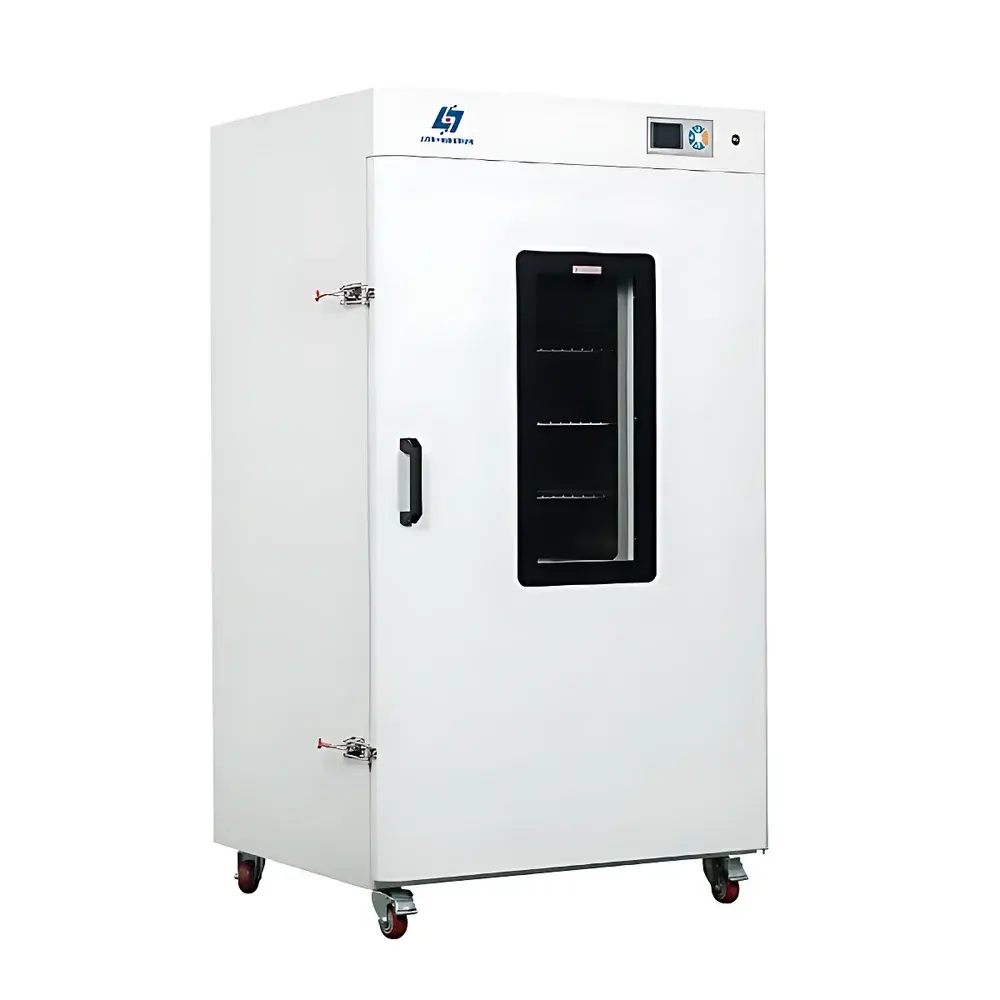
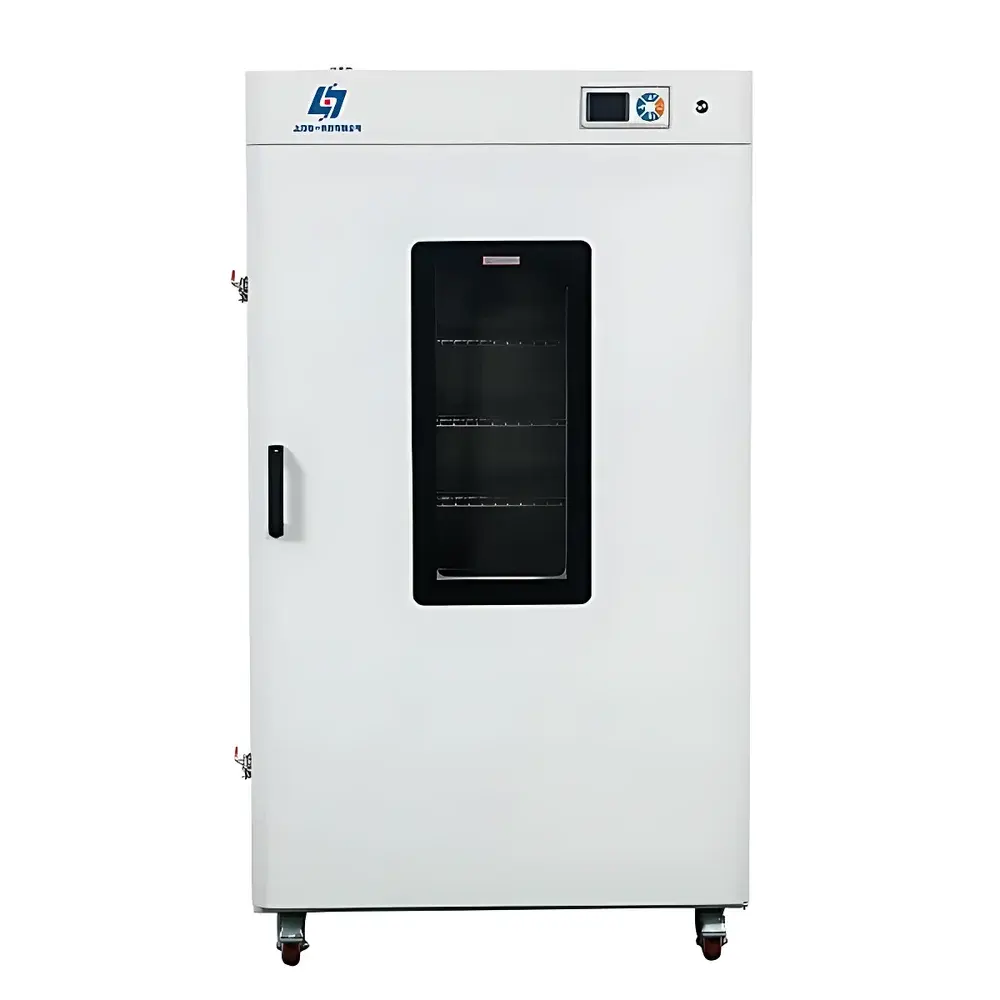
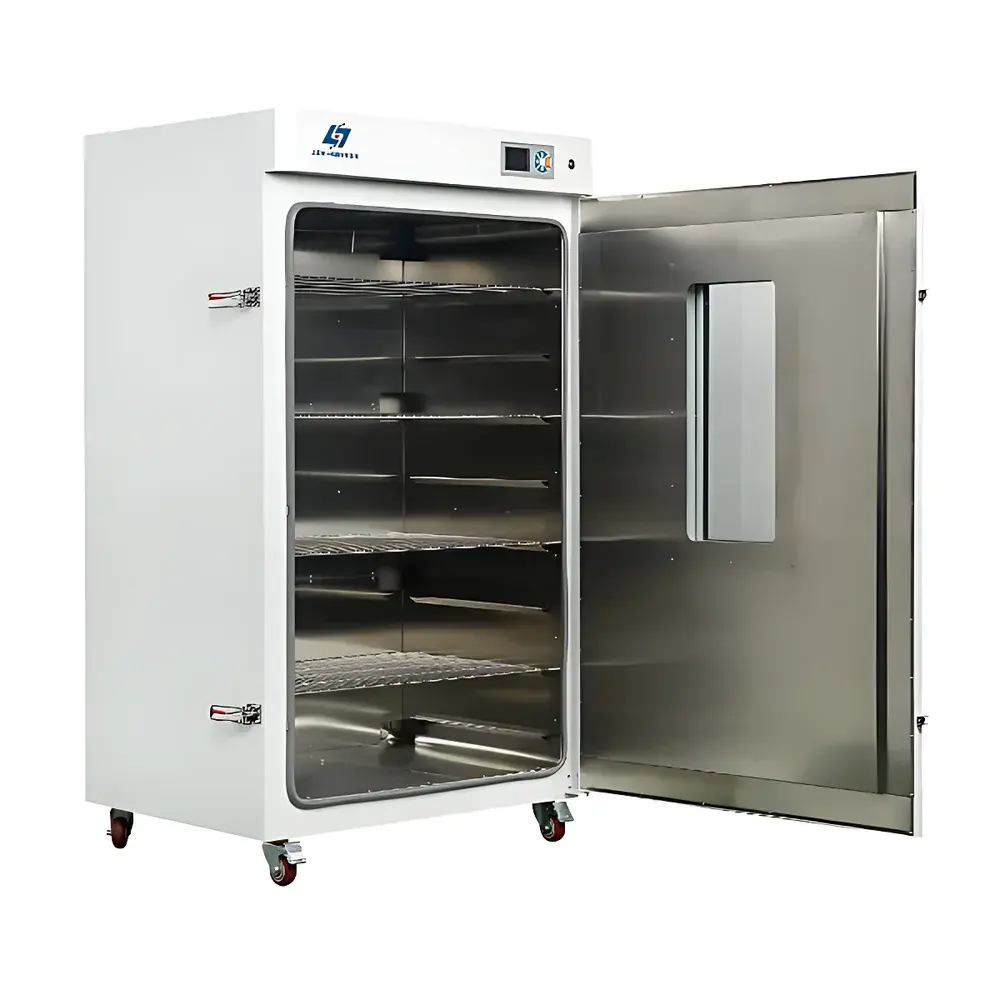
Yoyi DHG-9425C Nitrogen-Purged Forced-Air Drying Oven
| Brand | Yoyi |
|---|---|
| Origin | Shanghai, China |
| Manufacturer Type | Direct Manufacturer |
| Model | DHG-9425C |
| Temperature Fluctuation | ±1℃ |
| External Dimensions | 780×750×1750 mm |
| Temperature Control Range | RT+10 to 300℃ |
| Internal Chamber Dimensions | 600×550×1300 mm |
| Temperature Resolution | 0.1℃ |
| Chamber Material | Mirror-Finish Stainless Steel (SUS304) |
| Heating Method | Electric Heaters with Balanced Airflow Distribution |
| Temperature Uniformity | ±2.5% (measured at 100℃, non-purged condition) |
| Inert Gas Inlet | Φ10 mm |
| Nitrogen Flow Rate Range | 0–10 L/min |
| Power Supply | AC 220 V / 50 Hz |
| Rated Power | 3500 W |
| Working Environment | RT+5 to 40℃, ≤85% RH |
| Timer Range | 1–9999 min |
| Standard Shelving | 3 adjustable stainless steel trays |
Overview
The Yoyi DHG-9425C is a vertically oriented, nitrogen-purged forced-air drying oven engineered for applications requiring controlled inert atmospheres and high thermal stability. It operates on the principle of convective heat transfer enhanced by a dynamically balanced horizontal air circulation system, coupled with programmable inert gas purging to displace ambient oxygen and moisture. This dual-control architecture—precise temperature regulation via PID algorithm and reproducible nitrogen flow management—enables reliable processing of oxygen-sensitive, thermally labile, or oxidation-prone materials. Designed for compliance-critical environments, the DHG-9425C supports GLP/GMP-aligned workflows in pharmaceutical stability testing, polymer curing, catalyst activation, electronic component baking, and pre-sterilization conditioning of medical device components.
Key Features
- Microprocessor-based 4.3-inch LCD interface with intuitive menu-driven navigation—displays setpoint temperature, real-time chamber temperature, elapsed/remaining time, and status indicators simultaneously.
- Intelligent PID temperature control with auto-tuning capability ensures stable thermal profiles across the full operating range (RT+10℃ to 300℃), with ±1℃ fluctuation tolerance under no-load conditions.
- Triple-layer thermal insulation combined with high-efficiency axial fans and optimized duct geometry achieves ±2.5% temperature uniformity (tested at 100℃ per ISO 15502 Annex B methodology).
- Front-loading vertical design with reinforced double-glazed observation window (heat-resistant tempered glass) allows continuous visual monitoring without thermal interruption or door-induced turbulence.
- Sealed chamber construction featuring high-temperature silicone gasketing (rated to 350℃), seamless mirror-finish SUS304 interior, and corrosion-resistant cold-rolled steel exterior with epoxy-powder coating.
- Dedicated nitrogen inlet port (Φ10 mm) integrated with calibrated rotameter (0–10 L/min range) enables precise, repeatable inert gas dosing—critical for preventing oxidation during thermal treatment of metal powders, lithium battery electrodes, or organic semiconductors.
- Automatic ventilation system with rear-mounted intake/exhaust ports maintains dynamic pressure equilibrium while expelling condensate and volatile decomposition products without manual valve adjustment.
- Power failure recovery function retains user-defined parameters—including temperature setpoints, timer values, and alarm thresholds—eliminating reconfiguration after unexpected outages.
Sample Compatibility & Compliance
The DHG-9425C accommodates diverse sample formats including Petri dishes, crucibles, aluminum pans, glass vials, PCB assemblies, and bulk powder containers up to 600×550×1300 mm internal volume. Its inert atmosphere capability aligns with ASTM E145-22 (Standard Specification for Gravity-Convection and Forced-Ventilation Ovens) and supports protocols referenced in USP , ISO 17025:2017 (clause 7.2.2 on equipment suitability), and ICH Q1A(R2) for long-term stability studies. The stainless-steel chamber meets FDA-recommended material standards for non-reactive contact surfaces. Optional RS485 communication module enables audit-trail-capable data logging compliant with 21 CFR Part 11 when paired with validated software.
Software & Data Management
While the base unit operates via embedded firmware, optional accessories extend digital functionality: an RS485 interface (with Modbus RTU protocol support) permits integration into centralized Lab Information Management Systems (LIMS) or SCADA platforms. The optional multi-segment programmable controller allows up to 32 step sequences—ideal for ramp-hold-cool thermal profiles required in polymer annealing or ceramic sintering prep. An embedded thermal printer (optional) generates timestamped hardcopy records of temperature logs, meeting paper-trail requirements for QA/QC audits. All configuration changes are logged with timestamps and operator IDs when audit mode is enabled.
Applications
- Pharmaceutical: Moisture content determination (per USP ), excipient drying, lyophilized product secondary drying, and stability-indicating thermal stress testing.
- Materials Science: Degassing of composites, solvent removal from sol-gel precursors, pre-oxidation of thin-film substrates, and thermal aging of elastomers and adhesives.
- Electronics: Bake-out of printed circuit boards prior to conformal coating, desiccation of humidity-sensitive SMD components, and flux residue removal.
- Academic Research: Controlled pyrolysis of biomass, catalyst regeneration under inert conditions, and thermal gravimetric pre-conditioning for TGA sample loading.
- Quality Control Labs: Residue-on-ignition (ROI) analysis, loss-on-drying (LOD) assays, and calibration standard preparation under oxygen-free environments.
FAQ
What inert gases are compatible with the DHG-9425C?
Nitrogen (N₂) is the primary recommended gas; argon (Ar) and helium (He) may also be used, provided pressure regulators and flowmeters are rated for the selected gas and delivery pressure does not exceed 0.3 MPa.
Is the chamber vacuum-rated?
No—the DHG-9425C is designed for positive-pressure inert gas purging only and is not rated for vacuum operation.
Can the oven be validated for GMP use?
Yes—its consistent temperature performance, traceable calibration points, and optional data logging features support IQ/OQ/PQ documentation per Annex 15 of the EU GMP Guidelines.
How often should the silicone door gasket be replaced?
Under normal operation (≤250℃, daily use), replacement is recommended every 18–24 months; inspection intervals should increase if operating near 300℃ continuously.
Does the unit include over-temperature protection?
Yes—a redundant independent mechanical over-temperature limiter (set at 320℃) cuts power to heating elements if the primary PID controller fails, satisfying EN 61000-6-2 and IEC 61010-1 safety requirements.



