
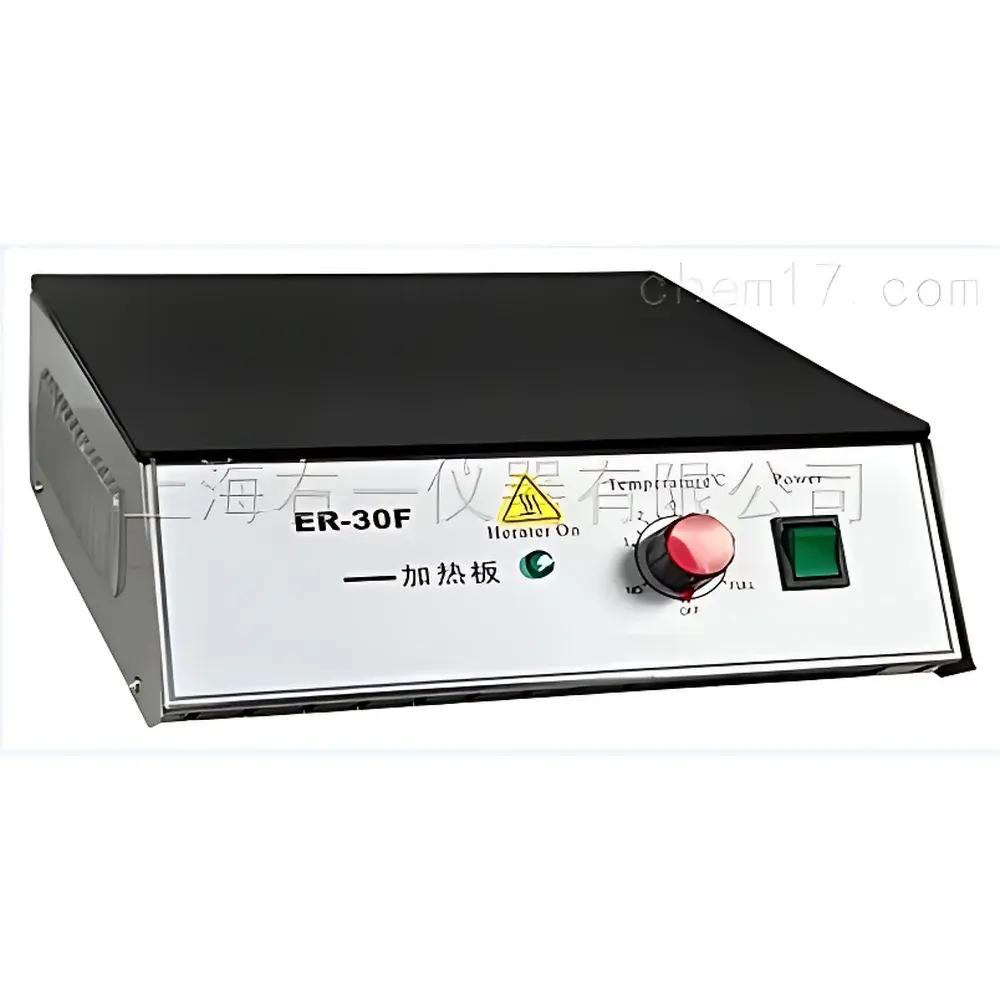
Yoyi ER-30F Corrosion-Resistant Electric Heating Plate with Microcrystalline Glass Surface
| Brand | Yoyi |
|---|---|
| Origin | Shanghai, China |
| Manufacturer Type | Direct Manufacturer |
| Model | ER-30F |
| Price | USD 275 (FOB Shanghai) |
| Heating Power | 1200 W |
| Max. Operating Temperature | 450 °C |
| Temperature Uniformity | ±2 °C |
| Surface Dimensions | 300 × 300 mm |
| Heating Zone Dimensions | 300 × 300 mm |
| Display Type | Analog Dial Scale |
Overview
The Yoyi ER-30F Corrosion-Resistant Electric Heating Plate is engineered for precise, stable, and chemically inert thermal control in demanding laboratory sample preparation workflows. Unlike conventional metal-surface heating plates, the ER-30F employs a high-purity microcrystalline glass top plate—characterized by ultra-low thermal expansion coefficient (< 1.0 × 10⁻⁶ /°C), exceptional mechanical rigidity, and intrinsic resistance to aggressive chemical exposure. Its operational principle relies on embedded high-density nickel-chromium alloy heating elements beneath the glass surface, delivering uniform conductive heat transfer across the entire 300 × 300 mm active zone. Designed specifically for applications requiring prolonged exposure to concentrated mineral acids (e.g., HNO₃, HCl, HF), alkalis (e.g., NaOH, KOH), and oxidizing reagents, the ER-30F meets the functional requirements of open-vessel digestion, solvent evaporation, reflux setup preheating, and controlled drying protocols under ISO/IEC 17025-compliant laboratory environments.
Key Features
- Chemically inert microcrystalline glass surface—resistant to etching, staining, or degradation from strong acids (including hydrofluoric acid at concentrations ≤ 5%) and caustic solutions up to 50% w/w NaOH at 450 °C.
- Full-perimeter construction using ASTM A276 Grade 316L stainless steel—providing passive corrosion resistance to chloride-induced pitting and crevice corrosion, even when splashed with digestate residues.
- Ceramic fiber insulation layer (density: 128 kg/m³) integrated beneath the heating zone—minimizing thermal loss, reducing exterior surface temperature rise (< 45 °C at ambient), and enabling rapid thermal response without thermal lag.
- Analog dial-scale temperature controller with calibrated bimetallic sensing element—offering repeatable setpoint accuracy of ±3 °C across the full 20–450 °C range (RT + 20 °C minimum ambient start).
- Robust mechanical architecture: 125 mm total height with reinforced base chassis; load capacity ≥ 8 kg uniformly distributed; no moving parts or exposed electronics on the working surface.
Sample Compatibility & Compliance
The ER-30F accommodates standard laboratory vessels including borosilicate glass beakers (50–2000 mL), PTFE and quartz digestion tubes, ceramic crucibles, and stainless steel trays—without risk of surface adhesion or thermal shock-induced cracking. Its design conforms to IEC 61010-1:2010 safety standards for electrical equipment used in laboratory environments, including overtemperature protection (independent mechanical cut-off at 480 °C) and earth leakage current < 0.75 mA. While not certified for Class I Division 1 hazardous locations, it is routinely deployed in EPA Method 3050B/3051A-accredited soil and sediment digestion labs, as well as pharmaceutical QC laboratories performing USP heavy metals testing where open-beaker acid digestion precedes AAS or ICP-MS analysis.
Software & Data Management
The ER-30F operates as a standalone analog instrument without digital connectivity or firmware. As such, it does not generate electronic records, lacks audit trail functionality, and is not compliant with FDA 21 CFR Part 11 or EU Annex 11 requirements for electronic data integrity. However, its deterministic analog control behavior ensures full traceability via manual logbook entries—including operator ID, start/end timestamps, setpoint, observed surface temperature (verified with NIST-traceable contact thermometer), and vessel identification. For GLP/GMP-aligned workflows requiring documented thermal profiles, integration with external data loggers (e.g., Omega OM-DAQPRO-5300 series) via K-type thermocouple input is supported through the optional rear-panel sensor port (available on ER-30FS variant).
Applications
- Open-vessel acid digestion of environmental samples (soils, sediments, sludges) per EPA SW-846 Methods 3050B and 3051A.
- Controlled evaporation of organic solvents (acetone, methanol, ethyl acetate) during extract concentration prior to GC or HPLC injection.
- Preheating of reflux condensers and reaction flasks in synthetic organic chemistry protocols.
- Drying of filter papers, gravimetric crucibles, or ash content determination substrates in AOAC 923.03-compliant food testing.
- Thermal conditioning of pH electrodes and conductivity cells during calibration stability verification.
FAQ
Is the microcrystalline glass surface resistant to hydrofluoric acid?
Yes—when used at concentrations ≤ 5% and temperatures ≤ 450 °C for durations ≤ 4 hours per cycle, the surface shows no measurable etch depth (tested per ASTM C1619). Prolonged exposure requires post-use neutralization with saturated CaCO₃ slurry.
Can the ER-30F replace a hotplate-stirrer in mixing applications?
No—it provides only conductive heating with no magnetic stirring capability. For combined heating/stirring, consider the Yoyi HS-30F series with integrated stirrer motor and PTFE-coated stir bar compatibility.
What is the recommended calibration interval for the analog temperature scale?
Per ISO/IEC 17025 Clause 6.4.10, verify setpoint accuracy against a NIST-traceable surface thermometer every 90 days or after 200 operational hours—whichever occurs first.
Does the unit include overtemperature protection?
Yes—an independent mechanical thermal cutoff switch de-energizes the heating circuit if internal chassis temperature exceeds 480 °C, preventing insulation degradation or fire hazard.
Is the 316L stainless steel housing suitable for fume hood installation?
Yes—the fully sealed front panel and absence of ventilation grilles allow safe operation inside Class II A2 biosafety cabinets and general-purpose chemical fume hoods without airflow disruption or corrosion acceleration.
Related Products



