
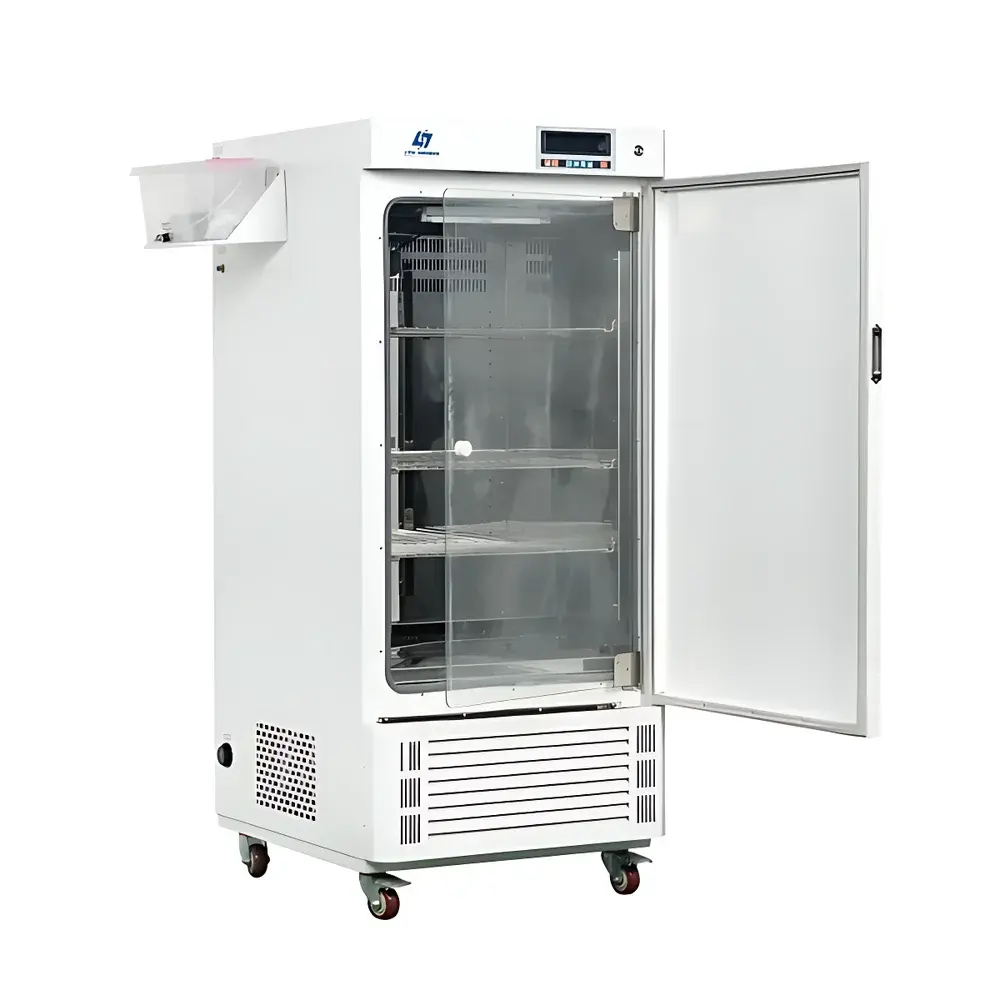
Yoyi LHS-100SC Benchtop Temperature and Humidity Controlled Chamber
| Brand | Yoyi |
|---|---|
| Origin | Shanghai, China |
| Manufacturer Type | Direct Manufacturer |
| Model | LHS-100SC |
| Instrument Type | Upright Chamber |
| Temperature Range (with Humidification) | 15–60 °C |
| Temperature Range (dry operation) | 10–60 °C |
| Humidity Range | 50–85 %RH |
| Temperature Uniformity | ±1 °C |
| Temperature Fluctuation | ±1 °C |
| Humidity Uniformity | ±5 %RH |
| Humidity Fluctuation | ±1 %RH |
| Interior Dimensions (W×D×H) | 450×380×590 mm |
| Refrigerant | R134a / R406a (CFC-free) |
| Control System | Microprocessor-based PID with Programmable Cycle Logic (99 cycles × 30 segments × 99 h 59 min per segment) |
| Compliance | GB/T 10586–2006, GB/T 2424.6–2006, GJB/J 3827–1999 |
Overview
The Yoyi LHS-100SC is a compact, upright temperature and humidity controlled chamber engineered for precision environmental simulation in laboratory-scale physical property testing and stability assessment. It operates on the principle of active thermoelectric and vapor-phase humidification control, integrating forced-air convection with optimized airflow distribution to ensure spatial uniformity across the working volume. Designed for compliance-driven applications—including pharmaceutical stability studies (ICH Q1–Q5), material aging tests, microbiological incubation, and quality control validation—the LHS-100SC delivers reproducible thermal-hygrometric conditions under defined load and ambient constraints. Its stainless steel interior, rounded-corner construction, and double-glazed observation door support cleanroom-compatible operation and minimize contamination risk during extended exposure protocols.
Key Features
- Microprocessor-controlled PID algorithm for independent regulation of temperature and relative humidity, supporting up to 99 programmable cycles, each with 30 user-defined segments (max. 99 h 59 min per segment)
- High-efficiency CFC-free refrigeration system using R134a/R406a refrigerants, compliant with international environmental standards (Montreal Protocol Annex A, Group II)
- Integrated electric heating tube humidification system with auto-refill-capable internal water reservoir and high-stability capacitive humidity sensor (calibrated traceable to NIST-traceable references)
- Optimized air circulation architecture featuring rear-mounted centrifugal blower and symmetrical ducting, achieving ≤±1 °C temperature uniformity and ≤±5 %RH humidity uniformity (measured per GB/T 2424.6–2006 at empty chamber, 20 °C/50 %RH ambient)
- Double-layer insulated door with tempered glass viewport and magnetic seal, minimizing thermal leakage during visual monitoring without disturbing internal equilibrium
- Adjustable stainless steel shelving (2 standard trays included), mirror-polished AISI 304 interior surfaces with radius-rounded corners for ease of decontamination and residue-free cleaning
- Four-point leveling system with dual-mode mobility: swivel casters (locking) + adjustable leveling feet for stable placement on uneven floors
Sample Compatibility & Compliance
The LHS-100SC accommodates a wide range of sample types—petri dishes, vials, polymer films, electronic components, textile swatches, and small-volume bioreactors—within its 100 L working volume (450 × 380 × 590 mm). It meets key national metrological and performance verification standards: GB/T 10586–2006 (“Technical Specifications for Damp Heat Test Chambers”), GB/T 2424.6–2006 (“Performance Verification of Temperature/Humidity Chambers”), and GJB/J 3827–1999 (“Verification Procedures for Standard Constant Temperature and Humidity Chambers”). While not inherently 21 CFR Part 11-compliant, optional RS485 interface with audit-trail-enabled software enables integration into GLP/GMP workflows requiring electronic record integrity and user-access control.
Software & Data Management
The embedded controller features a 4.3-inch backlit LCD interface with intuitive menu navigation and real-time graphing of setpoint vs. actual values. Optional RS485 communication module supports Modbus RTU protocol for connection to SCADA or LIMS platforms. When paired with supplied PC software, users can export timestamped CSV logs containing temperature, humidity, cycle phase, and alarm status—each entry stamped with operator ID and system-generated checksum. Optional embedded thermal printer (25 mm width) provides hard-copy output of runtime profiles for regulatory submission or internal QA review.
Applications
- Accelerated stability testing of APIs and finished dosage forms per ICH guidelines
- Thermal aging of elastomers, adhesives, and packaging materials (ASTM D3045, ISO 188)
- Humidity-induced corrosion screening of metallic substrates (ISO 6270-2)
- Biological incubation for fungal growth inhibition assays or microbial challenge studies
- Conditioning of hygroscopic samples prior to tensile, rheological, or dielectric analysis
- Environmental stress screening of PCB assemblies and passive electronic components (MIL-STD-810G Method 507.6)
FAQ
What is the maximum allowable ambient temperature for continuous operation?
The unit is rated for uninterrupted use at ambient temperatures between 10 °C and 30 °C, with relative humidity ≤80 %RH (non-condensing), as specified in GB/T 10586–2006.
Can the LHS-100SC operate below 15 °C with humidification enabled?
No. Humidification function is disabled below 15 °C to prevent condensation-related control instability and sensor drift; dry-mode operation (10–60 °C) remains available.
Is calibration certificate included with shipment?
A factory calibration report (covering temperature and humidity sensors at three points across the operating range) is provided. Full ISO/IEC 17025-accredited calibration is available as an add-on service.
How is over-temperature protection implemented?
Independent mechanical high-limit thermostat (adjustable up to 65 °C) provides fail-safe cut-off; optional electronic over-temp alarm module adds configurable threshold alerts and relay shutdown.
What maintenance intervals are recommended for optimal performance?
Monthly inspection of water reservoir cleanliness and drain port integrity; quarterly verification of sensor response time and PID tuning parameters; annual full-system verification against reference standards per GB/T 2424.6–2006.



