
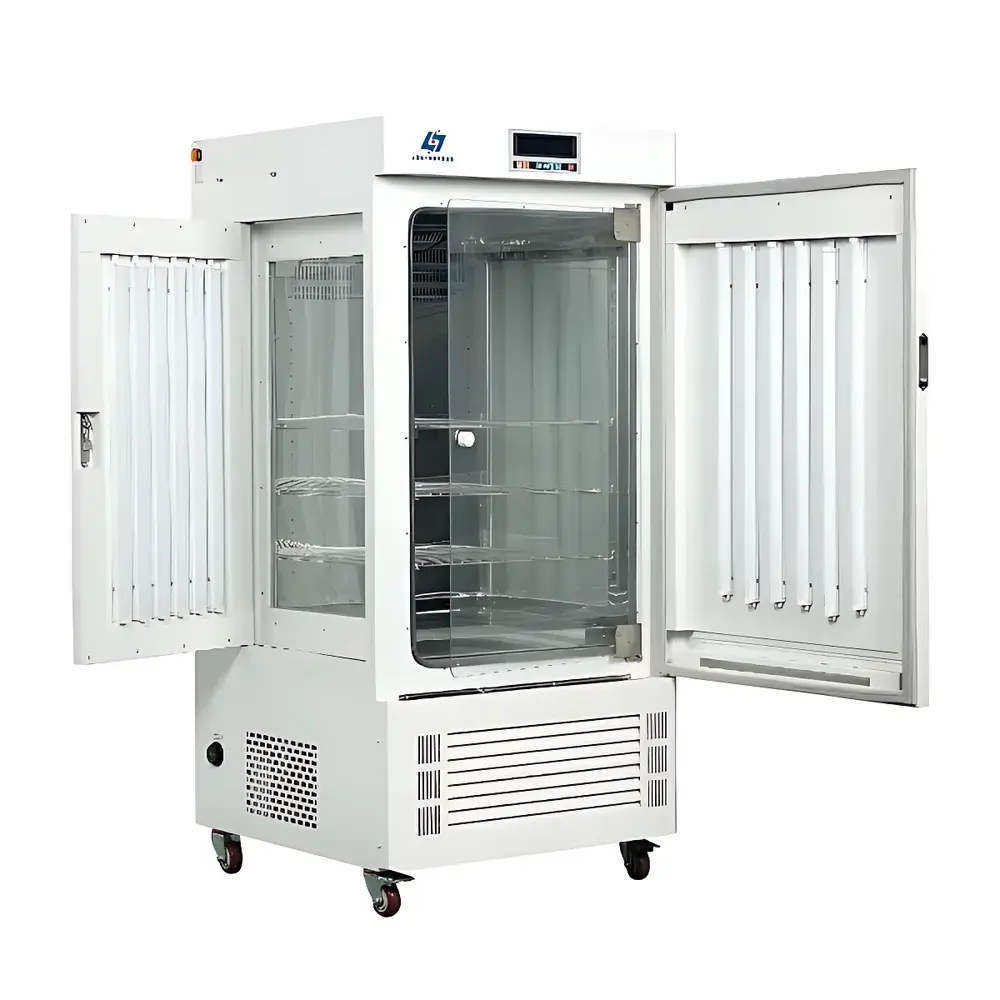
Yoyi MGC-300 Plant Growth Chamber
| Brand | Yoyi |
|---|---|
| Origin | Shanghai, China |
| Manufacturer | Yoyi Instrument Co., Ltd. |
| Model | MGC-300 |
| Capacity | 300 L |
| External Dimensions (W×D×H) | 780 × 780 × 1660 mm |
| Temperature Range | 4–50 °C (dark), 10–50 °C (with illumination) |
| Temperature Uniformity | ±1.5 °C |
| Temperature Fluctuation | ±1 °C |
| Illumination | Triple-side LED lighting |
| Spectral Range | Visible spectrum (400–700 nm) |
| Light Intensity Adjustment | 6-level dimming (up to 20,000 lx) |
| Control System | Microprocessor-based PID temperature & light control |
| Programmable Cycles | 99 cycles × 30 segments × 99 h 59 min per segment |
| Power Input | 220 V AC, 50 Hz, 2200 W |
| Refrigerant | R134a / R406a |
| Construction | Mirror-finish stainless steel interior with rounded corners |
| Door Design | Double-glazed insulated door with observation window |
| Mobility | Four swivel casters with locking brakes |
| Continuous Operation | ≥360 h (15 days) |
| Optional Features | Independent over-temperature alarm, USB/RS485 interface, embedded printer, customizable LED spectra (red/blue) |
Overview
The Yoyi MGC-300 Plant Growth Chamber is an engineered environmental simulation system designed for reproducible, long-term plant physiology studies, seed germination assays, tissue culture maintenance, and photobiological research under tightly controlled temperature and light conditions. It operates on a dual-regime thermal management principle: active refrigeration (using R134a/R406a compressors) combined with precision PID-controlled heating ensures stable setpoint maintenance across both illuminated and non-illuminated phases. The triple-side LED illumination architecture delivers uniform photosynthetically active radiation (PAR, 400–700 nm) across the entire 300 L working volume—critical for avoiding phototropic artifacts in developmental or circadian rhythm experiments. Unlike conventional incubators, the MGC-300 integrates diurnal cycle programming at the firmware level, enabling independent temperature and light intensity scheduling per time segment to emulate natural day/night transitions—essential for phenotyping, stress acclimation, and photoperiod-sensitive cultivar evaluation.
Key Features
- Triple-side high-efficiency LED lighting array with six-step intensity adjustment (0–20,000 lx), delivering uniform PAR distribution without shadow zones or edge attenuation.
- Mirror-polished 304 stainless steel interior with fully rounded corners and adjustable stainless steel shelving (3 standard trays included) for easy cleaning and flexible sample arrangement.
- Dual-glazed, argon-filled observation door with silicone gasket sealing minimizes thermal leakage while maintaining optical clarity during real-time monitoring—no internal temperature perturbation upon visual inspection.
- Redundant compressor system (optional configuration) enables automatic alternation between two independent cooling units, extending mean time between failures (MTBF) and supporting uninterrupted operation for ≥360 hours.
- Microprocessor-based control interface with 7-inch backlit LCD display; intuitive menu navigation supports multi-parameter concurrent viewing (setpoint, actual temp, light level, elapsed time, cycle stage).
- Programmable logic controller capable of storing up to 99 multi-stage cycles, each comprising 30 programmable segments with individual temperature, light intensity, and duration parameters—enabling complex abiotic stress protocols (e.g., heat shock + dark recovery + re-illumination).
- Energy-optimized design featuring low-GWP refrigerants (R134a/R406a), EC-type centrifugal circulation fan, and optimized air duct geometry to achieve ±1.5 °C temperature uniformity across full load at 25 °C ambient.
Sample Compatibility & Compliance
The MGC-300 accommodates standard botanical growth vessels—including Petri dishes, Magenta boxes, growth pouches, hydroponic trays, and small potted plants up to 45 cm height—within its 580 × 550 × 950 mm working chamber. Its temperature stability (±1 °C fluctuation) and spectral fidelity meet requirements for ISO 17025-accredited laboratories conducting GLP-compliant plant phenotyping, OECD Guideline 208 (terrestrial plant toxicity testing), and ASTM E2874 (standard practice for plant growth chamber performance verification). The unit conforms to IEC 61000-6-3 (EMC emissions) and IEC 61000-6-2 (immunity), and optional RS485/USB interfaces support 21 CFR Part 11-compliant data logging when paired with validated third-party software.
Software & Data Management
While the onboard controller provides standalone operation, optional connectivity modules enable integration into centralized lab infrastructure. The RS485 interface supports Modbus RTU protocol for bidirectional communication with SCADA or LIMS platforms; USB port permits direct export of time-stamped temperature and illumination logs (CSV format) to external storage. An optional dedicated PC software package provides real-time remote monitoring, alarm event history with timestamps, audit trail generation (user login, parameter changes, cycle starts/stops), and automated report compilation aligned with ISO/IEC 17025 documentation standards. All data records include metadata such as environmental chamber ID, operator ID, calibration certificate expiry, and sensor validation status.
Applications
- Controlled-environment plant phenotyping for drought, heat, or photoperiod response screening.
- In vitro micropropagation and callus induction requiring precise light/dark cycling.
- Seed viability and germination rate quantification per ISTA or AOSA protocols.
- Circadian clock gene expression studies using synchronized light-on/light-off transitions.
- Microbial culture under defined photic conditions (e.g., cyanobacteria, phototrophic bacteria).
- Small-animal behavioral assays (Drosophila, zebrafish larvae) where ambient light quality and thermal stability directly influence locomotor activity patterns.
- Pharmaceutical stability testing of light-sensitive biologics under ICH Q1B photostability conditions (when configured with UV-filtered LEDs).
FAQ
What is the maximum PAR irradiance achievable inside the chamber?
The triple-side LED system delivers up to 20,000 lux (measured at center position, 0.5 m from each panel) within the visible spectrum (400–700 nm); spectral power distribution (SPD) reports are available upon request.
Can the unit maintain temperature stability during extended dark periods?
Yes—the refrigeration system remains fully active during darkness; the lower limit of 4 °C (vs. 10 °C with illumination) reflects enhanced cooling capacity without competing radiant heating from LEDs.
Is calibration traceable to national standards?
Factory calibration uses NIST-traceable PT100 sensors; users may perform in-house verification using accredited reference thermometers and lux meters per ISO/IEC 17025 clause 6.5.
Are custom LED spectra (e.g., monochromatic red/blue) supported?
Yes—Yoyi offers OEM-specified LED arrays with peak wavelengths at 660 nm (red) and 450 nm (blue), configurable during order placement; spectral output certificates provided with shipment.
Does the unit comply with electrical safety directives for export to EU markets?
CE marking is applied per EN 61010-1:2019 (Safety Requirements for Electrical Equipment for Measurement, Control, and Laboratory Use) and RoHS 2011/65/EU.





