
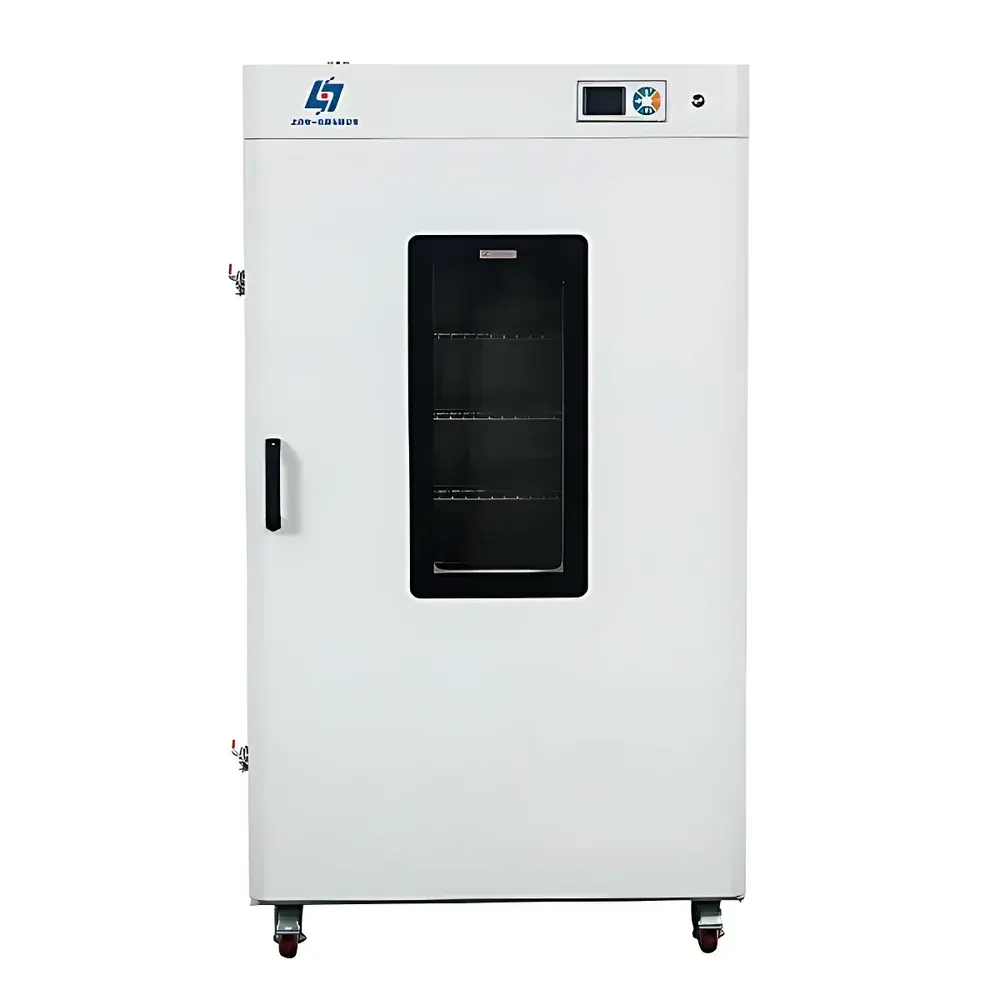
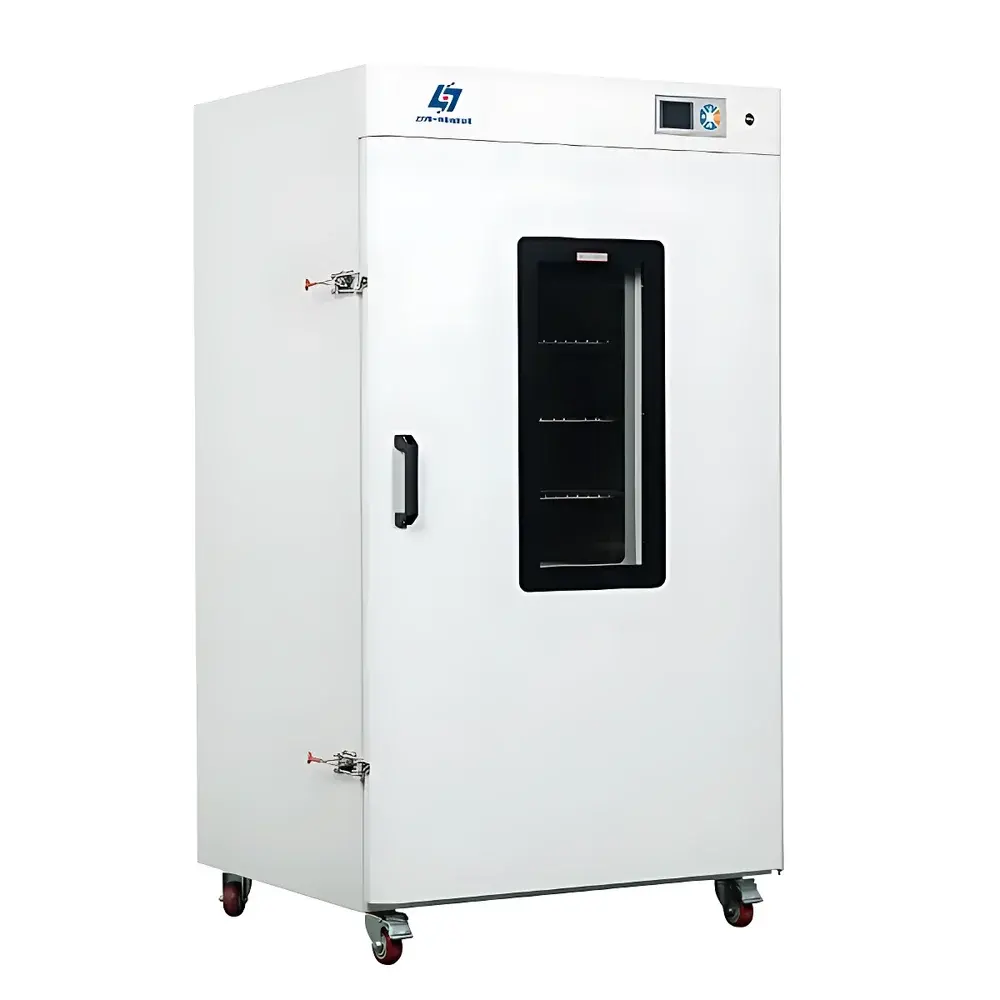
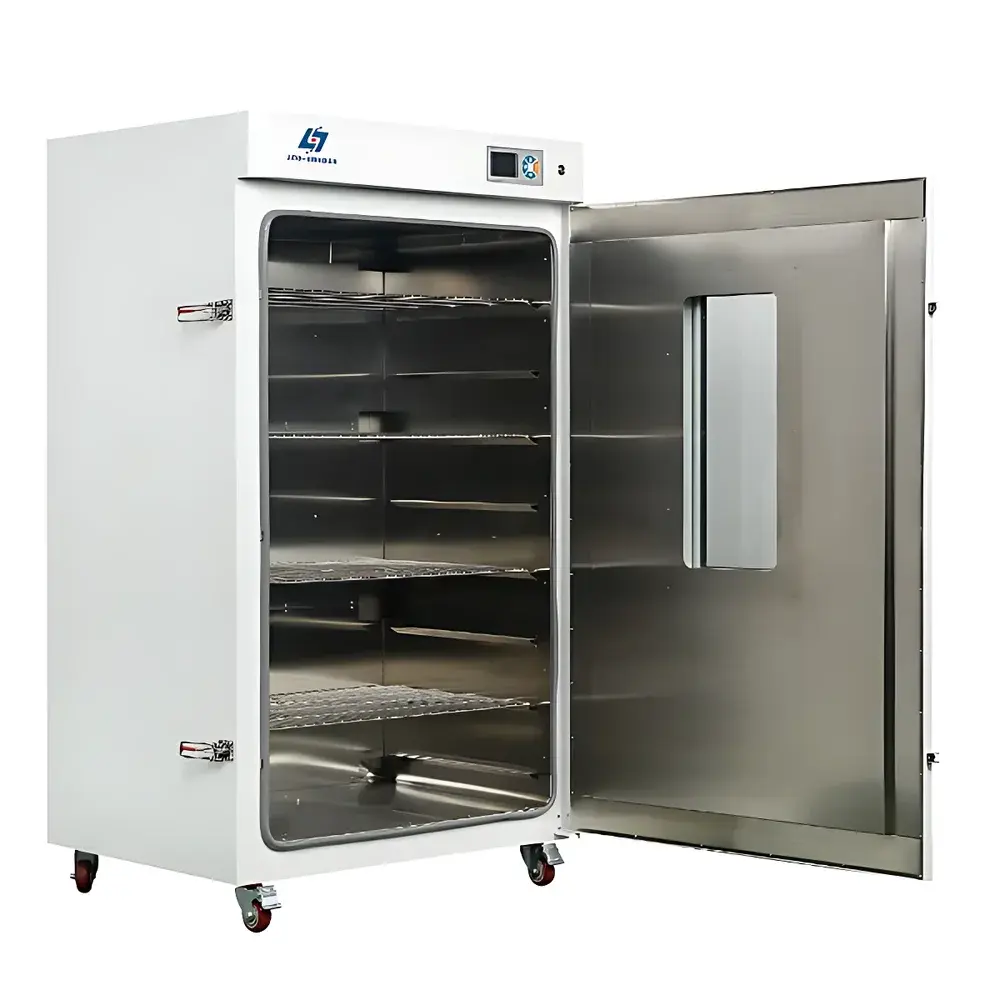
Yoyilab DHG-9960A Vertical Forced-Air Constant-Temperature Drying Oven (1000 L, 250 °C Max)
| Brand | Yoyilab |
|---|---|
| Origin | Shanghai, China |
| Manufacturer Type | Direct Manufacturer |
| Model | DHG-9960A |
| Temperature Range | RT+10 °C to 250 °C |
| Temperature Uniformity | ±2.5% at 100 °C |
| Temperature Fluctuation | ±1 °C |
| Temperature Resolution | 0.1 °C |
| Internal Chamber Dimensions (W×D×H) | 1000 mm × 800 mm × 1300 mm |
| External Dimensions (W×D×H) | 1180 mm × 910 mm × 1750 mm |
| Chamber Volume | 1000 L |
| Chamber Material | Mirror-Finish Stainless Steel (SUS304) |
| Construction | Cold-Rolled Steel Outer Shell with Electrostatic Powder Coating |
| Air Circulation | Rear-Mounted Forced-Air Convection System with Adjustable Intake/Exhaust Vents |
| Compliance | GB/T 30435–2013 |
Overview
The Yoyilab DHG-9960A is a high-capacity vertical forced-air drying oven engineered for precision thermal processing in regulated laboratory and industrial quality control environments. Designed around a robust convection-based heating architecture, it maintains stable, uniform temperature distribution across its 1000 L stainless-steel chamber using a rear-mounted, dynamically balanced blower system and optimized airflow ducting. Its operational range spans from ambient +10 °C to 250 °C, making it suitable for applications requiring extended thermal exposure—such as moisture removal from bulk pharmaceutical intermediates, pre-conditioning of polymer composites, residual solvent evaporation in analytical sample preparation, and thermal stabilization of calibration standards. The unit complies fully with GB/T 30435–2013, the Chinese national standard for electrically heated drying ovens, which specifies requirements for temperature accuracy, uniformity, safety interlocks, and electromagnetic compatibility under routine laboratory operating conditions (ambient temperature 20 °C, 50% RH, no external vibration or strong magnetic fields).
Key Features
- Microprocessor-based PID temperature controller with 0.1 °C resolution, real-time display of setpoint, actual chamber temperature, and remaining timer duration on a backlit LCD interface
- Dual-layer tempered glass observation window with integrated anti-fog coating enables continuous visual monitoring without thermal interruption or door opening
- Mirror-finish SUS304 stainless-steel interior chamber and adjustable stainless-steel shelving (standard configuration: 3 shelves, load-rated to 15 kg per shelf)
- High-efficiency forced-air circulation system featuring rear-mounted centrifugal blower, independently controllable intake and exhaust dampers, and condensate-evacuation pathway to prevent internal humidity accumulation
- Redundant safety architecture including independent mechanical overtemperature cutoff (optional), auto-recovery after power interruption, and non-volatile parameter memory preserving all user settings
- Electrostatically coated cold-rolled steel exterior with reinforced structural frame for long-term dimensional stability under repeated thermal cycling
- High-temperature silicone door gasket rated for continuous operation up to 250 °C, ensuring low-leakage sealing and extended service life
Sample Compatibility & Compliance
The DHG-9960A accommodates heterogeneous sample loads—including stacked trays of glass vials, ceramic crucibles, metal test coupons, and large-format composite panels—without compromising thermal homogeneity. Its chamber geometry supports ISO/IEC 17025-compliant validation protocols: temperature mapping can be performed using calibrated thermocouples at ≥9 spatial points (per ICH Q5C guidance), confirming uniformity within ±2.5% at 100 °C (measured per GB/T 30435–2013 Annex B). While not certified to UL 61010-1 or EN 61010-1 out-of-the-box, the unit’s electrical design—including grounded chassis, double-pole main switch, and Class H insulation on heating elements—aligns with fundamental safety principles required for GLP and GMP environments. Documentation packages support audit readiness for FDA 21 CFR Part 11–aligned workflows when paired with optional RS485 data logging.
Software & Data Management
The standard controller supports programmable timer operation (1–9999 minutes) and stores up to 10 user-defined thermal profiles. Optional RS485 communication interface (Modbus RTU protocol) enables integration into centralized Lab Information Management Systems (LIMS) or SCADA platforms for automated temperature logging, alarm forwarding, and electronic record generation. When configured with the optional embedded thermal printer, the system produces time-stamped hardcopy reports compliant with ALCOA+ data integrity principles—including operator ID, start/end timestamps, max/min/mean temperatures, and deviation flags. All optional peripherals—including inert gas inlet with calibrated rotameter (0–10 L/min N₂ flow range)—are supplied with traceable calibration certificates and installation schematics for IQ/OQ documentation.
Applications
- Pharmaceutical: Residual solvent removal from active pharmaceutical ingredients (APIs), excipient drying prior to granulation, and stability study sample conditioning per ICH Q1A(R2)
- Materials Science: Pre-baking of ceramic green bodies, post-cure thermal treatment of epoxy composites, and moisture equilibration of hygroscopic polymers
- Food & Agriculture: Moisture content determination per AOAC 950.46, mycotoxin reference material stabilization, and botanical extract concentration
- Electronics: PCB pre-baking to mitigate popcorning during reflow soldering, conformal coating curing, and capacitor aging tests
- Academic Research: Controlled dehydration of biological specimens, catalyst calcination, and calibration standard preparation for gravimetric analysis
FAQ
What is the maximum validated temperature uniformity across the full 1000 L chamber?
Temperature uniformity is verified per GB/T 30435–2013 at 100 °C in empty-chamber conditions and documented as ±2.5% (i.e., ±2.5 °C deviation from setpoint across nine defined test points). Uniformity degrades marginally at extremes; users conducting critical work above 200 °C are advised to perform in-situ mapping.
Can this oven be validated for GMP production use?
Yes—when equipped with RS485 logging and paired with qualified temperature sensors, the DHG-9960A supports IQ/OQ/PQ execution per ASTM E2500 and EU Annex 15. Full validation kits—including sensor placement templates, protocol templates, and calibration traceability documentation—are available upon request.
Is inert gas purging supported natively?
An optional inert gas inlet port (with calibrated rotameter and quick-connect fitting) is factory-integrated into the rear panel. Nitrogen or argon purging is configurable for oxygen-sensitive materials, with flow rates adjustable from 0–10 L/min and pressure tolerance up to 0.1 MPa gauge.
What maintenance intervals are recommended for sustained accuracy?
Blower motor lubrication and door gasket inspection are recommended every 12 months or 2000 operational hours. Chamber calibration verification using NIST-traceable reference thermometers should occur quarterly in regulated environments or after any physical impact to the unit.
Are custom chamber configurations available?
Yes—Yoyilab provides engineering-led customization including modified shelving layouts, additional access ports (25 mm or 50 mm diameter), dual-door configurations, and specialized interior coatings (e.g., electropolished SS316L) for corrosive process gases. Lead time and qualification requirements apply.
Related Products



