
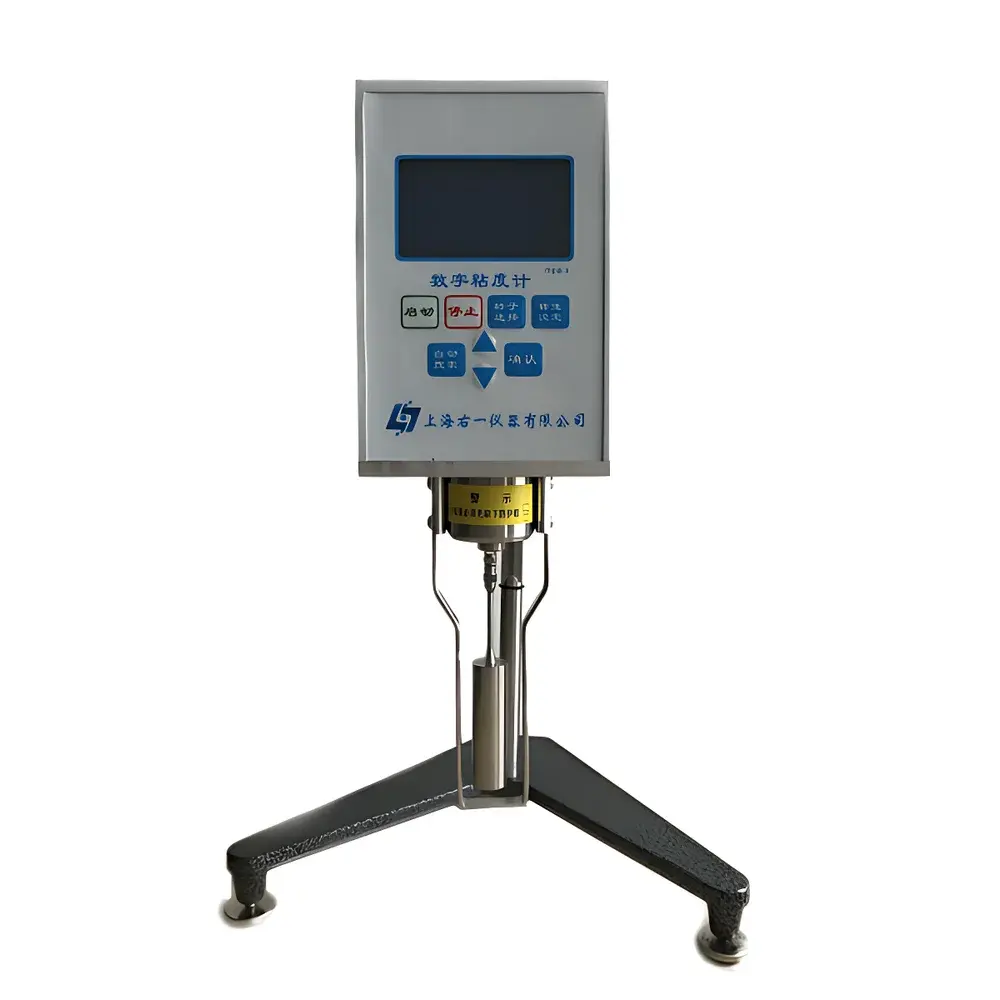
Yoyilab RVDV-1 High-Viscosity Digital Rotational Viscometer
| Brand | Yoyilab |
|---|---|
| Origin | Shanghai, China |
| Manufacturer Type | Direct Manufacturer |
| Instrument Type | Benchtop Rotational Viscometer |
| Operating Environment | Ambient Temperature (5–35 °C) |
| Viscosity Range | 10–13,000,000 mPa·s |
| Accuracy | ±1% FS |
| Repeatability | ±0.3% FS |
| Resolution | 1 mPa·s |
| Speed Options | Three Configurable Speed Profiles (8/10/10 speed settings across 0.3–100 rpm) |
| Standard Spindles | #1–#7 (7 total) |
| Display | Backlit LCD |
| Temperature Probe | Integrated, Real-Time Monitoring |
| Data Interface | RS-232 or USB (software-enabled) |
| Power Supply | AC 100–240 V, 50/60 Hz |
| Dimensions (H×W×D) | 95×130×155 mm (excl. base) |
| Net Weight | 2 kg (excl. base) |
Overview
The Yoyilab RVDV-1 is a benchtop digital rotational viscometer engineered for precision measurement of Newtonian and non-Newtonian fluid viscosity across an exceptionally wide dynamic range—from 10 mPa·s to 13 million mPa·s. Based on the Couette principle, it determines viscosity by quantifying the torque required to rotate a spindle immersed in the test fluid at a controlled, constant angular velocity. This method delivers high reproducibility under steady-shear conditions and is widely accepted in quality control laboratories, R&D facilities, and production environments where regulatory compliance and traceable rheological data are essential. Designed for ambient-temperature operation (5–35 °C), the RVDV-1 supports routine viscosity verification per ASTM D2196, ISO 2555, and GB/T 2794—standards commonly referenced in coatings, adhesives, pharmaceutical suspensions, and food processing applications.
Key Features
- Intelligent auto-scan functionality: Automatically identifies optimal spindle and rotational speed combinations for unknown samples, minimizing operator error and accelerating method development.
- Triple-speed configuration architecture: Offers three preconfigured speed profiles (A/B/C) with up to 10 discrete speeds each (0.3–100 rpm), enabling flexible shear-rate selection across low-, medium-, and high-viscosity regimes.
- Seven interchangeable spindles (#1–#7) included as standard: Enables seamless transition between low-torque (e.g., solvents) and high-torque (e.g., polymer melts, pastes) measurements without hardware modification.
- Integrated Pt100 temperature probe: Provides real-time, calibrated temperature monitoring during measurement—critical for temperature-dependent viscosity profiling and compliance with ISO 5628 (temperature control requirements for viscometry).
- Microcontroller-based signal processing: Implements full-scale linear calibration across all speed/spindle combinations, ensuring consistent accuracy (±1% FS) and exceptional repeatability (±0.3% FS).
- Backlit LCD interface with English-language menu navigation: Supports intuitive local operation, parameter recall (including last-used spindle, speed, and temperature offset), and on-device data review.
- RS-232/USB connectivity with proprietary PC software: Facilitates automated data logging, time-stamped viscosity vs. time/temperature/shear rate plots, and export to CSV or PDF for audit-ready reporting.
Sample Compatibility & Compliance
The RVDV-1 accommodates a broad spectrum of liquid and semi-solid materials—including solvent-based adhesives, hydrogels, emulsions, ceramic slurries, edible oils, and thermoplastic polymer solutions—provided sample volume exceeds minimum fill requirements for each spindle geometry. Its mechanical design complies with IEC 61010-1 safety standards for laboratory electrical equipment. While not intrinsically rated for hazardous environments, its robust enclosure and thermal management support stable operation under GLP- and GMP-aligned workflows. Data integrity is reinforced through timestamped acquisition, user-defined metadata tagging, and software-based audit trail generation—features supporting alignment with FDA 21 CFR Part 11 expectations when deployed with validated configurations.
Software & Data Management
The bundled Windows-compatible software provides real-time graphical visualization of viscosity trends, automatic calculation of apparent viscosity at defined shear rates, and batch export of raw torque/time/temperature datasets. Users may define custom test protocols—including ramped speed sequences, timed hold intervals, and multi-point temperature sweeps—with saved templates enforce method consistency across operators and shifts. All exported files include embedded instrument ID, firmware version, calibration certificate ID, and environmental metadata—ensuring full traceability for internal audits or regulatory submissions.
Applications
- Quality assurance of industrial adhesives and sealants (e.g., epoxy pastes, silicone gels)
- Rheological screening of pharmaceutical suspensions and topical ointments per USP <911>
- Process validation of food-grade starch thickeners, chocolate masses, and dairy concentrates
- Formulation optimization of waterborne paints and architectural coatings
- Stability assessment of nanofluid dispersions and battery electrode slurries
- Educational demonstration of shear-thinning behavior, yield stress estimation (via flow curve extrapolation), and temperature-viscosity relationships
FAQ
What spindle configurations are supported for maximum viscosity measurement?
The #5, #6, and #7 spindles—used in conjunction with the C-speed profile (up to 100 rpm)—are optimized for measurements approaching 13,000,000 mPa·s. Calibration certificates specify torque limits per spindle/speed combination.
Is temperature compensation applied automatically during measurement?
No—temperature compensation is not applied algorithmically. The integrated probe enables concurrent temperature logging; users must apply empirical or literature-based correction factors manually if required by application standards.
Can the RVDV-1 be validated for ISO/IEC 17025-compliant testing?
Yes—when used with NIST-traceable calibration fluids, documented SOPs, and periodic verification against reference standards, the system meets foundational metrological requirements for accredited testing labs.
Does the software support multi-user access control or electronic signatures?
The standard software does not include role-based permissions or digital signature modules. For regulated environments, integration with LIMS or third-party ELN platforms via CSV/API export is recommended.
What maintenance is required to sustain measurement accuracy?
Annual recalibration using certified viscosity standards is advised. Routine cleaning of spindles with appropriate solvents (e.g., acetone for organic residues) and inspection of bearing integrity ensure long-term torque sensor fidelity.



