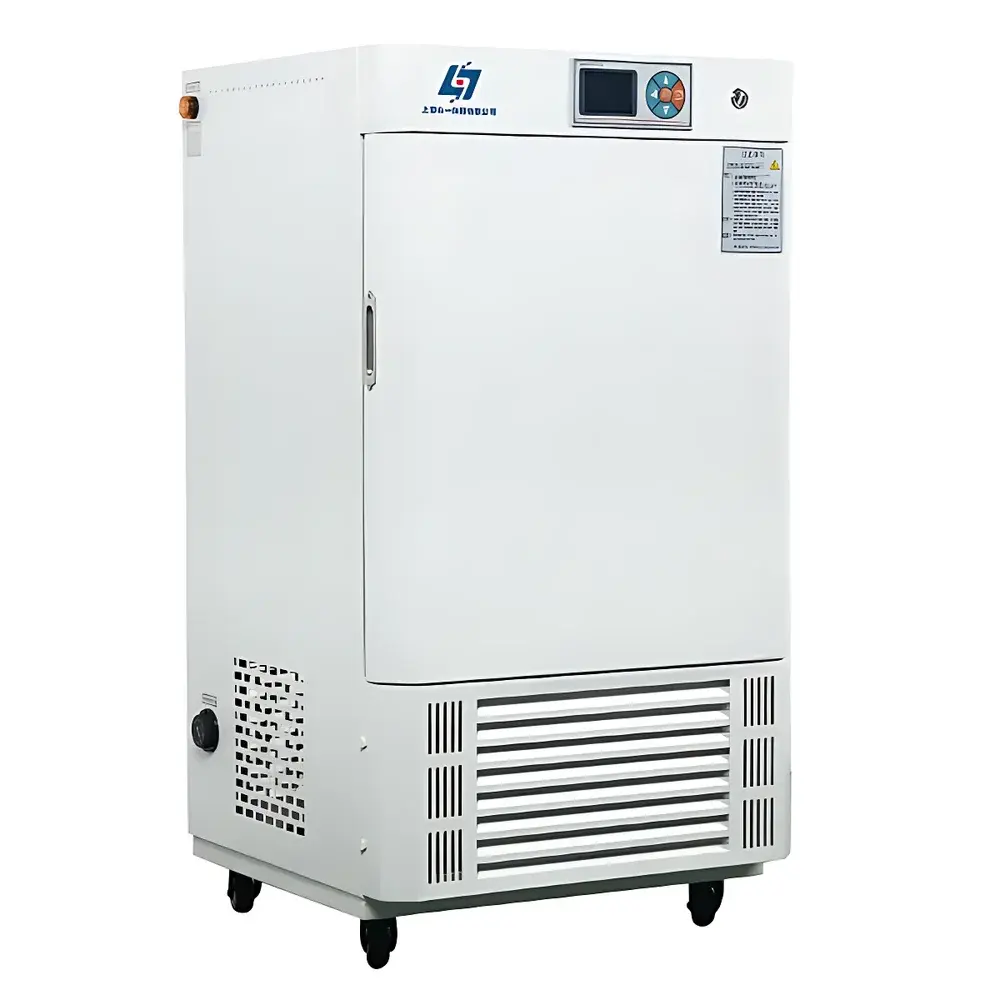
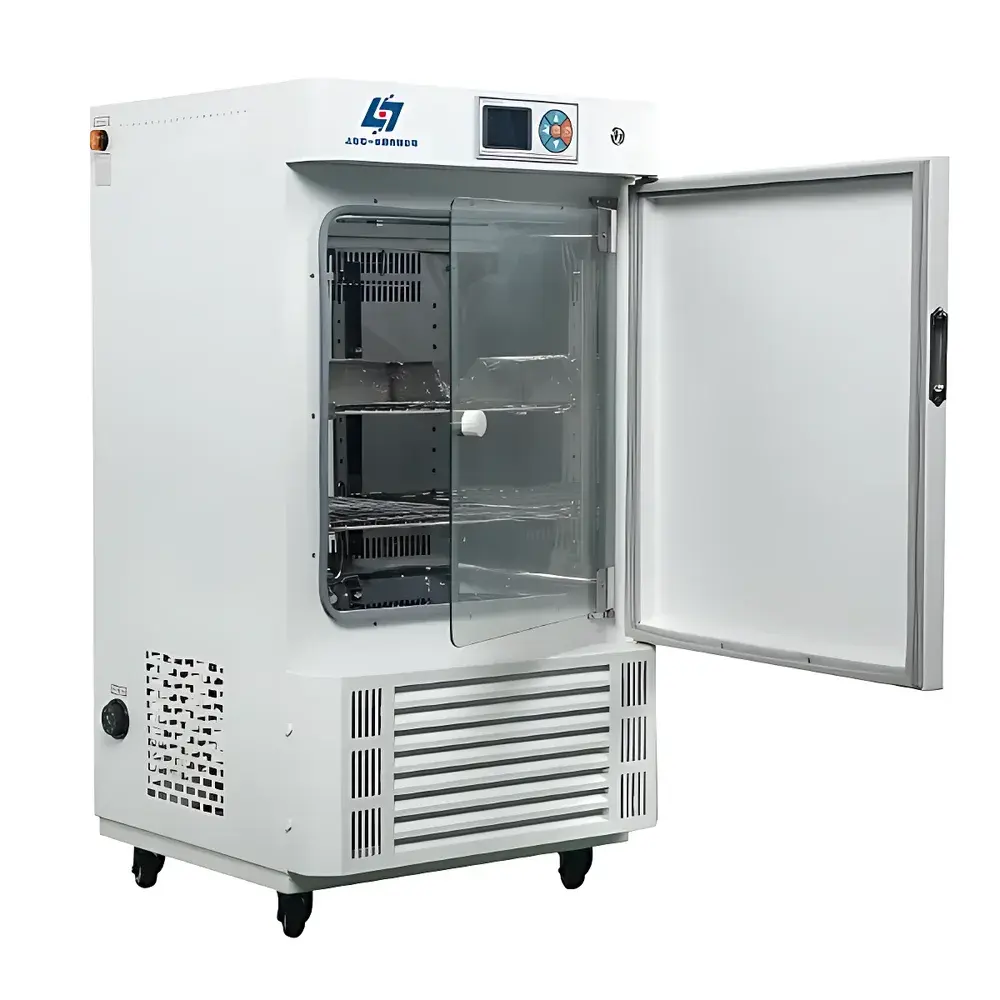
Yoyilab SPX-100 Biochemical Incubator
| Brand | Yoyilab |
|---|---|
| Origin | Shanghai, China |
| Manufacturer Type | Direct Manufacturer |
| Model | SPX-100 |
| Cooling Method | Compressor-based refrigeration |
| Air Circulation | Forced convection |
| Temperature Range | 0–65 °C |
| Temperature Resolution | 0.1 °C |
| Temperature Fluctuation | ±0.5 °C (high-temp), ±1.0 °C (low-temp) |
| Temperature Uniformity | ±1.5 °C (at 25 °C test point) |
| Chamber Capacity | 100 L |
| External Dimensions | 575 × 605 × 1160 mm (W × D × H) |
Overview
The Yoyilab SPX-100 Biochemical Incubator is a precision-engineered, microprocessor-controlled environmental chamber designed for stable, reproducible temperature regulation in life science laboratories. It operates on dual-mode thermoregulation—combining Peltier-free compressor-based cooling with resistive heating—to maintain setpoints across a broad operational range of 0 to 65 °C. Unlike passive or natural-convection incubators, the SPX-100 employs a forced-air circulation system with optimized airflow distribution, minimizing thermal stratification and ensuring rapid equilibration after door opening. Its primary function is to support static cultivation and long-term preservation of microorganisms—including bacteria, yeasts, molds, and fungi—as well as cell line maintenance, seed germination studies, BOD (Biochemical Oxygen Demand) assays, and plant tissue culture protocols. The unit conforms to fundamental laboratory infrastructure requirements for GLP-compliant environmental control, serving as a foundational platform in academic research, pharmaceutical quality control, environmental monitoring, and agricultural biotechnology labs.
Key Features
- Robust construction: Cold-rolled steel exterior with electrostatic epoxy powder coating; mirror-finish stainless-steel interior chamber with rounded corners for easy decontamination and reduced microbial retention.
- Dual-door thermal barrier design: Outer door with magnetic seal and inner tempered glass door significantly reduce heat loss and minimize internal temperature perturbation during observation.
- Intelligent PID temperature control: 5.7-inch LCD touchscreen interface enables simultaneous display and real-time adjustment of setpoint temperature, actual chamber temperature, and remaining timer duration.
- Power-loss recovery logic: Automatically restores previously configured parameters—including target temperature and elapsed/remaining time—after unexpected power interruption or system reset.
- Over-temperature safety protection: Independent hardware-based limit controller triggers audible/visual alarm and cuts heating output if chamber temperature exceeds user-defined deviation thresholds.
- Mobility and stability: Integrated swivel casters with locking mechanism and adjustable leveling feet allow flexible placement and vibration-dampened operation on standard lab flooring.
Sample Compatibility & Compliance
The SPX-100 accommodates standard-sized Petri dishes, multi-well plates, Erlenmeyer flasks (up to 1 L), and culture tubes without spatial interference. Its 100 L working volume supports up to three adjustable stainless-steel shelves (included), enabling vertical optimization for heterogeneous sample loads. The chamber’s ±1.5 °C uniformity at 25 °C meets ISO 15195:2018 recommendations for incubator validation in clinical microbiology applications. While not certified to IEC 61000-4 electromagnetic compatibility standards out-of-box, the unit complies with CE marking directives for electrical safety (EN 61010-1) when operated within specified ambient conditions (5–30 °C, ≤80% RH non-condensing). Optional accessories—including RS485 communication modules and programmable multi-segment controllers—facilitate integration into centralized lab management systems aligned with FDA 21 CFR Part 11 data integrity expectations.
Software & Data Management
The embedded firmware supports local data logging of temperature profiles at user-selectable intervals (1–60 min), with storage capacity for up to 30 days of continuous 1-minute sampling. Logged data can be exported via USB flash drive in CSV format for downstream analysis in MATLAB, Python (Pandas), or Excel. An optional RS485 interface enables Modbus RTU protocol communication with SCADA or LIMS platforms, supporting remote parameter setting, real-time telemetry, and audit-trail generation. For enhanced traceability, the optional embedded thermal printer produces time-stamped hard-copy records of temperature excursions, alarm events, and calibration verification points—critical for QA/QC documentation in regulated environments.
Applications
- Biochemical Oxygen Demand (BOD) testing per APHA Standard Methods 5210B and ISO 5815-1.
- Microbial growth curve analysis under controlled thermal stress (e.g., thermal tolerance screening of probiotic strains).
- Long-term viability assessment of fungal spores and bacterial endospores in environmental persistence studies.
- Seed dormancy breaking and germination kinetics experiments in plant physiology labs.
- Pre-incubation of ELISA plates and antigen-antibody binding steps requiring precise thermal conditioning.
- Storage and stabilization of temperature-sensitive reagents, including restriction enzymes and RNA extraction kits.
FAQ
What is the recommended calibration frequency for the SPX-100?
Annual verification against NIST-traceable reference thermometers is advised; quarterly in-house checks using calibrated digital probes are recommended for GxP environments.
Can the SPX-100 operate continuously at 4 °C for cold-adapted organism culture?
Yes—the compressor-based cooling system maintains stable sub-ambient temperatures down to 0 °C, with verified performance at 4 °C under standard load conditions.
Is the unit suitable for CO₂-independent mammalian cell culture?
No—it lacks CO₂ regulation and humidity control; it is intended for non-CO₂-dependent applications such as bacterial/fungal culture, BOD, and seed germination.
Does the SPX-100 support external data acquisition via analog voltage output?
Not natively; however, the RS485 interface (optional) provides digital access to all real-time sensor values and system status flags.
What is the maximum allowable ambient temperature for safe operation?
The specified operating ambient range is +5 to +30 °C; sustained operation above 30 °C may compromise cooling efficiency and shorten compressor service life.
Related Products