
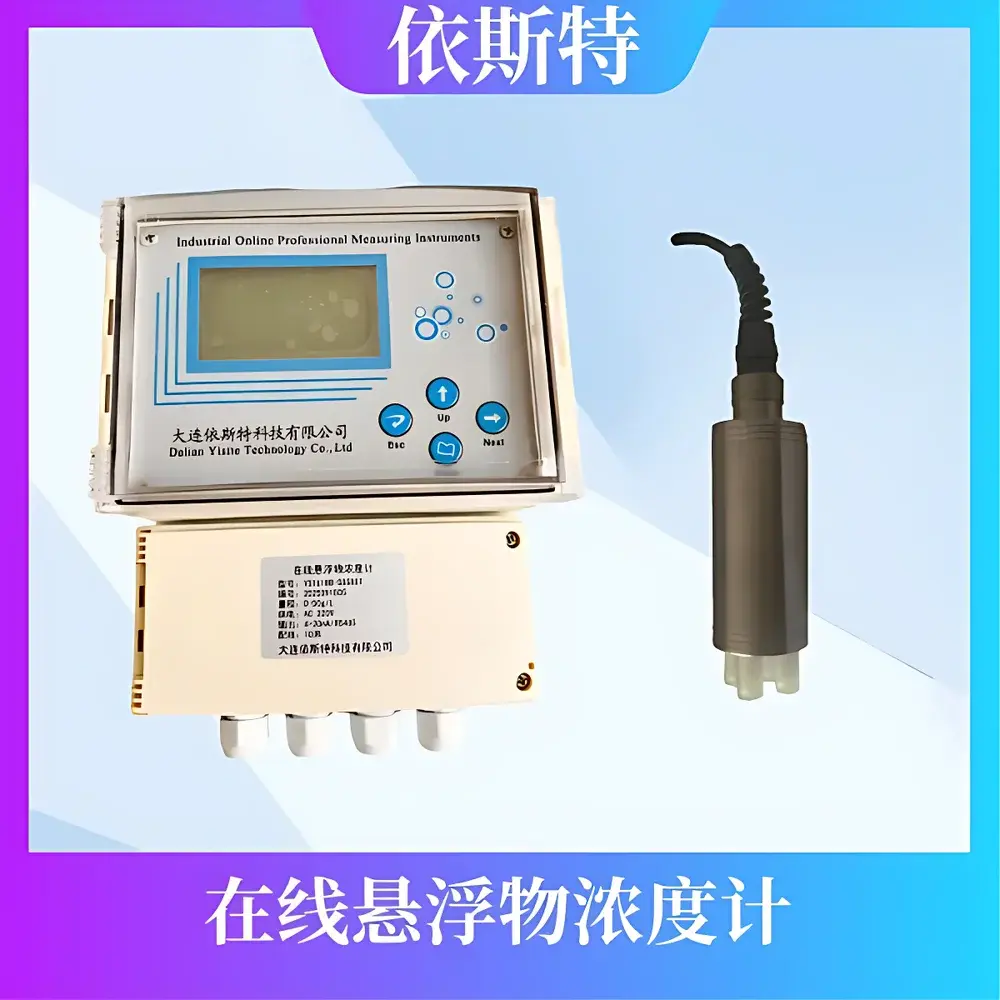
YST308B-MS880T Suspended Solids Analyzer by Dalian Yist Environmental Technology
| Brand | YST (Dalian Yist Environmental Technology) |
|---|---|
| Origin | Liaoning, China |
| Model | YST308B-MS880T |
| Measurement Range | 0–20,000 mg/L |
| Accuracy | ≤ ±2% FS |
| Output Signal | 4–20 mA DC |
| Power Supply | AC 220 V ±10%, 50/60 Hz |
| Operating Temperature | −10 °C to +55 °C |
| Relative Humidity | 10–90% RH (non-condensing) |
| Ingress Protection | IP65 |
| Installation Options | Immersion or Flow-Through |
Overview
The YST308B-MS880T Suspended Solids Analyzer is an optical turbidimetric sensor engineered for continuous, in-situ monitoring of total suspended solids (TSS) concentration in wastewater streams. It operates on the principle of near-infrared (NIR) light scattering—measuring the attenuation and angular distribution of incident light as it interacts with particulate matter suspended in liquid phase. This method delivers stable, interference-resistant readings across variable water matrices, including activated sludge effluent, chemical industrial discharge, and primary/secondary clarifier influents. Designed for integration into SCADA-based environmental control systems, the analyzer supports real-time process feedback loops essential for optimizing sedimentation efficiency, sludge blanket depth control, and regulatory compliance reporting under national discharge standards (e.g., China’s GB 8978-1996 and EU Directive 91/271/EEC). Its robust mechanical architecture and sealed optical path ensure long-term reliability in harsh, high-fouling environments typical of municipal and industrial wastewater treatment plants.
Key Features
- Optically stabilized NIR sensing platform with automatic baseline compensation to minimize drift from lens fouling or ambient temperature fluctuation
- Dual-mode installation support: submersible probe configuration for open-channel or tank deployment; inline flow-cell variant for pressurized pipe applications (optional)
- IP65-rated enclosure with stainless steel (316L) wetted parts and chemically resistant optical window for extended service life in corrosive wastewater
- Integrated digital signal conditioning circuitry eliminating external transmitter requirements—output conforms to industry-standard 4–20 mA analog protocol with HART compatibility (optional)
- Low-power consumption design (< 5 W) enabling operation from standard AC mains without auxiliary power conditioning
- Self-diagnostics capability including sensor health status, signal-to-noise ratio monitoring, and calibration validity flagging
Sample Compatibility & Compliance
The YST308B-MS880T is validated for use with municipal sewage, mixed liquor suspended solids (MLSS), digested sludge supernatant, and chemically complex industrial effluents containing organic colloids, metal hydroxides, and fine mineral particulates. It complies with ISO 7027:2016 for turbidity measurement methodology equivalence and meets functional requirements outlined in ASTM D3977-18 (Standard Practice for Sampling and Analysis of Wastewater Suspended Solids). While not certified for GLP or FDA 21 CFR Part 11 environments, its analog output and audit-ready calibration log functionality support traceable data acquisition workflows aligned with ISO/IEC 17025 laboratory quality management frameworks. The device does not require reagents or consumables and is compatible with third-party data loggers supporting Modbus RTU or analog input channels.
Software & Data Management
The analyzer operates as a standalone field instrument with no embedded firmware-based configuration software. All setup—including zero/span calibration, damping time adjustment (0.1–60 s), and linearization curve selection—is performed via front-panel push-button interface with dual-line LCD display. Calibration records (date, operator ID, reference standard used, pre-/post-calibration deviation) are stored locally in non-volatile memory and retrievable through serial diagnostic port (RS-485, optional). For centralized monitoring, the 4–20 mA output integrates seamlessly with PLCs, DCS platforms, or cloud-connected IoT gateways. When paired with YST’s optional YDataLink™ edge module (sold separately), users gain remote access to real-time diagnostics, historical trend export (CSV), and automated alerting via email/SMS upon threshold violation—functionality designed to meet basic IEC 62443-3-3 cybersecurity baseline requirements for Level 1 assets.
Applications
- Real-time TSS monitoring at final effluent discharge points to verify compliance with permitted limits (e.g., ≤10–30 mg/L for municipal outfalls)
- Process optimization in secondary clarifiers—detecting early signs of sludge bulking or washout through rapid TSS spikes
- Feed-forward control of polymer dosing systems based on influent TSS load variations
- Performance verification of dissolved air flotation (DAF) units and lamella settlers
- Baseline characterization of industrial pretreatment streams prior to municipal sewer entry
- Supporting ISO 14001 environmental management system documentation through auditable, timestamped measurement logs
FAQ
What calibration standards are recommended for routine verification?
Certified formazin or polyethylene glycol (PEG) suspensions traceable to NIST SRM 2134 are advised. Field calibration should be conducted quarterly or after sensor cleaning, using at least three points spanning 0–200, 1,000, and 15,000 mg/L.
Can the sensor operate in aerated basins with high bubble content?
Yes—the NIR wavelength (850 nm) and optimized detector geometry reduce sensitivity to transient gas bubbles; however, sustained foam layers >5 mm thickness may require mechanical skimming or sensor relocation.
Is the probe compatible with existing 2-inch NPT mounting threads?
The immersion probe features a standard 2-inch BSP male thread; adapters for NPT are available upon request.
Does the device support digital communication protocols beyond 4–20 mA?
Modbus RTU over RS-485 is supported as a factory-configurable option; Profibus DP and Foundation Fieldbus variants are not offered.
What is the expected service interval between maintenance cycles?
Under typical municipal wastewater conditions, optical window cleaning is recommended every 4–8 weeks; annual inspection of O-ring integrity and cable gland torque is advised per IEC 60529 maintenance guidelines.
Related Products







