
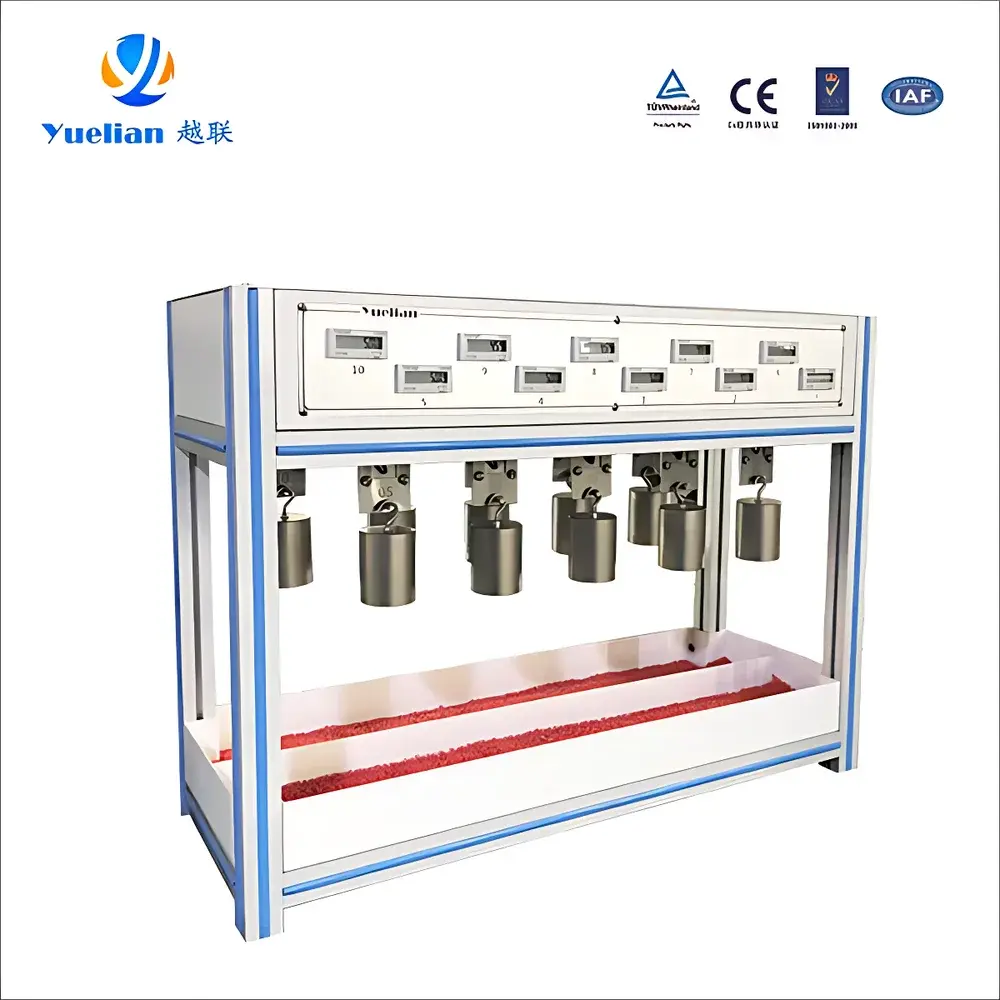
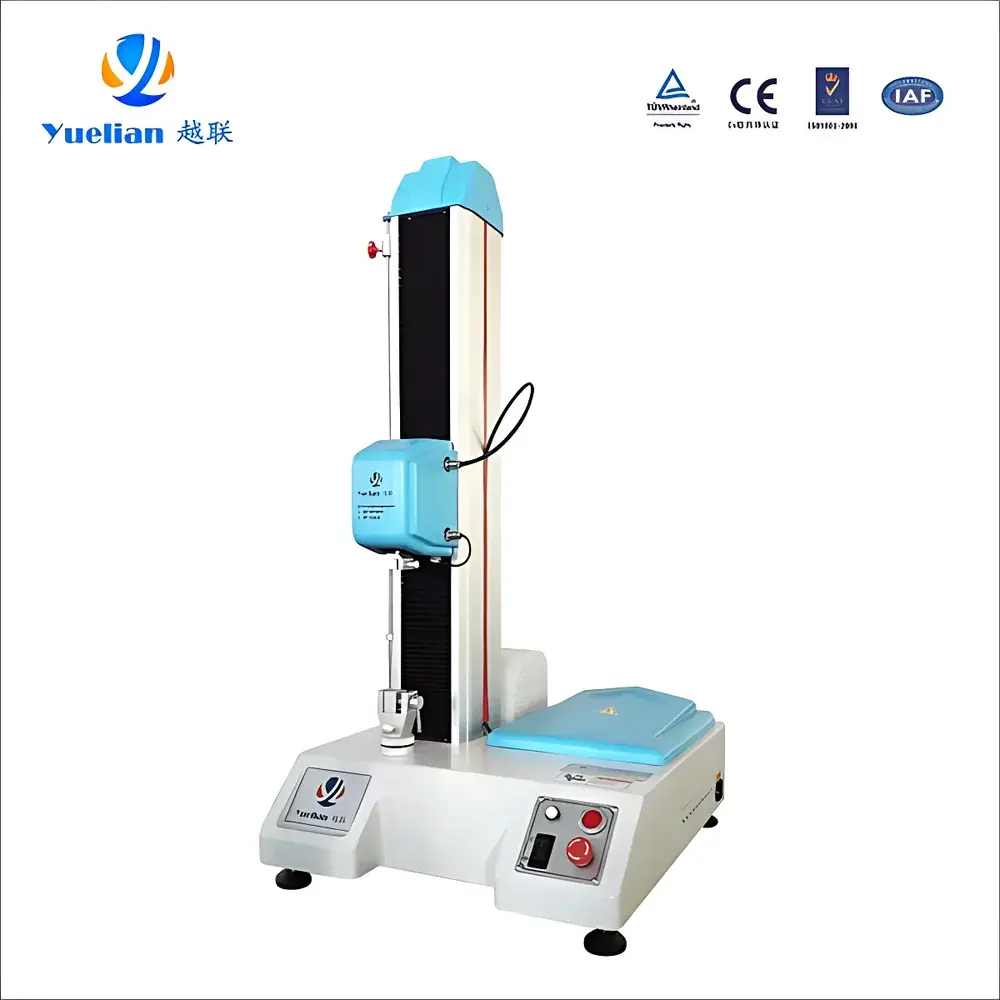
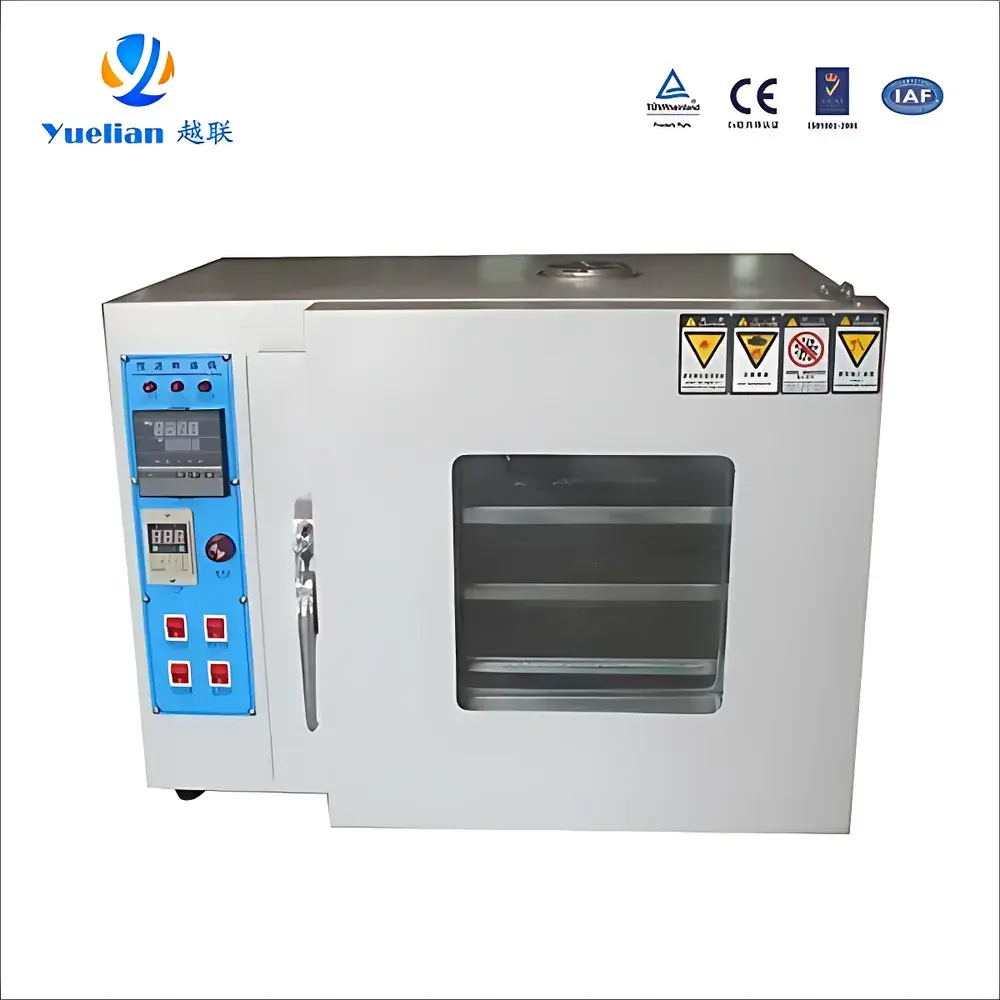
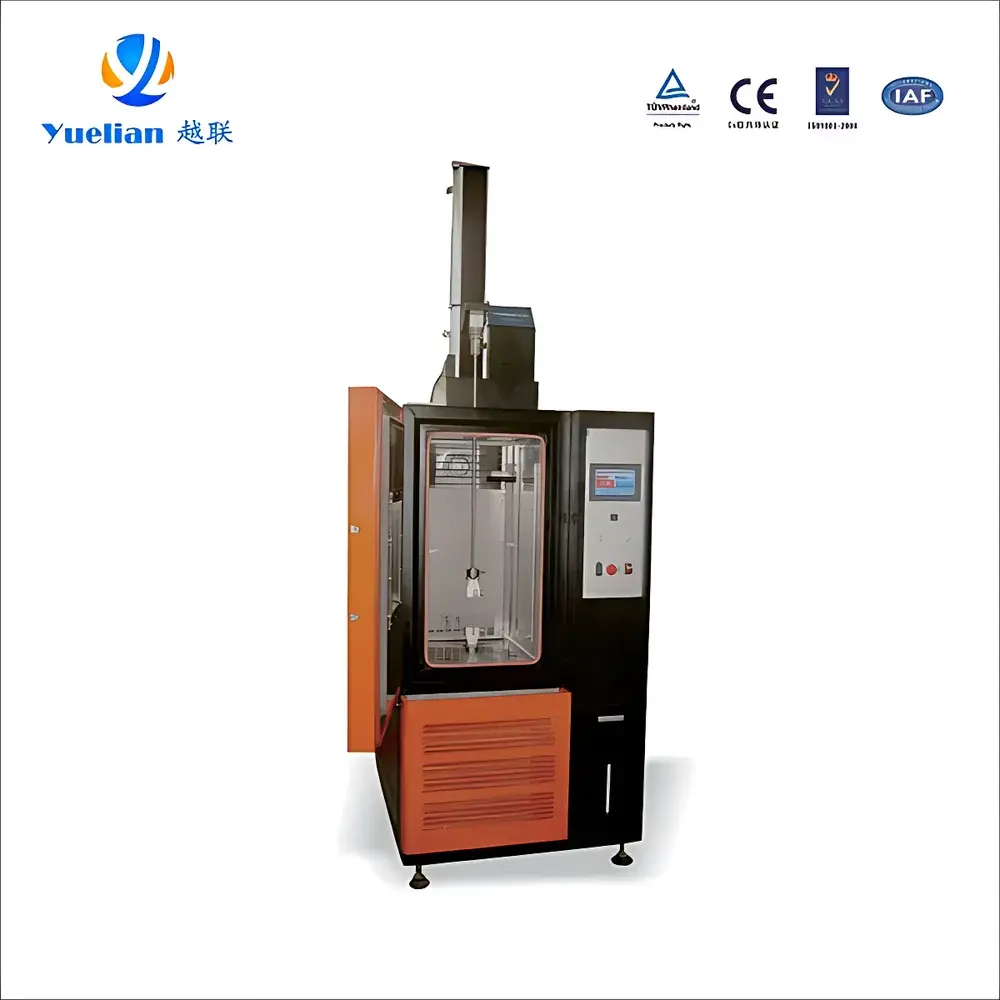
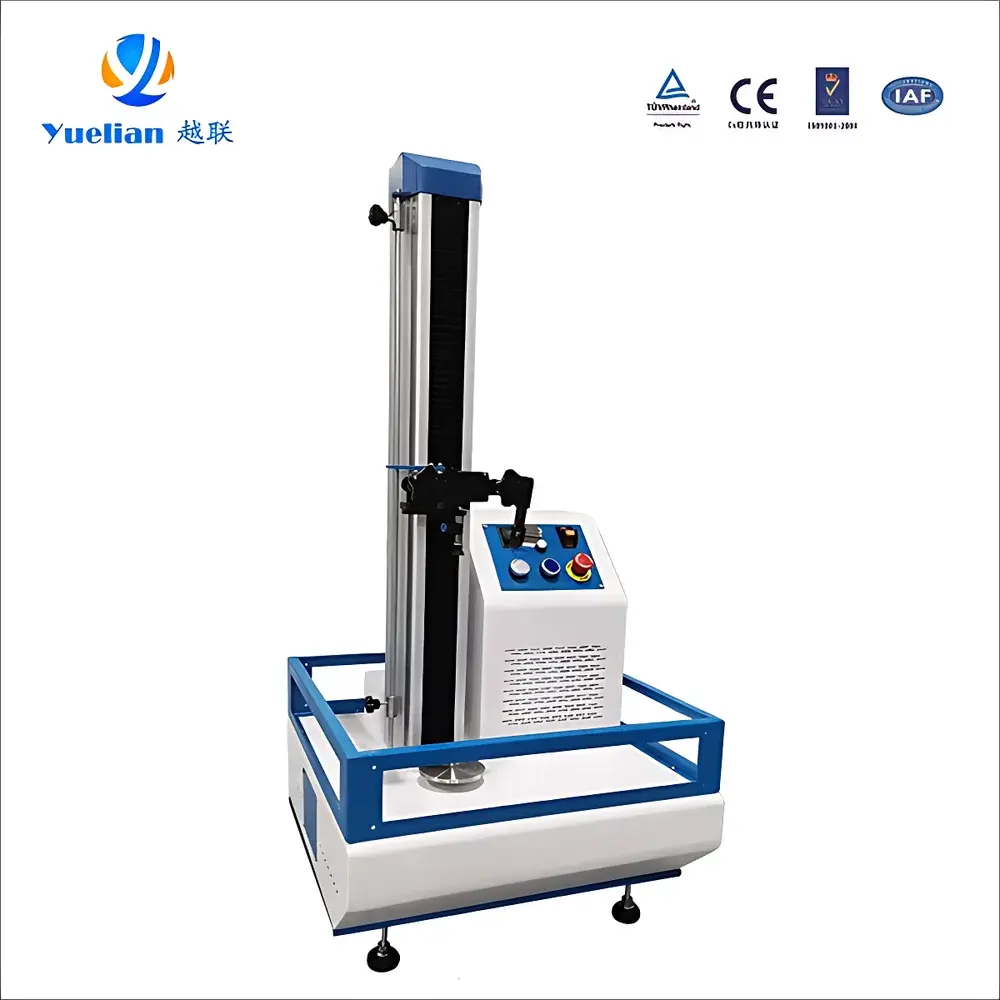
Yuelian 5507FIT Foam Impact Energy Absorption Tester
| Brand | Yuelian |
|---|---|
| Origin | Guangdong, China |
| Manufacturer Type | Authorized Distributor |
| Country of Origin | China |
| Model | 5507FIT |
| Price Range | USD 7,000 – 14,000 |
| Instrument Type | Free-Fall Impact Tester for Flexible Polymeric Foams |
| Nominal Impact Energy | 5 J |
| Impact Velocity | 100 mm/s (calculated equivalent at standard drop height) |
| Pendulum Moment (Impact Constant) | 100 N·mm/rad |
| Load Cell Capacity | 100 N |
| Maximum Lift Height | 800 mm |
| Drop Height Adjustment Range | 0–800 mm (motorized, programmable) |
| Steel Ball Mass & Diameter | User-configurable per ASTM D3574 / ISO 2439 |
| Data Acquisition Rate | 100 kHz |
| Release Mechanism | Electromagnetic solenoid |
| Positioning System | X-Y adjustable sample stage with IR centering sensor |
| Dimensions (L×W×H) | 500 × 300 × 1400 mm |
| Net Weight | 35 kg |
| Power Supply | 220 V AC, 50/60 Hz |
Overview
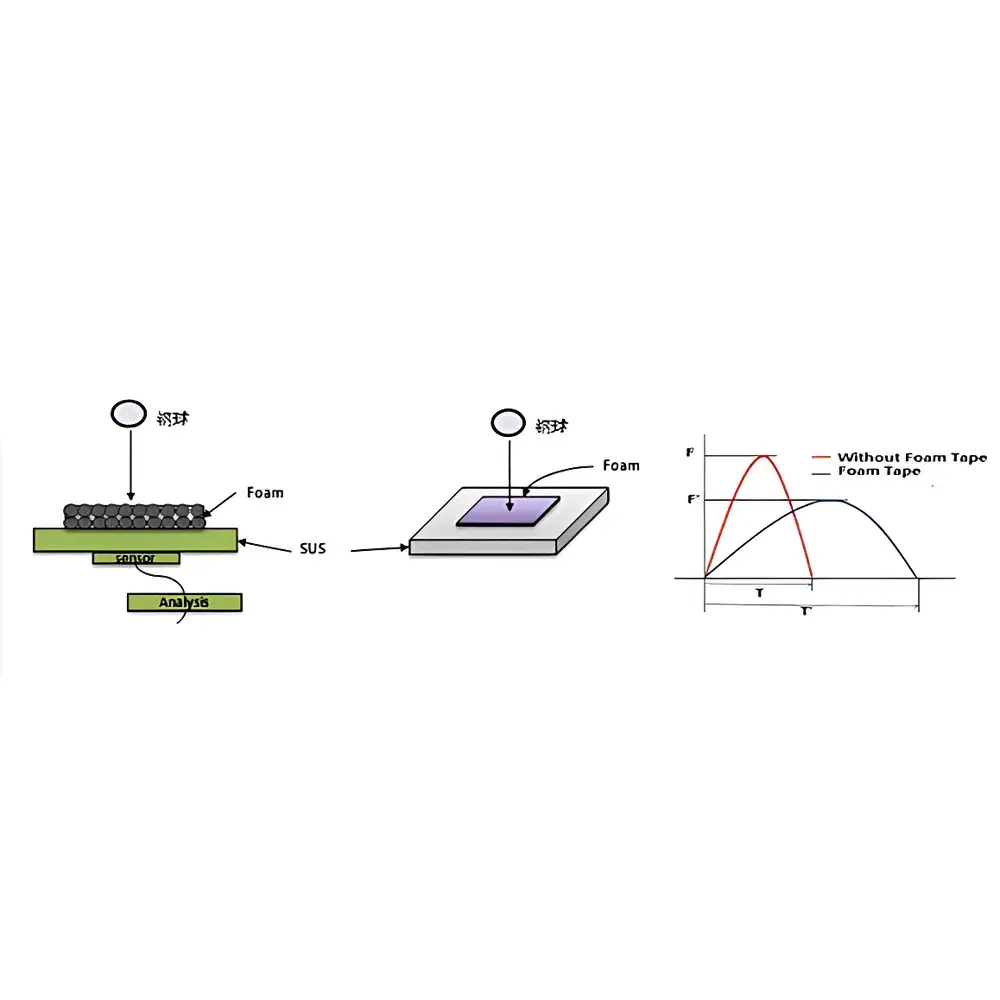
The Yuelian 5507FIT Foam Impact Energy Absorption Tester is a precision-engineered free-fall impact system designed specifically for quantifying the dynamic energy absorption characteristics of flexible polymeric foams—including polyurethane (PU), ethylene-vinyl acetate (EVA), expanded polystyrene (EPS), and cross-linked polyethylene (XLPE). It operates on the principle of controlled gravitational impact: a standardized steel ball of defined mass and diameter is elevated to a user-specified height (0–800 mm), then released via electromagnetic actuation onto a horizontally mounted foam specimen. The resulting force-time history is captured in real time using a high-fidelity 100 N load cell and a 100 kHz sampling data acquisition system. From this waveform, key mechanical parameters—including peak impact force, energy absorption capacity (J), rebound ratio, and compression-set under dynamic loading—are derived in strict accordance with international test standards such as ASTM D3574 (Section 12: Impact Resistance), ISO 2439 (Method B: Free-Fall Impact), and GB/T 6670 (Chinese national standard for flexible foam impact testing).
Key Features
- Motor-driven vertical lift mechanism enabling precise, repeatable, and programmable drop height control from 0 to 800 mm—critical for generating impact energies ranging from sub-1 J to 5 J.
- Electromagnetic release system with sub-millisecond timing accuracy ensures zero mechanical pre-load and eliminates release-induced variability.
- Integrated infrared optical centering sensor guarantees consistent impact location within ±0.5 mm tolerance relative to specimen geometric center—essential for minimizing edge effects and ensuring inter-laboratory reproducibility.
- X-Y motorized sample stage allows fine positional adjustment before testing, accommodating non-uniform foam sheets or multi-zone evaluation protocols.
- Rugged aluminum alloy frame and vibration-damped base structure minimize environmental interference and support long-term measurement stability under routine QC conditions.
- Real-time waveform visualization and post-test parameter extraction are performed via dedicated Windows-based software compliant with GLP documentation requirements.
Sample Compatibility & Compliance
The 5507FIT accommodates foam specimens up to 150 mm × 150 mm × 50 mm (L×W×T), with optional custom fixtures available for cylindrical or contoured samples. It supports interchangeable steel balls (e.g., 16.0 mm Ø, 16.4 g; 38.1 mm Ø, 113 g) to meet material-specific energy scaling needs per ASTM D3574 Annex A3. All test sequences adhere to traceable calibration protocols aligned with ISO/IEC 17025 requirements. The system’s force transducer is factory-calibrated against NIST-traceable deadweight standards, and full calibration certificates—including linearity, hysteresis, and repeatability data—are provided with each unit. Test reports generated by the software include metadata required for internal audit trails and regulatory submissions (e.g., ISO 9001, IATF 16949).
Software & Data Management
The proprietary Yuelian TestSuite v3.2 software provides intuitive workflow management—from test setup and parameter configuration to automated report generation in PDF and CSV formats. Each test record embeds timestamped operator ID, environmental conditions (optional external hygrothermograph integration), raw force-time data (100 kHz), and calculated metrics (peak force, absorbed energy, rebound velocity, damping coefficient). Audit trail functionality logs all user actions—including method edits, data deletions, or export events—in compliance with FDA 21 CFR Part 11 (electronic records/signatures) when configured with role-based access control and digital signature modules. Raw binary files (.bin) are retained for reprocessing, enabling retrospective analysis without loss of resolution.
Applications
- Quality assurance of automotive interior foams (headliners, door panels, seat cushions) for crash-relevant energy dissipation performance.
- R&D validation of viscoelastic response in medical cushioning materials (e.g., pressure-relief mattress cores, orthopedic padding).
- Comparative benchmarking of bio-based foams versus petrochemical analogues under standardized dynamic loading.
- Process optimization support for foam manufacturers—correlating blowing agent ratios, curing temperatures, or crosslink density with impact resilience.
- Supplier qualification testing per OEM specifications (e.g., Ford WSS-M99P1111-A, GMW15634, Toyota TSL-0001G).
FAQ
What standards does the 5507FIT directly support?
ASTM D3574 (Sections 12 and 13), ISO 2439 (Method B), GB/T 6670, and JIS K 6400-5—all implemented via preloaded test templates with auto-parameter validation.
Can the system be integrated into an existing LIMS or MES environment?
Yes—via OPC UA or TCP/IP socket interface; full API documentation and sample Python/C# drivers are included for custom middleware development.
Is third-party calibration certification available?
Yes—accredited calibration services (ISO/IEC 17025) are offered annually, including uncertainty budgeting per GUM guidelines.
Does the software support multi-specimen batch testing with pass/fail logic?
Yes—users define upper/lower limits for any derived parameter (e.g., absorbed energy ≥ 3.2 J); the system auto-classifies results and flags outliers in summary dashboards.
What maintenance is required for long-term accuracy?
Biannual verification of drop height encoder linearity and annual load cell recalibration; no consumables or scheduled wear-part replacements are required within the first five years of operation.



