
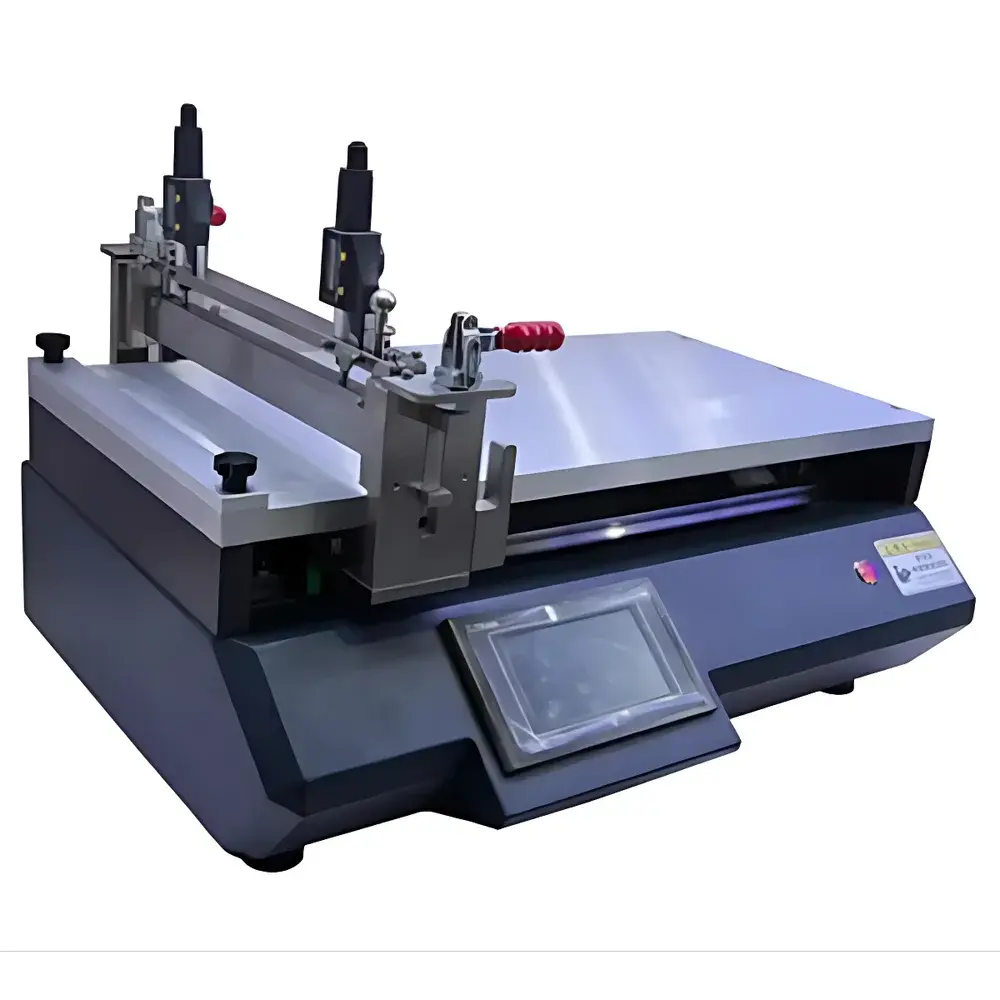
Yuelian PW-C01 Laboratory Hot-Melt Coating Machine
| Brand | Yuelian/PW |
|---|---|
| Origin | Guangdong, China |
| Manufacturer Type | Authorized Distributor |
| Country of Origin | China |
| Model | PW-C01 |
| Application | Laboratory-scale precision coating |
| Coating Method | Dual-mode — Doctor Blade & Wire Rod (independently operable) |
| X-axis Coating Travel | 300 × 450 mm |
| Temperature Range | Ambient to 160 °C (PID-controlled constant-temperature heating) |
| Wet Film Thickness Range | 5 µm – 5 mm |
| Overall Dimensions (L×W×H) | 660 × 470 × 390 mm |
| Coating Speed | 1–5 m/min (digital setpoint control) |
| Leveling Mechanism | Integrated aluminum alloy leveling bar |
| Substrate Platform | Removable anodized aluminum + tempered glass surface |
| Coating Uniformity | ±4% (dependent on substrate flatness and surface energy) |
| Wire Rod Specifications | Ø10 × 400 mm (standard), supplied with dual adjustable counterweights |
| Blade Material | High-hardness stainless steel alloy |
| Power Supply | 110–220 V AC, 50/60 Hz |
| Power Consumption | 48 W (standby), 2000 W (heating mode active) |
| Net Weight | 42 kg |
Overview
The Yuelian PW-C01 Laboratory Hot-Melt Coating Machine is an engineered solution for controlled, repeatable thin-film deposition in R&D and quality assurance environments. Designed around the principles of shear-controlled fluid dynamics and thermally stabilized substrate interaction, it enables precise wet-film formation across diverse planar substrates—without requiring vacuum or solvent recovery infrastructure. Its dual-coating architecture supports both wire rod (draw-down) and doctor blade methodologies, each independently actuated and calibrated, allowing researchers to isolate rheological effects from thermal boundary conditions. The integrated PID-heated platform ensures uniform thermal distribution across the full 300 × 450 mm coating zone, critical for solvent evaporation kinetics, polymer melt viscosity modulation, and crosslinking onset timing. Unlike benchtop dispensers or manual applicators, the PW-C01 delivers deterministic process parameters—speed, temperature, pressure, and dwell time—enabling direct correlation between coating variables and final film morphology (e.g., edge bead formation, Marangoni flow suppression, or phase separation onset).
Key Features
- Dual independent coating modules: Motor-driven wire rod assembly (with standardized Ø10 × 400 mm rods and dual mass-adjustable counterweights) and pneumatically assisted rear-flip doctor blade—both digitally programmable via 7-inch PLC touchscreen interface.
- PID-regulated heated stage: Maintains ±0.5 °C stability over the full 0–160 °C range; calibrated traceable to NIST-traceable reference thermocouples.
- Leveling-first architecture: Pre-coating mechanical flattening using a hardened aluminum alloy leveling bar minimizes substrate topography-induced thickness variation before material application.
- Modular platform design: Anodized aluminum frame with removable tempered glass surface enables rapid cleaning, substrate alignment verification, and compatibility with optical inspection setups.
- Digital parameter lock: All operational settings—including speed (1–5 m/min), travel length (10–450 mm), temperature setpoint, and dwell time—are stored in non-volatile memory with timestamped audit logs.
- Low-power standby mode (48 W) and high-efficiency heating circuitry (2000 W peak) comply with IEC 61000-3-2 harmonic emission standards for laboratory-grade electrical equipment.
Sample Compatibility & Compliance
The PW-C01 accommodates rigid and semi-rigid planar substrates up to 450 mm in width and 300 mm in active coating length, including paper, PET, PVC, aluminum foil, stainless steel sheets, and silicon wafers. Surface energy compatibility spans 30–72 mN/m (Dyne level), supporting aqueous dispersions, UV-curable acrylates, thermoplastic melts, and solvent-based polymer solutions. The system meets ISO 8501-1 visual cleanliness grading requirements for pre-coating substrate assessment. Its control firmware supports GLP-compliant operation: all parameter changes are logged with user ID, timestamp, and value delta. While not FDA 21 CFR Part 11-certified out-of-box, the PLC architecture permits integration with third-party electronic lab notebook (ELN) systems via Modbus RTU protocol for full audit trail generation.
Software & Data Management
The embedded HMI runs on a real-time Linux kernel with deterministic task scheduling. Coating protocols are saved as .CSV-configurable templates with version control. Each run generates a metadata-rich output file containing: start/stop timestamps, average speed deviation (<±0.3%), temperature variance across 9-point grid sampling, and motor current signature (indicative of coating resistance). Export formats include CSV, PDF summary reports, and raw binary logs for post-hoc MATLAB or Python analysis. Optional Ethernet/WiFi module enables remote monitoring and centralized fleet management via OPC UA server integration.
Applications
- R&D of functional coatings: anti-reflective layers, conductive inks, battery electrode slurries, and barrier films for flexible electronics.
- QC validation of coating formulations: comparative viscosity-thickness mapping under controlled thermal profiles.
- Accelerated aging studies: simulating industrial oven dwell times by varying substrate temperature ramp rates and hold durations.
- Adhesion optimization trials: correlating interfacial energy, substrate temperature, and wet-film thickness to peel strength per ASTM D903.
- Thin-film optics development: producing gradient-index layers via sequential multi-pass coating with incremental thickness modulation.
FAQ
What substrates are compatible with the PW-C01?
Rigid and semi-rigid planar materials up to 450 mm wide and 300 mm long—including PET, PVC, aluminum, stainless steel, silicon, and coated papers—with surface roughness Ra < 3.2 µm and surface energy ≥30 mN/m.
Can the machine operate without heating?
Yes—the heating function is fully decoupled from motion control; ambient-temperature coating is supported with identical speed and thickness repeatability.
How is coating thickness accuracy verified?
Thickness is set via calibrated wire rod diameter or blade gap; final wet-film uniformity is validated using ISO 2808 drawdown test plates and confirmed via gravimetric analysis or profilometry per ASTM D1210.
Is the PLC interface programmable for custom sequences?
Yes—via ladder logic editor (password-protected); users may define multi-step programs with conditional triggers (e.g., “hold at 120 °C for 30 s after reaching target speed”).
Does the system support regulatory compliance documentation?
It provides full operational logs and configurable electronic signatures; IQ/OQ documentation packages are available upon request for GMP-aligned validation workflows.



