
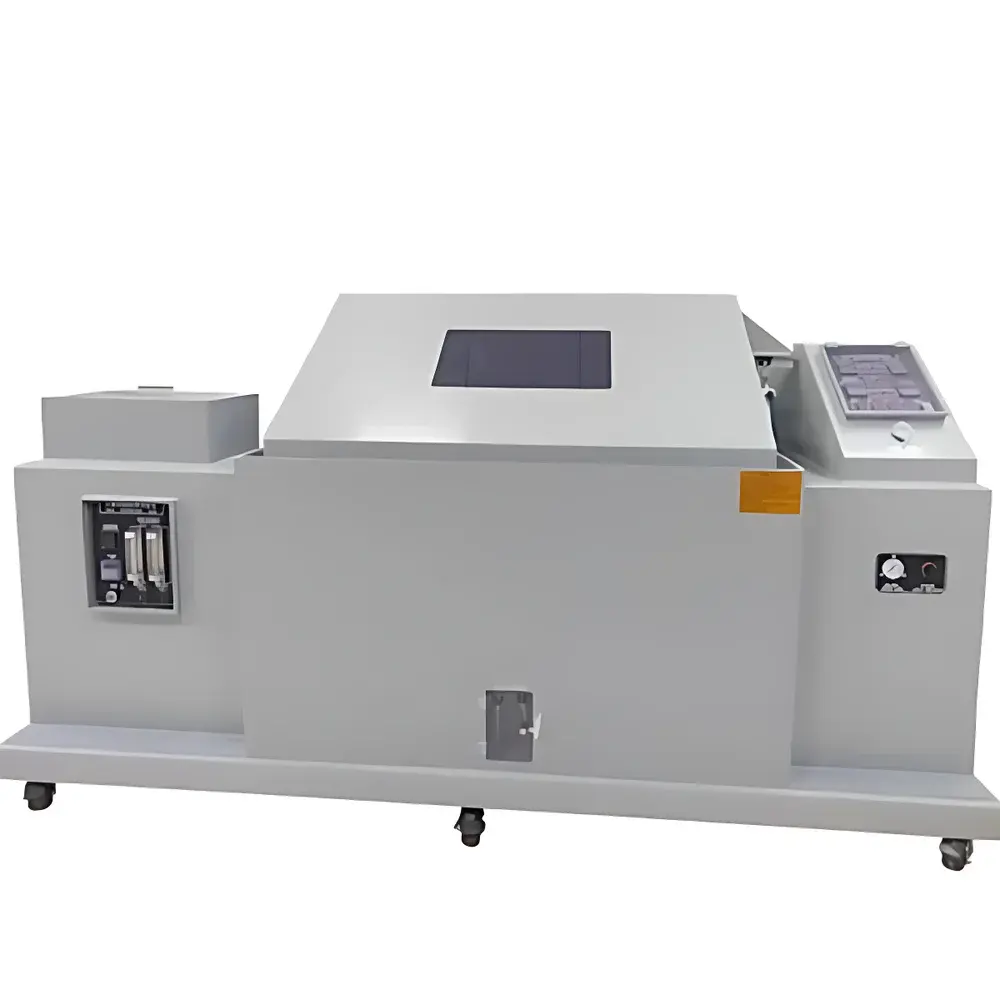
Yuelian PW-CS600-SO2 SO₂ Salt Spray Corrosion Test Chamber
| Brand | Yuelian / PW |
|---|---|
| Origin | Guangdong, China |
| Manufacturer Type | Manufacturer |
| Model | PW-CS600-SO2 |
| Spray Rate | 1–2 mL/h per 80 cm² |
| Nozzle Pressure | 70–170 kPa |
| Fog Removal Method | Compressed-air-assisted exhaust |
| SO₂ Concentration Range | 0.05–1.0 vol% |
| Temperature Range | RT+10°C to 70°C |
| Salt Fog Deposition Rate | 1–2 mL/h/80 cm² (16-h average) |
| Compliance Standards | GB/T 2423.17, ISO 9227, ASTM B117, GB/T 2423.33, GB/T 9789 |
Overview
The Yuelian PW-CS600-SO₂ SO₂ Salt Spray Corrosion Test Chamber is a dual-mode environmental test system engineered for accelerated corrosion evaluation under controlled saline and sulfur dioxide–laden atmospheres. It integrates two distinct yet co-located test modalities—standard salt spray (NSS, AASS, CASS) and high-concentration sulfur dioxide exposure—within a single corrosion-resistant chamber. The system operates on electrochemical corrosion acceleration principles: chloride ions induce pitting and crevice corrosion in metallic substrates, while SO₂ gas dissolves in surface moisture to form sulfurous acid (H₂SO₃), lowering local pH and promoting uniform or intergranular attack—particularly relevant for coated steels, aluminum alloys, zinc die-castings, and conversion-coated components. Designed to replicate aggressive industrial or coastal atmospheric conditions, it supports standardized testing per ISO 9227, ASTM B117, and GB/T 2423.33, enabling comparative assessment of coating integrity, passivation layer stability, and substrate corrosion resistance without requiring field exposure timelines measured in years.
Key Features
- Integrated dual-test architecture: Independent control of salt fog generation and SO₂ gas dosing within one sealed chamber, minimizing cross-contamination and enabling sequential or hybrid test protocols.
- Corrosion-resistant construction: Inner chamber and lid fabricated from 8 mm thick imported PVC (Nanya Taiwan), rated for continuous operation up to 70°C; water-sealed lid with pneumatic actuation ensures gas-tight containment during SO₂ exposure.
- Precision雾化 system: Air-driven glass nozzles operating at 70–170 kPa, coupled with adjustable conical spray towers and calibrated collection funnels (two-position placement per ISO 9227), guaranteeing uniform deposition of 1–2 mL/h/80 cm² across the test zone.
- SO₂ delivery & abatement: Mass-flow-controlled SO₂ supply (0–1000 mL/min) via high-purity (≥99.9%) cylinder gas, regulated through stainless steel solenoid valves and precision flowmeters; post-test exhaust routed through activated carbon + NaOH/Ca(OH)₂ scrubbing to meet occupational and environmental safety thresholds.
- Temperature & humidity fidelity: Dual-zone PID control (test chamber and saturated air tower); chamber temperature uniformity ±1.0°C, fluctuation ±0.5°C; saturated tower temperature range RT–63°C with auto-level maintenance via dual-point liquid level sensing.
- Safety-integrated design: Dry-run protection for heaters, low-water cutoffs for chamber and saturator, over-temperature alarms, and electrical isolation between fluid and control circuits per IEC 61000-6-2 EMC requirements.
Sample Compatibility & Compliance
The PW-CS600-SO₂ accommodates non-hazardous, non-volatile, non-biological specimens up to 1200 × 1000 × 500 mm (W × D × H). Prohibited samples include flammable, explosive, radioactive, highly toxic, or strongly electromagnetic-emitting materials. The chamber meets full regulatory alignment with multiple international standards: ISO 9227 (salt spray), ASTM B117 (neutral salt spray), ASTM G87 (cyclic SO₂/humidity), GB/T 2423.33 (high-concentration SO₂), and GB/T 9789 (condensing SO₂ corrosion). Its design supports GLP-compliant documentation when paired with optional data logging—traceable temperature, SO₂ concentration, spray duration, and cycle timing are recordable for audit readiness under ISO/IEC 17025 or FDA 21 CFR Part 11–enabled software configurations.
Software & Data Management
Equipped with Yudian digital PID controller (English UI, keypad input), the system supports both fixed-setpoint and programmable cycling modes. Temperature resolution: 0.1°C; timer range: 1 second to 9999 hours with selectable units (sec/min/hr). While the base controller provides real-time display and manual override, optional RS485/Modbus RTU interface enables integration into centralized lab management systems. When configured with third-party SCADA or LIMS platforms, all operational parameters—including SO₂ flow rate, chamber temperature, saturator water level, and spray-on/off status—can be logged with timestamped audit trails. For regulated environments, optional validation packages (IQ/OQ) and electronic signature support align with GMP/GLP data integrity expectations.
Applications
This chamber serves critical roles in quality assurance, R&D, and supplier qualification across automotive, aerospace, electronics, and infrastructure sectors. Typical use cases include: evaluating galvanized steel fasteners under simulated urban-industrial atmospheres; benchmarking epoxy-polyester powder coatings on outdoor enclosures; validating anodized aluminum busbar corrosion resistance in substation environments; assessing solder mask integrity on printed circuit boards exposed to marine-salt + SO₂ synergies; and qualifying zinc-nickel plating performance on engine brackets per SAE J2334 cyclic corrosion testing. Its ability to execute multi-phase cycles—e.g., 8 h condensation at 40°C/100% RH followed by 16 h SO₂ exposure—makes it suitable for simulating diurnal pollution patterns affecting architectural metals.
FAQ
What standards does this chamber fully comply with?
It satisfies ISO 9227, ASTM B117, ASTM G87, GB/T 2423.17, GB/T 2423.33, GB/T 9789, and JIS H8502—verified via third-party calibration reports included with shipment.
Can NSS, AASS, and CASS tests be run without SO₂ gas?
Yes—the salt spray subsystem operates independently; SO₂ injection is fully isolatable via solenoid valve control and physical shutoff.
Is compressed air conditioning required externally?
Yes—users must supply clean, oil-free, dry compressed air at 0.4–0.8 MPa; integrated dual-stage filtration and saturator pre-heating ensure consistent spray quality.
What maintenance intervals are recommended?
Daily: inspect nozzle clogging and saturator water level; weekly: clean PVC chamber walls with deionized water; quarterly: replace activated carbon and alkali scrubber media; annually: verify thermocouple accuracy and SO₂ flowmeter calibration.
Does the system support automated test reporting?
The base controller logs runtime data locally; for automated PDF/CSV report generation with pass/fail criteria, optional PC-based software with configurable templates is available.
Related Products



