
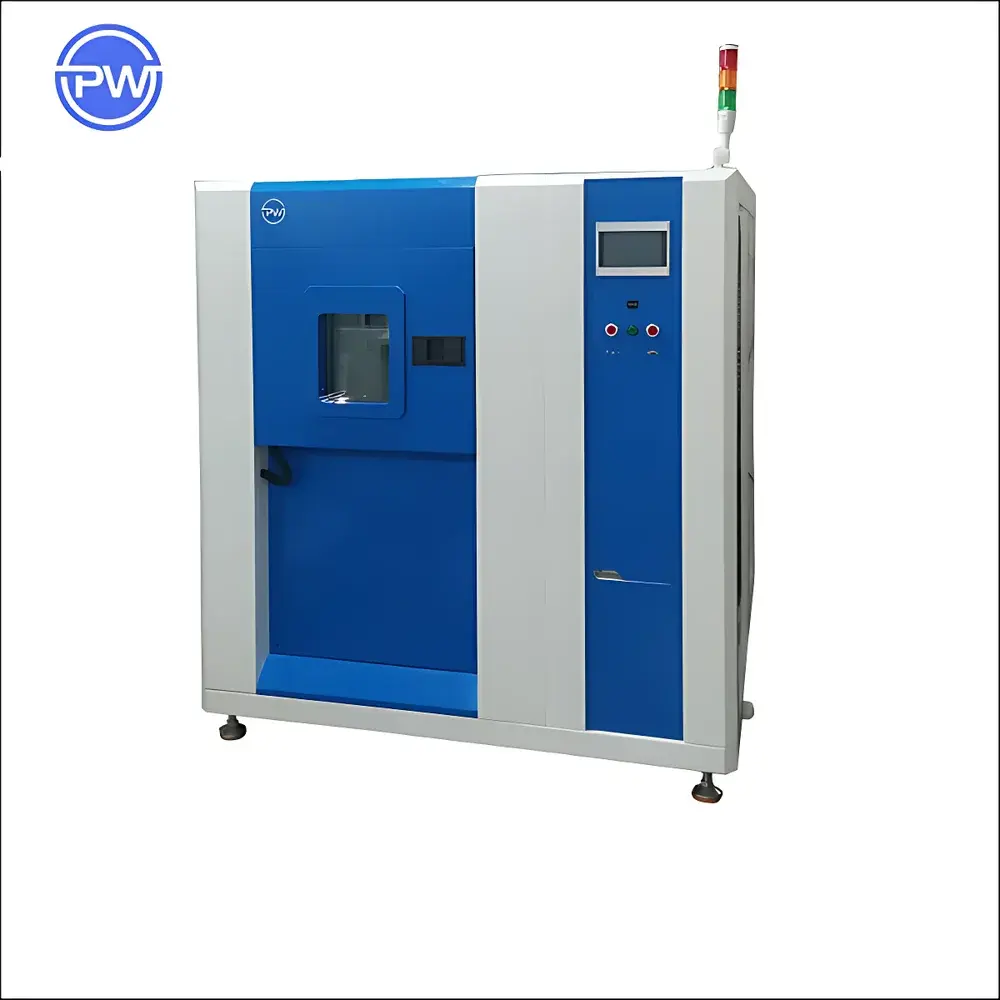
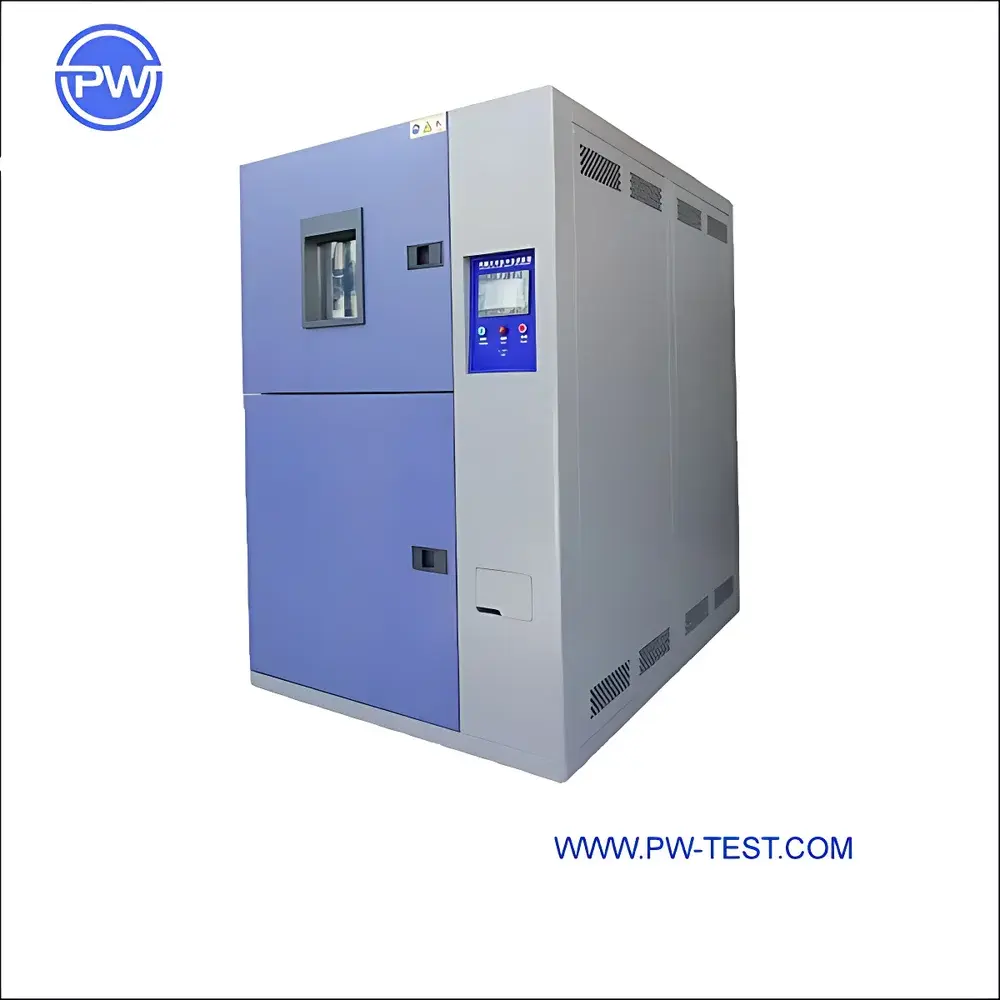
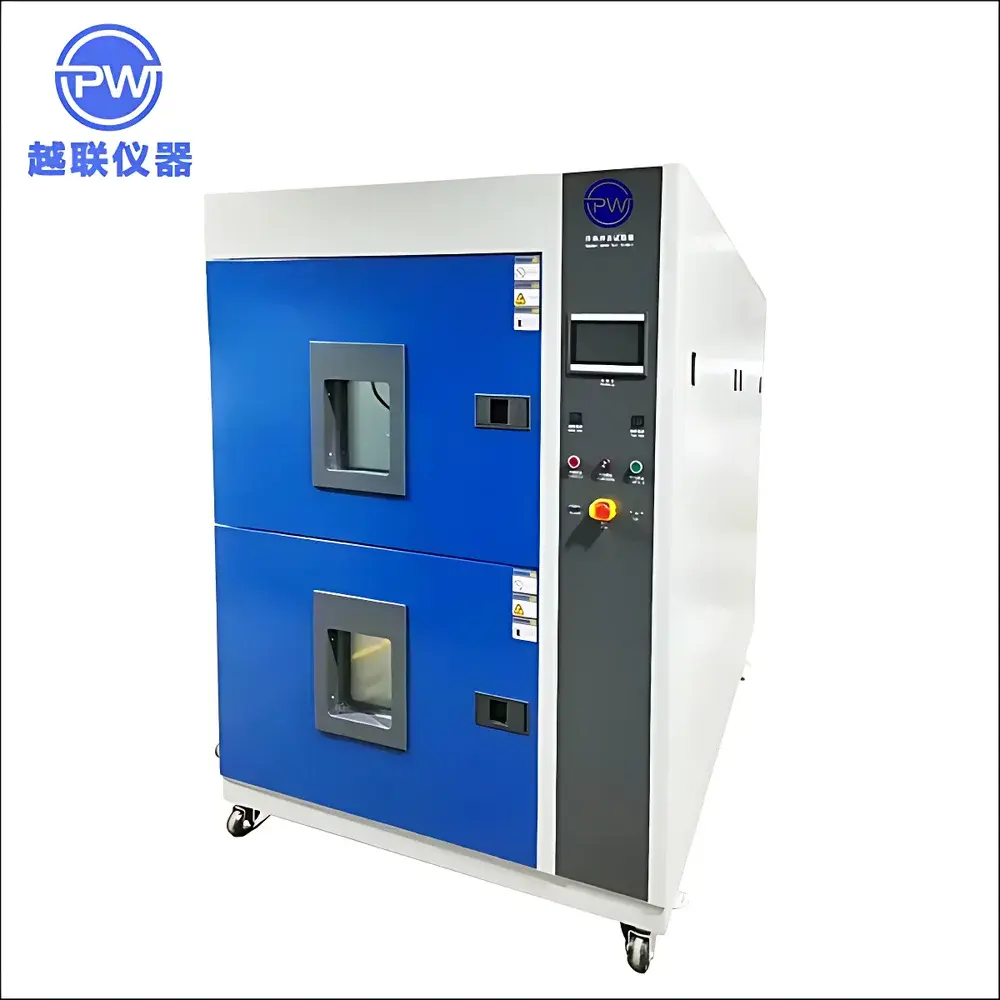
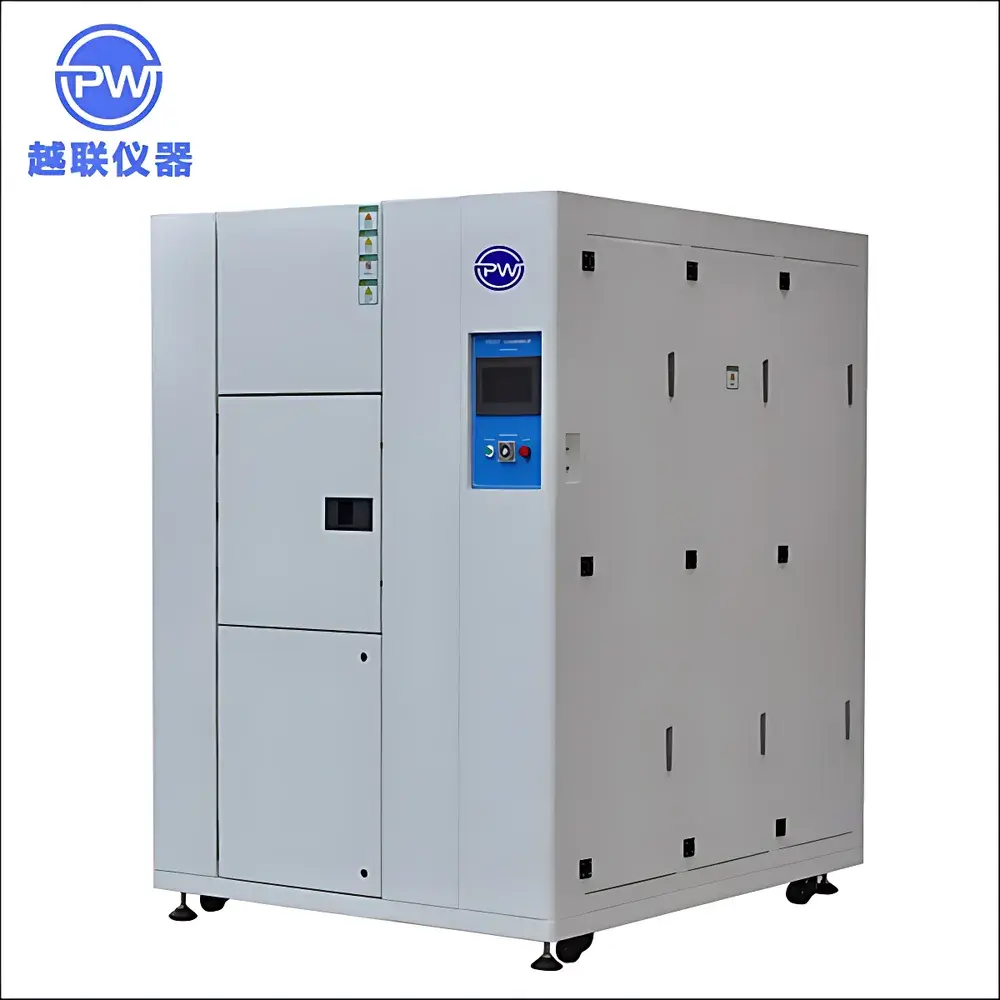
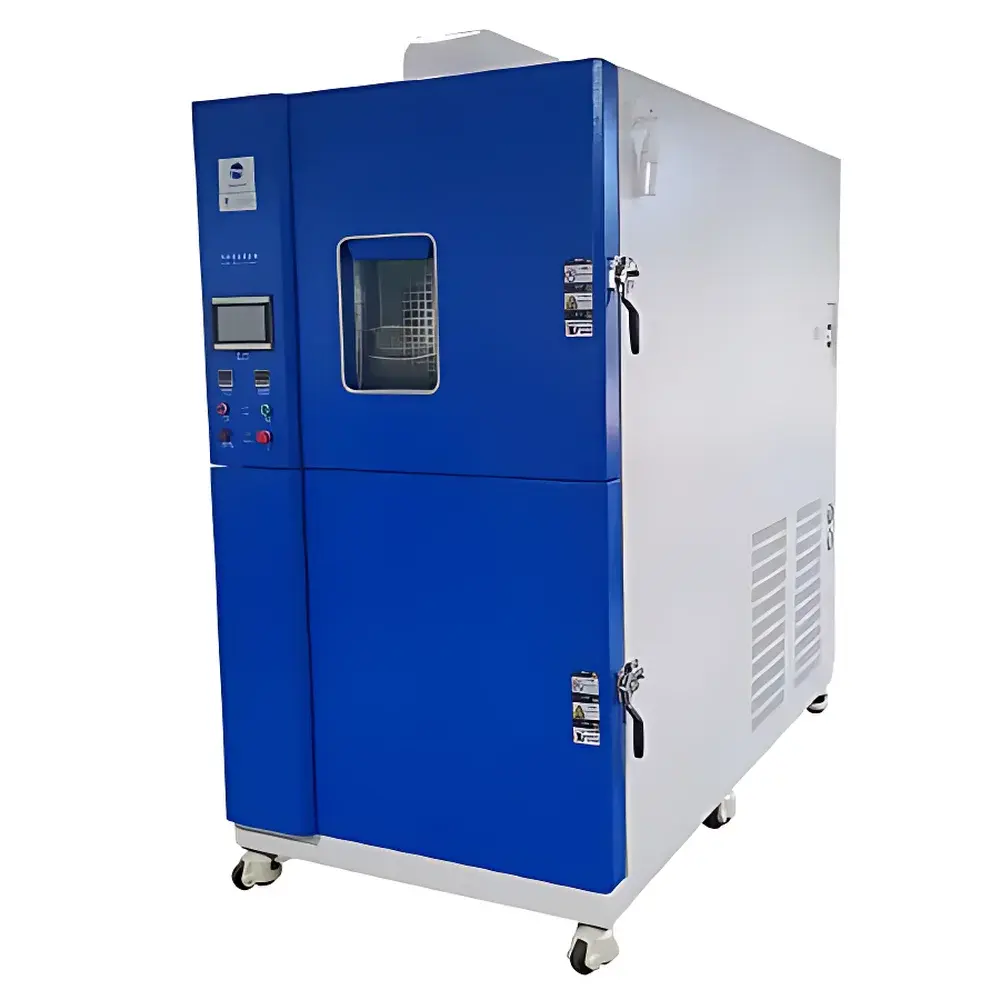
Yuelian PW-CTS3-80 Three-Zone Thermal Shock Test Chamber
| Brand | Yuelian / PW |
|---|---|
| Origin | Guangdong, China |
| Model | PW-CTS3-80 |
| High Temperature Range | +150 °C |
| Low Temperature Range | −55 °C |
| Thermal Shock Range | −55 °C to +150 °C |
| Temperature Stability | ±0.5 °C |
| Heating Rate | ≥3 °C/min (non-linear, empty load) |
| Cooling Rate | ≥2 °C/min (non-linear, empty load) |
| Transfer Time (Hot ↔ Cold) | ≤10 s |
| Recovery Time | 3–5 min (non-linear, empty load) |
| Internal Volume | 80 L |
| Internal Dimensions (W×H×D) | 500 × 400 × 400 mm |
| External Dimensions (W×H×D) | 1650 × 1720 × 1680 mm |
| Weight | 800 kg |
| Power Supply | 3-phase 380 V ±10%, 50 Hz, 23 kW max |
| Noise Level | ≤70 dB(A) |
| Compliance | GB/T 2423.1–2008, GB/T 2423.2–2008, GB/T 2423.22–1987, GJB 150.5–1986, GJB 360.7–1987, GJB 367.2–1987 |
Overview
The Yuelian PW-CTS3-80 Three-Zone Thermal Shock Test Chamber is an engineered environmental stress screening system designed for rapid, repeatable thermal cycling between extreme high and low temperature extremes. Unlike two-zone configurations, its three-chamber architecture—comprising independent pre-heating, pre-cooling, and test zones—enables true zero-dwell thermal shock testing with no ambient conditioning phase. This design eliminates thermal inertia delays inherent in single- or dual-zone systems, allowing precise control over transition dynamics per IEC 60068-2-14 (Test N: Change of Temperature) and MIL-STD-810G Method 503.5. The chamber operates on a dual-stage cascade refrigeration cycle using R404A/R23 refrigerants—zero ozone depletion potential (ODP = 0)—and integrates PID-based BTC (Balance Temperature Control) with DCC (Dynamic Cold Capacity) modulation to maintain thermal stability within ±0.5 °C under non-linear, unloaded conditions. Its structural integrity, stainless steel interior, and polyurethane/glass fiber insulation ensure long-term dimensional stability and minimal thermal leakage—critical for qualification testing in regulated industries.
Key Features
- Three-zone configuration (pre-heat / pre-cool / test) enabling true thermal shock without ambient dwell, compliant with GJB 150.5 and MIL-STD-810G Method 503.5
- Dual-stage cascade refrigeration system with French Tecumseh TAG4573Z compressors, brazed stainless steel plate heat exchangers, and Danfoss thermostatic expansion valves
- PID-driven BTC + DCC + DEC intelligent control architecture for energy-efficient thermal management; up to 35% lower power consumption versus conventional resistive-heating systems
- TFT color LCD controller with bilingual (English/Chinese) touch interface, 120 programmable profiles, infinite loop capability, and battery-backed RAM for 180-day data logging (60-s sampling interval)
- High-speed pneumatic transfer mechanism (≤10 s hot-to-cold transition) using Airtac 50–125 mm cylinders and SNS pressure regulators
- Comprehensive safety suite: compressor high/low pressure cutouts, oil pressure monitoring (for larger units), adjustable overtemperature protection, phase failure detection, emergency stop, and door-interlocked refrigerant leak alarm
- Low-noise operation (≤70 dB(A) at 1 m) achieved via optimized airflow path, centrifugal fans with aluminum alloy blades, and acoustic dampening insulation
Sample Compatibility & Compliance
The PW-CTS3-80 is strictly intended for non-hazardous, non-volatile, non-corrosive, and non-biological test specimens. It prohibits testing of flammable, explosive, radioactive, toxic, or electromagnetically emissive materials—as defined in IEC 61000-4-2 and ISO 10360-5. Sample loading must not exceed 60 kg total distributed mass (25 kg per stainless steel shelf), maintaining ≤35 kg/m³ volumetric density per GJB 367.2 requirements. The chamber meets electromagnetic compatibility (EMC) Class B per GB/T 17626 series and conforms to structural safety standards per GB 4793.1–2007 (IEC 61010-1). All electrical components—including Omegadyne T-type thermocouples, OMRON MY2J relays, and Taiwan Shihlin circuit breakers—are certified to UL/CE/CCC standards. Data integrity complies with ALCOA+ principles: audit trails, electronic signatures, and secure parameter locking are supported via optional FDA 21 CFR Part 11–compliant software add-ons.
Software & Data Management
The embedded controller supports RS-232 and USB (U-disk) interfaces for bidirectional communication with host PCs. Included Windows-compatible software enables real-time monitoring, remote profile editing, CSV export of time-stamped temperature logs (with ±0.2 °C controller accuracy), and automated report generation per ISO/IEC 17025 calibration documentation templates. Data storage includes timestamped alarms, fault codes (e.g., “E03: Compressor Discharge Overtemp”), and system status history—all retained during power interruption via supercapacitor-backed memory. Optional network-enabled versions support Modbus TCP for integration into centralized MES or SCADA environments. Firmware updates are performed via encrypted U-disk to prevent unauthorized modification—a requirement under GLP and GMP Annex 11 validation protocols.
Applications
This chamber serves critical reliability validation across aerospace (AS9100), automotive (IATF 16949), semiconductor (JEDEC JESD22-A104), and medical device (ISO 13485) supply chains. Typical use cases include: solder joint fatigue analysis of PCBAs under repeated −55 °C/+150 °C cycling; validation of hermetic seal integrity in MEMS sensors; thermal aging assessment of polymer encapsulants in LED modules; accelerated life testing of lithium-ion battery cells; and qualification of avionics housings per DO-160 Section 4.2. Its ability to replicate field-relevant thermal transients—without condensation-induced microcracking—makes it indispensable for failure mode identification in HALT/HASS protocols and DOE-based robustness studies.
FAQ
What distinguishes a three-zone thermal shock chamber from a two-zone system?
A three-zone design isolates heating, cooling, and test functions—eliminating the need to thermally reset a shared chamber between cycles. This enables faster transitions (<10 s), tighter temperature stability (±0.5 °C), and elimination of ambient-temperature interference—critical for ASTM E1545-compliant material coefficient-of-expansion (CTE) measurements.
Is the chamber suitable for testing sealed electronic enclosures?
Yes—provided enclosures are non-hermetic or vented to prevent internal pressure differentials exceeding 1.5 kPa. Unvented sealed units may rupture due to differential thermal expansion of internal gases; users must perform preliminary pressure-drop verification per IPC-9701.
Can the system be validated per IQ/OQ/PQ protocols?
Absolutely. The chamber ships with a full factory calibration certificate traceable to NIM (China National Institute of Metrology), including as-found/as-left data for all 9 thermocouple channels. Optional IQ/OQ documentation packages include sensor mapping reports, alarm response verification, and cycle repeatability studies (n≥3, per ISO/IEC 17025).
What maintenance intervals are recommended?
Compressor oil and refrigerant analysis every 2,000 operating hours; condenser coil cleaning quarterly (or semi-annually in low-dust environments); thermocouple recalibration annually; and full safety circuit verification prior to each qualification run per GJB 150.1A.
Does the system support custom test profiles beyond standard GB/T or GJB methods?
Yes—the controller accepts user-defined multi-segment profiles with variable ramp rates, dwell times, and conditional branching (e.g., “if T > 145 °C for >60 s, trigger alarm and pause”). Profiles can be imported/exported via U-disk in CSV format for cross-platform reproducibility.



