
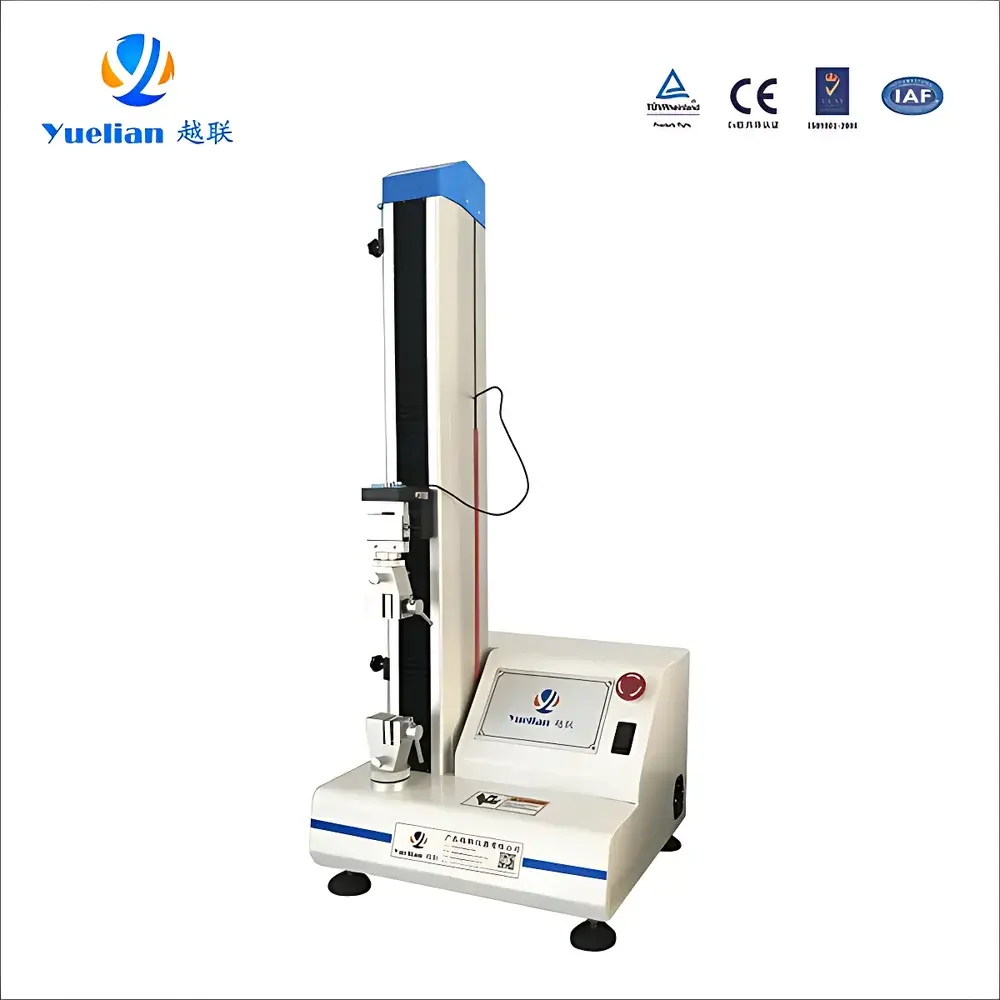
Yuelian YL-S90 Universal Tensile and Peel Strength Tester for Aluminum Battery Electrode Foils
| Brand | Yuelian |
|---|---|
| Origin | Guangdong, China |
| Manufacturer Type | Authorized Distributor |
| Country of Origin | China |
| Model | YL-S90 |
| Load Capacity Options | 10 N, 20 N, 50 N, 100 N, 200 N, 500 N, 1 kN (dual-range configuration optional) |
| Force Resolution | 1/500,000 full scale |
| Force Accuracy | ±0.30% of reading |
| Travel Resolution | 1/500,000 full stroke |
| Maximum Stroke | 500 mm (standard), 800 mm (optional) |
| Test Width | 110 mm |
| Speed Range | 0.1–500 mm/min (software-controlled, programmable) |
| Drive System | Stepper motor + precision preloaded ball screw |
| Transmission Efficiency | >85% |
| Power Supply | 220 V AC, 50/60 Hz, 10 A |
| Power Consumption | 180 W |
| Dimensions (W×D×H) | 40 × 37 × 92 cm (standard) |
| Net Weight | 28 kg (standard) |
| Compliance Standards | GB/T 2792, ASTM D3330, GB/T 12914–1991, GB 13022–91, GB/T 1040–92, GB/T 14344–9, GB/T 2191–95, QB/T 2171–95, GB/T 10003–2008 |
Overview
The Yuelian YL-S90 Universal Tensile and Peel Strength Tester is an electromechanical force measurement system engineered for high-reproducibility mechanical characterization of thin-film electrode interfaces—particularly aluminum current collector–coating bonds in lithium-ion and emerging aluminum-ion battery development. It operates on the principle of controlled uniaxial displacement under load, applying calibrated tensile or peel forces per ISO 2424, ASTM D903, and ASTM D3330 methodologies. Designed to meet the stringent metrological requirements of R&D labs and QC facilities in energy storage manufacturing, the YL-S90 delivers traceable force data with sub-millinewton resolution and closed-loop positional fidelity. Its modular architecture supports both standalone operation via USB-connected PC control and integration into automated test workflows compliant with GLP/GMP documentation protocols.
Key Features
- Precision stepper motor drive coupled with preloaded ground ball screw transmission ensures minimal hysteresis, <85% mechanical energy loss, and repeatable speed profiles across the full 0.1–500 mm/min range.
- High-resolution force transduction (1/500,000 FS) and travel encoding enable detection of interfacial delamination onset, cohesive failure thresholds, and progressive debonding kinetics in composite electrode laminates.
- Quick-release universal mounting interface accommodates standardized peel fixtures (e.g., 90° and 180° T-peel jigs), tensile grips (pneumatic or mechanical), shear plates, and ring-shear adapters—fully interchangeable without tools.
- Dual-mode operation: real-time dual-channel display (force vs. displacement) on host PC; optional direct thermal printer output with timestamped, ISO-compliant report templates (PDF/CSV).
- Configurable stop conditions include overload cutoff, specimen rupture detection, user-defined upper/lower displacement limits, and automatic return-to-start post-test—programmable per ASTM E4 and ISO 527-1.
- Fully compliant with FDA 21 CFR Part 11 audit trail requirements when operated with validated software: electronic signatures, version-controlled test methods, and immutable raw data logging.
Sample Compatibility & Compliance
The YL-S90 is validated for testing metallic foils (Al, Cu ≥6 µm thickness), polymer-coated current collectors, slurry-cast cathode/anode films, separator laminates, and dry-electrode architectures. Its 110 mm test width and 500 mm stroke accommodate standard 50 × 100 mm electrode coupons per IEC 62660-1 and JIS C 8714. All force calibration procedures adhere to ISO/IEC 17025-accredited traceability chains, with annual verification supported by NIST-traceable deadweight standards. The system satisfies mandatory mechanical test clauses in GB/T 36276–2018 (lithium battery safety), UL 1642 Annex B (cell-level adhesion), and UN 38.3 Section 38.3.10 (mechanical abuse simulation).
Software & Data Management
The included Windows-based control suite provides method-driven test sequencing, real-time curve overlay, statistical batch analysis (mean, SD, CV%, Weibull modulus), and export to LIMS-compatible formats (XML, CSV, PDF/A-1b). Audit logs record operator ID, calibration status, environmental metadata (optional external temp/humidity input), and all parameter modifications—retained for ≥36 months. Software validation documentation (IQ/OQ/PQ templates) and 21 CFR Part 11 compliance packages are available upon request. USB 2.0 and RS-232 interfaces ensure interoperability with legacy lab networks and MES systems.
Applications
- Quantification of Al-foil–active-material adhesion strength during electrode drying and calendering process optimization.
- Accelerated aging studies: thermal cycling (−20°C to 85°C) followed by peel strength retention assessment per IEC 62620.
- Comparative evaluation of binder chemistries (PVDF, CMC/SBR, PAA) on interfacial fracture energy (Gc) using J-integral derived from load-displacement curves.
- Quality gate testing for incoming foil suppliers: 100% sampling at ≤1 N tolerance against specification limits defined in internal QAP-047.
- Failure mode mapping: distinguishing adhesive failure (coating–foil interface) from cohesive failure (within active layer) via SEM cross-section correlation.
FAQ
Does the YL-S90 support ASTM D3330 Type F (Floating Roller) peel configuration for flexible battery electrodes?
Yes—custom-engineered floating roller fixtures with ±0.5° angular tolerance are available as optional accessories, fully compatible with the quick-mount interface.
Can test methods be locked to prevent unauthorized modification in production environments?
Yes—role-based access control (admin/operator) and method password protection are embedded in firmware v2.3.1 and later.
Is third-party calibration certification included with shipment?
A factory calibration certificate (traceable to CNAS-accredited reference standards) is supplied standard; ISO/IEC 17025-certified field calibration services are offered separately.
What is the minimum resolvable peel force for 20 N capacity configuration?
0.04 mN (based on 1/500,000 resolution at full scale), suitable for ultrathin (<2 µm) conductive coatings.
How is mechanical overload protection implemented beyond software limits?
Hardware-based torque-limiting clutch engages at 110% of selected capacity, decoupling the motor before strain gauge saturation or structural deformation occurs.



